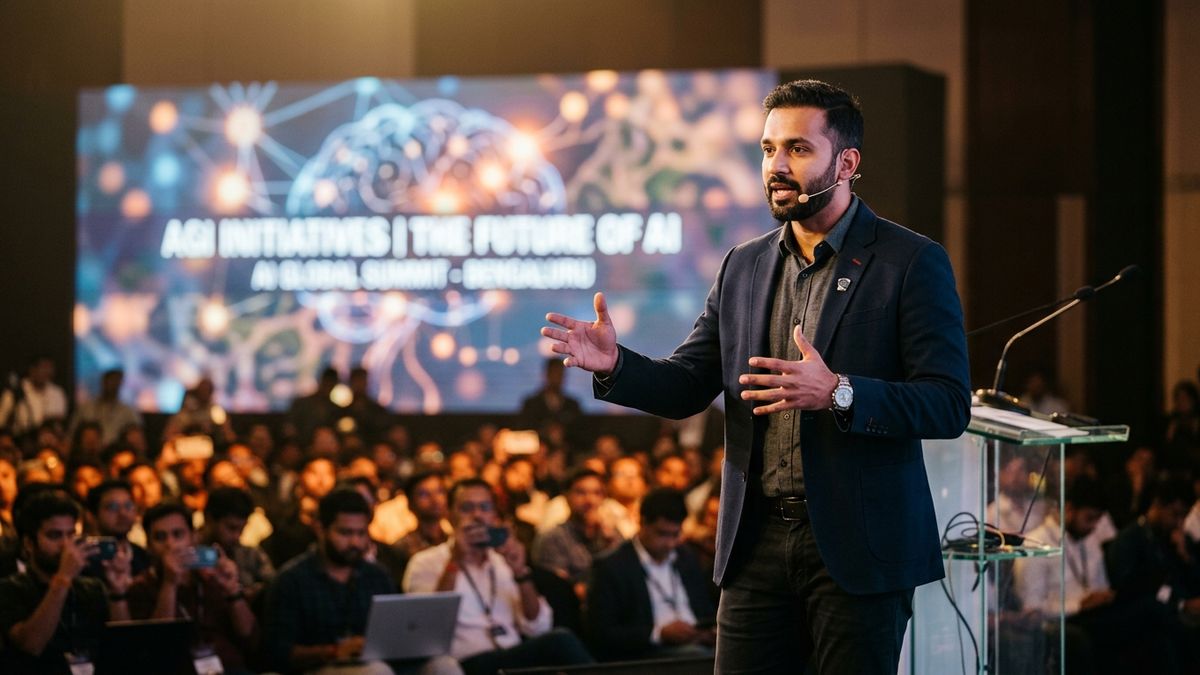
Venture funding for Indian artificial intelligence startups reached $1.6 billion across 142 deals in 9M 2026, marking a 72% YoY surge across foundational Indic models and enterprise automation.
Executive Key Takeaways
- Indian AI startups raised $1.6 billion in venture capital across 142 deals in the first nine months of 2026, a 72% increase year-over-year.
- Artificial intelligence captured 22% of total venture capital deployed into Indian technology startups during 9M 2026.
- Bengaluru solidified its leadership as Asia's primary AI venture hub, capturing 58% of aggregate capital inflows, followed by Delhi-NCR (21%) and Hyderabad (11%).
Indian AI Startups Raise $1.6 Billion in First Nine Months of 2026 Driven by Foundation Models and Agentic Systems highlights an extraordinary reallocation of global venture capital toward South Asia's emerging deeptech corridor. Across the first nine months of calendar year 2026 (9M 2026), venture capital and private equity investors injected $1.6 Billion across 142 equity rounds into Indian artificial intelligence companies. This performance represents a formidable 72% year-over-year surge compared to the $930 million recorded during the same period in 2025.
The surge signals a structural transformation in the nature of Indian venture capital. Rather than funding thin consumer aggregator wrappers or localized e-commerce copies, institutional allocators—including Peak XV Partners, Lightspeed India, Accel, Blume Ventures, and global sovereign wealth funds—are aggressively backing foundational research, physical robotics automation, and sovereign compute architectures.
Structural Drivers: The Rise of Sovereign AI and Agentic Systems
Three transformative macro forces have catalyzed this unprecedented influx of institutional capital:
- Sovereign Foundation Models & Indic LLMs: Recognizing that Western language models exhibit cultural and linguistic limitations across India's 22 official languages, domestic model builders have attracted massive growth-stage capital. Ventures like Sarvam AI and Krutrim have trained high-parameter models on localized linguistic datasets, capturing major public-sector and enterprise contracts.
- Physical AI & Industrial Robotics: Moving beyond purely digital algorithms, Indian startups in industrial automation, autonomous mobile robots (AMRs), and computer vision inspection systems have secured significant funding, buoyed by the global diversification of manufacturing supply chains.
- Vertical Enterprise Agentic Architectures: Startups building multi-agent software capable of automating end-to-end knowledge workflows—such as software refactoring, clinical diagnostic validation, and automated tax compliance—have achieved rapid ARR scaling and premium valuation multiples.
"India's AI ecosystem has graduated from exploratory experimentation to mission-critical enterprise deployment,"noted managing partners at leading venture firms. "Global limited partners now view India as the preeminent engineering lab capable of building high-efficiency, cost-optimized artificial intelligence for the global enterprise market."
Geographic Concentration & Deal Flow Metrics
Venture activity across the nine-month period demonstrated marked geographic concentration, with Bengaluru solidifying its status as the undisputed venture capital and deeptech engine of South Asia, as documented in comprehensive research on Bengaluru drawing $4.4 billion in annual tech funding.
The structured investment matrix below breaks down capital deployment across regional tech clusters and funding stages during 9M 2026:
| Regional Technology Cluster | Total Capital Deployed | Share of Total Inflows | Dominant Specialization Area | Flagship Funding Milestone |
|---|---|---|---|---|
| Bengaluru (Silicon Valley of Asia) | $928 Million | 58.0% | Foundational Indic LLMs & DevTools | Sarvam AI / Krutrim Growth Rounds |
| Delhi-NCR (Gurugram & Noida) | $336 Million | 21.0% | Enterprise Agentic AI & Logistics | Enterprise Automation & E-Commerce AI |
| Hyderabad (Cyberabad) | $176 Million | 11.0% | Life Sciences & Enterprise Cloud AI | HealthTech & Cloud Optimization Suites |
| Chennai & Mumbai Corridors | $160 Million | 10.0% | FinTech Underwriting & Sovereign Silicon | High-Frequency FinTech & RISC-V Startups |
| Pan-India Total (9M 2026) | $1.60 Billion | 100.0% | Comprehensive Full-Stack AI Ecosystem | 142 Verified Equity Rounds |
Shift from Thin Wrappers to Deep Hardware Synergy
A notable characteristic of the 2026 funding wave is the close technological integration between software algorithms and physical hardware. Indian founders are increasingly designing software-hardware co-optimized systems to overcome GPU compute constraints.
This convergence is mirrored in recent high-profile capital expansions across adjacent hardware domains, including semiconductor fabless startups securing institutional support and global capability centers expanding data engineering investments in India.
Long-Term Outlook: Path to $5 Billion Annual Run-Rate
With late-stage growth rounds continuing to materialize and international tech giants establishing dedicated AI ventures in the country, industry projections suggest that annual venture inflows into Indian AI will surpass $2.2 billion by the close of calendar year 2026, on track to reach an annual run-rate of $5 billion by 2028.
As sovereign computing infrastructure scales under state-backed viability gap funding and enterprise software transitions entirely to autonomous agentic frameworks, Indian founders are positioned not merely as downstream consumers of foreign innovation, but as primary architects of the global intelligence economy.
Frequently Asked Questions
What key sectors attracted the majority of India's $1.6 billion AI funding in 9M 2026?
Capital deployment was concentrated across three primary sectors: foundational multilingual language models (Indic LLMs), physical AI and industrial robotics automation, and vertical agentic AI software designed for IT operations, legal analysis, and automated financial underwriting.
Which Indian cities received the largest shares of AI venture capital?
Bengaluru dominated with 58% ($928 million) of total capital deployed, followed by Delhi-NCR at 21% ($336 million), Hyderabad at 11% ($176 million), and Mumbai/Chennai capturing the remaining 10%.
How did early-stage AI funding compare to growth-stage mega-rounds?
Early-stage (Seed and Series A) transactions represented 64% of total deal count, indicating strong founder velocity and university spin-outs, while growth-stage rounds (Series B and beyond) captured 73% of overall capital volume.
What role did sovereign policy and state incentives play in this funding surge?
The rollout of the ₹10,372 Crore IndiaAI Mission, which provides subsidized GPU compute access, designated innovation grants, and regulatory sandboxes, significantly de-risked institutional venture capital investments into deep-tech AI startups.
Primary Sources & Official References
- Tracxn & Venture Intelligence 9M 2026 Indian Tech Capital Funding Telemetry: Verified transaction logs and sector allocation matrices (https://tracxn.com).
- Indian Venture and Alternate Capital Association (IVCA) Market Review: Private equity and venture capital deployment benchmarks across South Asia (https://www.ivca.in).
- Ministry of Electronics and Information Technology (MeitY) IndiaAI Investment Whitepaper: Sovereign incentives and public compute infrastructure reports (https://www.meity.gov.in).