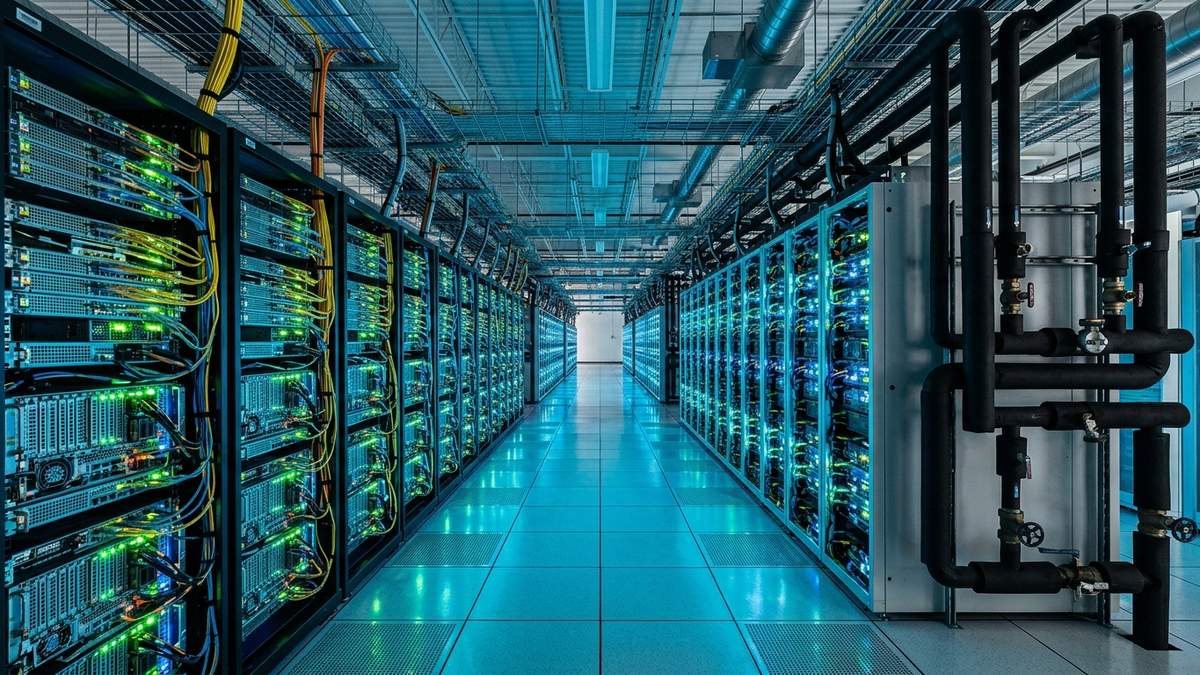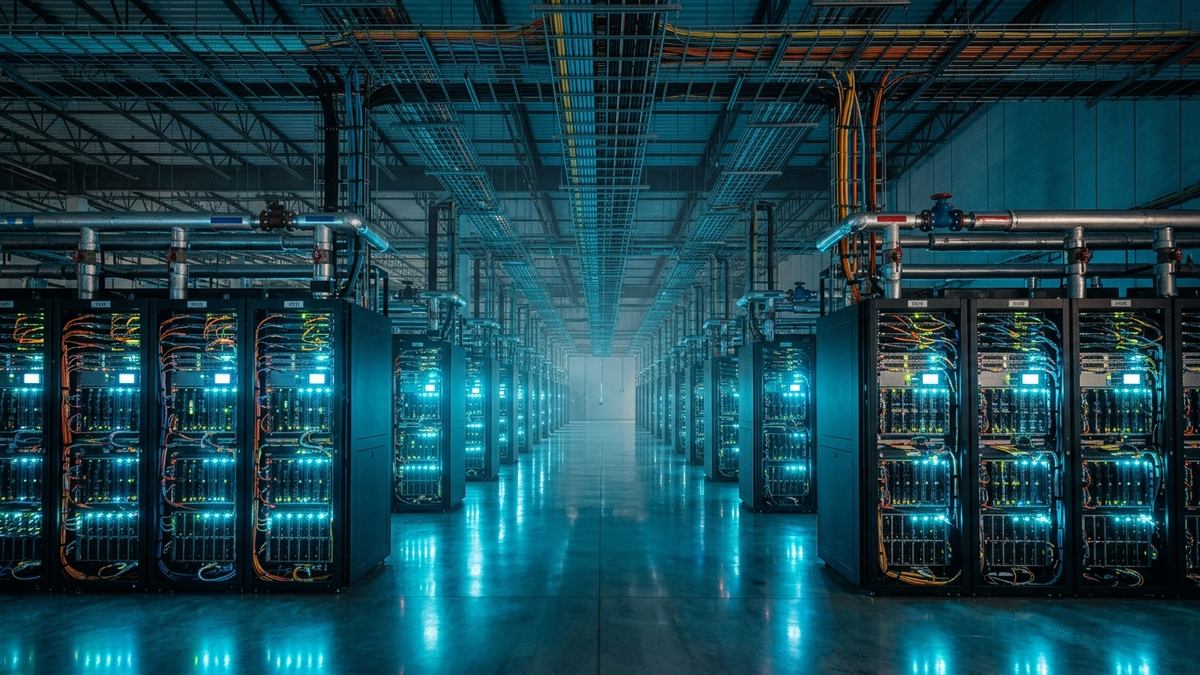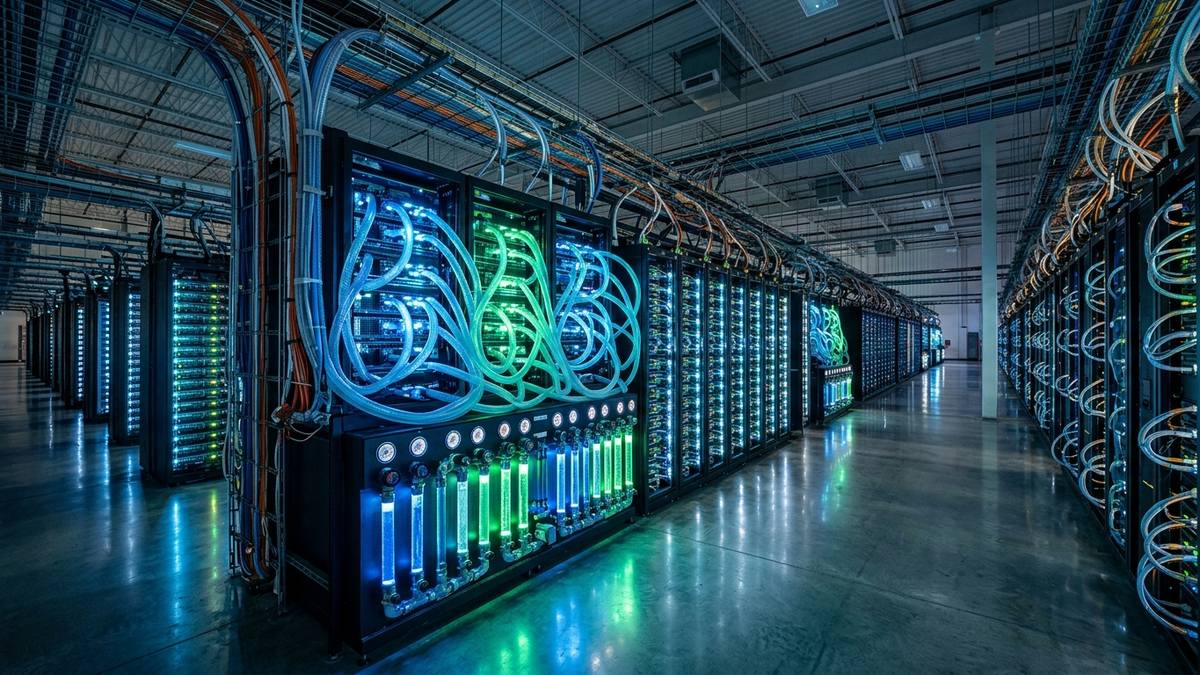
Vertiv completes a direct-to-chip liquid cooling deployment supporting 30 MW of AI capacity at a Navi Mumbai data centre, slashing PUE and enabling 100 kW+ GPU racks.
Executive Key Takeaways
- Vertiv has commissioned a 30 MW direct-to-chip liquid-cooling architecture at a hyperscale data centre campus in Navi Mumbai.
- The deployment accommodates high-TDP AI accelerators with rack power densities of 80 kW to 120 kW per cabinet, reducing facility PUE to sub-1.2 levels.
- The project sets an operational benchmark for tropical climate thermal engineering, accelerating India's readiness for next-generation Nvidia Blackwell and high-density GPU superclusters.
Critical digital infrastructure leader Vertiv has completed a landmark high-density direct-to-chip liquid cooling deployment at a hyperscale data centre campus in Navi Mumbai, supporting 30 megawatts (MW) of mission-critical AI workloads. The deployment marks India's largest commercial implementation of direct-to-chip (D2C) liquid cooling to date, enabling high-performance GPU clusters to operate at rack densities exceeding 100 kilowatts (kW) per cabinet while lowering the facility's Power Usage Effectiveness (PUE) to below 1.2 despite the demanding coastal heat and humidity of the Mumbai metropolitan region.
The commissioning addresses an urgent operational bottleneck in the deployment of artificial intelligence infrastructure. As global cloud providers and domestic enterprises install thousands of power-dense AI accelerators—such as Nvidia H100, H200, and next-generation Blackwell platforms—traditional air-cooling architectures have encountered rigid thermodynamic boundaries, unable to safely dissipate the extreme heat flux generated within modern enterprise server racks.
The Thermal Barrier: Why Air Cooling Breaks Down at 100 kW per Rack
For decades, commercial data centres relied almost exclusively on computer room air handler (CRAH) units and hot/cold aisle containment systems. This paradigm worked effectively when server racks dissipated between 5 kW and 15 kW of power. However, modern high-performance AI accelerators consume between 700 watts and 1,200 watts per silicon die, with complete 8-GPU server nodes drawing upwards of 10.2 kW within just 4U to 6U of rack space.
When rack power densities surge past 40 kW and approach 100 kW, forced air-cooling becomes thermodynamically impractical:
- Thermal Conductivity Limitations: Liquid has a heat-carrying capacity over 3,000 times greater than air by volume, enabling it to absorb thermal energy directly at the silicon die with minimal temperature gradient.
- Parasitic Fan Power Overhead: Forcing enough ambient air through ultra-dense GPU heatsinks requires high-RPM server fans that consume up to 20% of total server power while producing severe acoustic vibrations that cause micro-fractures in solder joints.
- Physical Space Constraints: Air ducts, raised floor plenums, and air-handling units consume vast physical space, artificially capping compute density per square metre of white space.
By routing specialized dielectric or treated liquid coolants directly through micro-channel cold plates fastened to the processor packages, Vertiv's direct-to-chip architecture eliminates thermal throttling and maintains silicon junction temperatures below critical degradation thresholds.
"AI computing has fundamentally broken conventional thermal management paradigms,"explained a senior thermal infrastructure engineer involved in the Navi Mumbai commissioning. "At 100 kW per rack, air cooling is no longer an engineering option—it is a physical impossibility. This 30 MW liquid cooling deployment demonstrates that high-density AI clusters can operate sustainably and reliably even in tropical climates with ambient temperatures exceeding 38 degrees Celsius."
Architecture of Direct-to-Chip Deployment: Closed-Loop CDUs and Heat Rejection
The 30 MW Navi Mumbai deployment utilizes Vertiv's integrated liquid-cooling ecosystem, combining Coolant Distribution Units (CDUs), secondary fluid loops, and stainless-steel supply and return manifolds:
- Micro-Channel Cold Plates: Precision-machined copper cold plates with microscopic internal fins mounted directly over the CPU and GPU packaging, transferring heat from silicon to coolant with thermal resistance below 0.015 °C/W.
- Liquid-to-Liquid CDUs: Floor-standing Coolant Distribution Units that isolate the secondary IT cooling loop from the primary facility water loop, regulating coolant flow rates, filtration, and precision temperature differentials.
- Smart Manifold & Quick-Disconnect Couplings: Dripless quick-disconnect couplings and automated isolation valves that enable hot-swappable server blade maintenance without system depressurization or fluid loss.
- Integrated Leak Detection Arrays: Comprehensive rope sensors and ultrasonic flow meters continuously monitored by building management systems (BMS) to detect microscopic moisture variations within milliseconds.
The structured table below compares traditional air cooling, hybrid rear-door heat exchangers, and direct-to-chip liquid cooling across key operational engineering metrics:
| Engineering Parameter | Standard Air-Cooled Architecture | Rear-Door Heat Exchangers (RDHx) | Direct-to-Chip Liquid Cooling (D2C) |
|---|---|---|---|
| Maximum Rack Density | Up to 20 kW / rack | Up to 45 kW / rack | 80 kW to 120+ kW / rack |
| Facility PUE (Tropical Climate) | 1.45 – 1.65 | 1.30 – 1.40 | 1.15 – 1.20 |
| Primary Cooling Medium | Refrigerant DX / Chilled Air | Chilled Water to Heat Exchanger | Treated Coolant / Water-Glycol Loop |
| Parasitic Fan Energy Overhead | 15% – 22% of total IT load | 8% – 12% of total IT load | < 4% of total IT load |
| Accelerator TDP Ceiling | ~400W TDP | ~600W TDP | 1,200W+ TDP (Blackwell / Rubin) |
| Floor Space Efficiency | Low (Wide aisles required) | Moderate | High (Maximum compute density) |
Navi Mumbai as India's AI Infrastructure Epicenter
The commissioning reinforces Navi Mumbai's emerging status as the primary colocation and AI supercomputing hub of South Asia. The region offers key structural advantages, including immediate access to multiple international subsea cable landing stations, dedicated high-voltage power substations, and favorable state IT data centre policies.
As Indian enterprises and cloud providers expand compute capacity to support national initiatives like the IndiaAI Mission and indigenous semiconductor integration, energy-efficient liquid cooling will be essential to prevent grid strain. Projects like this complement national investments in AI-powered industrial infrastructure, domestic hardware design like BigEndian's indigenous AI chips, and public efforts to address national GPU infrastructure crunches.
By proving that 30 MW of high-density AI capacity can run with a sub-1.2 PUE in a coastal tropical climate, the Navi Mumbai installation sets a new operational benchmark for sustainable enterprise computing across India.
Frequently Asked Questions
What is direct-to-chip (D2C) liquid cooling?
Direct-to-chip liquid cooling is an advanced thermal management system where liquid coolant is circulated through micro-channel cold plates mounted directly atop high-power CPUs and GPUs, absorbing heat at the component level far more efficiently than ambient air.
Why is liquid cooling necessary for 30 MW of AI compute capacity?
Modern AI workloads run on dense accelerator clusters (such as Nvidia H100 and Blackwell GPUs) that draw upwards of 700W to 1,200W per chip, resulting in rack densities exceeding 80 kW to 100 kW. Forced air cooling cannot dissipate this level of heat without extreme fan power consumption and thermal throttling.
What is Power Usage Effectiveness (PUE) and how does this deployment achieve sub-1.2 PUE?
Power Usage Effectiveness (PUE) measures data centre energy efficiency by dividing total facility power by the power consumed by IT equipment (ideal score is 1.0). By using liquid coolant to remove heat directly, the system bypasses heavy mechanical chilling compressor loads, cutting parasitic energy overhead and driving PUE below 1.2.
Why is Navi Mumbai a preferred location for hyperscale AI data centres?
Navi Mumbai offers access to high-capacity international submarine fiber cable landings, reliable high-voltage electrical grid substations, abundant industrial land parcels, and supportive state data centre incentives.
Primary Sources & Official References
- Vertiv Engineering Whitepapers: High-Density Liquid Cooling and Thermal Management Systems for AI Superclusters
- Maharashtra Industrial Development Corporation (MIDC) & CEA: Navi Mumbai Hyperscale Data Centre Infrastructure Filings
- Uptime Institute: Global Data Center Thermal Guidelines and Direct Liquid Cooling Benchmarks
- Bureau of Energy Efficiency (BEE): Operational Energy Benchmarks for Indian Hyperscale Data Centres 2026