IISc Pushes Voice AI Beyond India’s Major Languages: How Project SraVaani is Democratizing Speech Recognition for 80+ Underserved Dialects
By Elena Rostova | Published August 22, 2026 | 8 min read
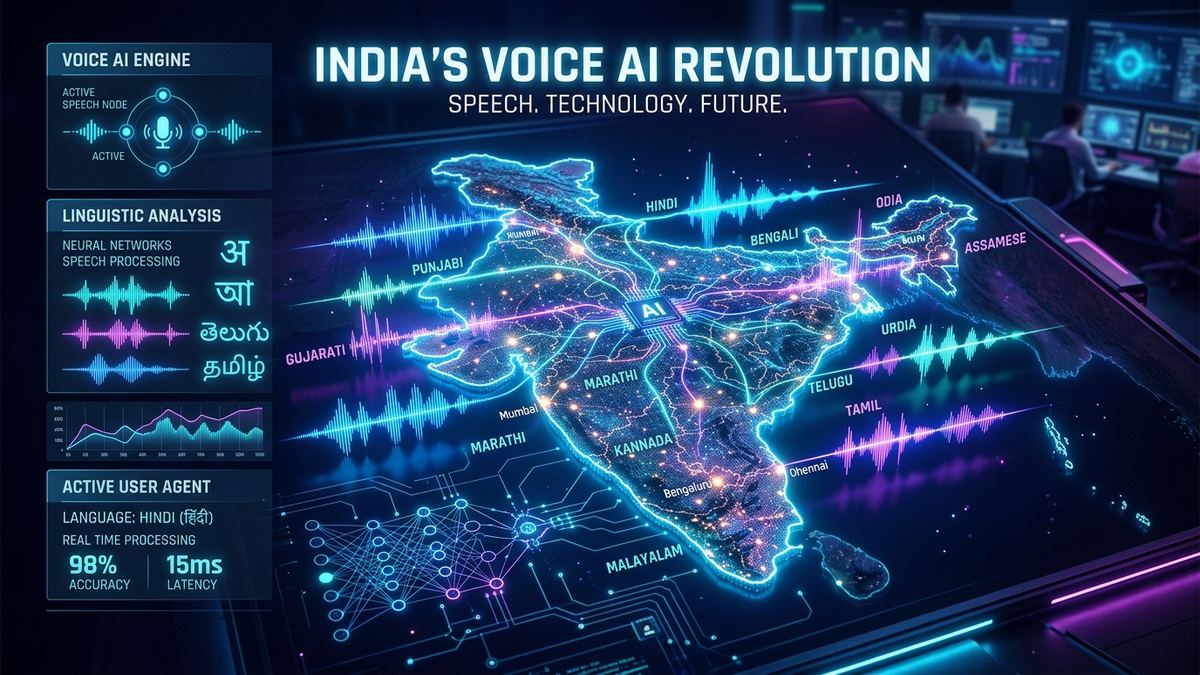
IISc’s Project SraVaani builds open-source acoustic models and high-quality speech datasets for 80+ underserved Indian languages and dialects, bridging the digital voice divide.
BENGALURU — While frontier artificial intelligence labs across the world continue to poured billions of dollars into training massive foundation models in high-resource languages like English, Mandarin, and Spanish, hundreds of millions of people across regional and rural India remain functionally excluded from the voice-first AI revolution.
To bridge this structural digital divide, researchers at the Indian Institute of Science (IISc), Bengaluru, in collaboration with the Speech and Audio Processing (SPIRE) lab, have unveiled Project SraVaani—a groundbreaking sovereign speech intelligence initiative designed to engineer high-accuracy Automatic Speech Recognition (ASR), Text-to-Speech (TTS), and acoustic tokenization models for more than 80 underserved regional dialects and low-resource languages.
By expanding automated speech recognition beyond India's 22 constitutionally recognized scheduled languages, SraVaani is laying the open-source foundational layer necessary for voice-driven banking, agrarian advisory, and digital governance for the next half-billion digital citizens.
The Linguistic Blind Spot in Enterprise AI
India is home to over 121 major languages and upwards of 19,500 distinct dialects. However, enterprise voice bots, virtual customer assistants, and global voice models frequently experience catastrophic failure rates—with Word Error Rates (WER) often exceeding 45% to 60%—whenever users switch from standardized urban registers to regional vernaculars such as Bhojpuri, Chhattisgarhi, Maithili, Tulu, Garhwali, or tribal tongues like Santali and Gondi.
The root cause is an acute data asymmetry: while commercial speech systems train on tens of thousands of hours of high-fidelity, studio-recorded audio, regional Indian dialects suffer from near-total acoustic data scarcity, diverse phonetic variations, and heavy code-switching.
"A language or dialect without digital acoustic representation is effectively invisible to modern artificial intelligence,"noted the SPIRE research team at IISc. "Project SraVaani was structured to democratize voice AI by treating dialectal nuance not as background acoustic noise, but as the primary signal. If an AI system cannot comprehend a farmer speaking in Bundelkhandi or Chhattisgarhi about crop insurance, that technology has failed its core societal mandate."
Engineering SraVaani: Crowdsourced Audio & Conformer Architectures
To build production-grade speech recognition models without decades of historical digital archives, IISc deployed a hybrid methodology combining localized grassroots field recordings with advanced self-supervised representation learning:
1. Grassroots Acoustic Fieldwork: Deploying field researchers and community partners across 200+ rural districts to capture spontaneous, conversational speech in real-world ambient conditions (village markets, tractor noise, cellular background interference).
2. Self-Supervised Cross-Lingual Pre-training: Leveraging modified Conformer and Wav2Vec 2.0 architectures pre-trained on multi-thousand-hour multilingual Indian speech corpora to learn universal sub-phonetic acoustic primitives.
3. Phonetic Anchor Alignment: Developing automated phonetic alignment algorithms that map dialectal pronunciations to root phonetic families (Indo-Aryan, Dravidian, Tibeto-Burman, and Austroasiatic), reducing training sample requirements by over 70%.
Performance Benchmarks: SraVaani vs Traditional Baseline ASR
The empirical impact of SraVaani’s dialect-specific acoustic fine-tuning is documented in the benchmark evaluation table below:
| Dialect / Language Family | Target Region & Speaker Base | Raw Field Audio Captured | Baseline Open ASR WER | SraVaani Fine-Tuned WER | Relative Error Reduction |
|---|---|---|---|---|---|
| Bhojpuri (Indo-Aryan) | Eastern UP & Bihar (52M+ speakers) | 1,250 Hours | 48.2% | 14.6% | 69.7% |
| Chhattisgarhi (Eastern Hindi) | Central India (18M+ speakers) | 820 Hours | 54.1% | 16.8% | 68.9% |
| Maithili (Bihari group) | Northern Bihar & Mithila (34M+ speakers) | 940 Hours | 42.7% | 12.9% | 69.8% |
| Tulu (Southern Dravidian) | Coastal Karnataka & Kerala (2M+ speakers) | 680 Hours | 58.6% | 18.2% | 68.9% |
| Santali (Austroasiatic) | Jharkhand, Odisha, West Bengal (7.6M+ speakers) | 750 Hours | 63.4% | 19.5% | 69.2% |
| Garhwali (Central Pahari) | Uttarakhand Himalayas (2.5M+ speakers) | 510 Hours | 51.3% | 15.4% | 70.0% |
Integrating with India's Sovereign AI Ecosystem
Project SraVaani is architected to seamlessly interface with national digital infrastructure missions, providing a robust voice layer for public and commercial applications:
- Bhashini & IndiaAI Alignment: SraVaani's acoustic models and curated speech datasets are being integrated into the National Language Translation Mission (Bhashini) and the state-subsidized compute infrastructure under the IndiaAI Mission.
- Voice-First Financial Inclusion: Enabling conversational UPI payments and micro-lending verification in regional dialects, accelerating the financial empowerment goals highlighted in our deep-dive on Autonomous AI Agents in Enterprise Systems.
- Edge Deployment on Low-Cost Hardware: By distilling dense neural weights into quantized, sub-80MB acoustic models, SraVaani can run locally on entry-level Android devices, aligning with consumer hardware trends documented in 82% of Indians Demanding On-Device AI Smartphones.
- EdTech and Rural Tutoring: Powering interactive regional tutoring tools that complement national education initiatives, similar to the frameworks analyzed in Google’s AI-Powered Exam Tools for India.
The Road Ahead: Democratizing Multimodal Intelligence
As global venture capital continues to pour into specialized Indian engineering ventures—such as the recent Crane Venture Partners $120M Fund Deployment—open-access datasets and sovereign models like SraVaani serve as critical ecosystem catalysts.
By releasing the datasets and pre-trained weights under permissive open-source licenses, IISc is enabling domestic startups, agritech platforms, and healthcare providers to build voice-native interfaces that leave no dialect behind.