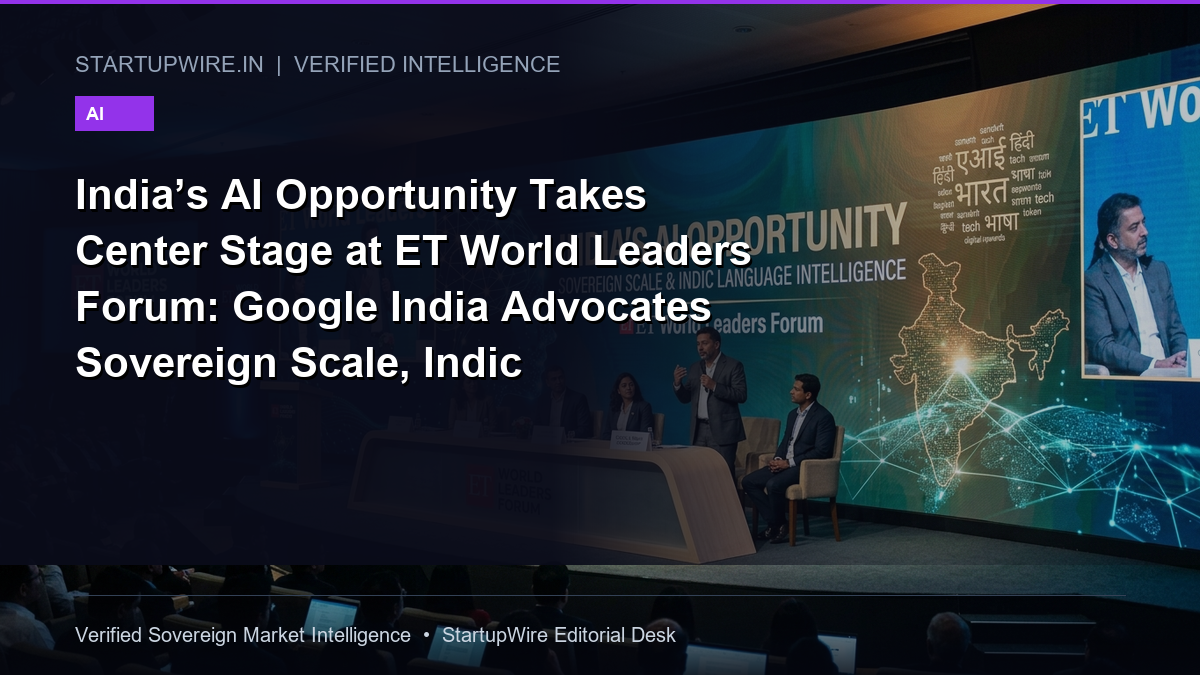
At the ET World Leaders Forum in New Delhi, Google India and global leaders highlighted India's unique AI opportunity, urging models built for Indian scale, languages, and DPI.
Executive Key Takeaways
- At the ET World Leaders Forum in New Delhi, Google India and global leaders highlighted India's unique AI opportunity, urging models built for Indian scale, languages, and DPI.
- India cannot simply import AI models trained on Western internet data and expect them to magically resolve agricultural credit, public healthcare triage, or vernacular education, stated a senior Google India executive during the forum panel. AI in India must be built around India's scale, India's linguistic diversity, and India's economic realities. When you solve artificial intelligence for a street vendor in Varanasi or a primary healthcare worker in rural Odisha, you build solutions that can serve the next four billion people across the Global South.
- Key Benchmark: **Tokenization Efficiency (Hindi/Tamil)** — 3.2 – 4.8 Tokens per Word (High Compute Penalty)
NEW DELHI — Addressing a distinguished gathering of policymakers, global technology executives, and venture pioneers at the prestigious ET World Leaders Forum in New Delhi, Google India and domestic technology leaders placed India’s artificial intelligence opportunity firmly at the center of the global economic dialogue.
Emphasizing that artificial intelligence must not be treated merely as a Western consumer toy or enterprise SaaS wrapper, leadership from Google India, MeitY, and top tech founders argued that India’s unique demographic scale, linguistic heterogeneity of over 22 scheduled languages, and world-leading Digital Public Infrastructure (DPI) constitute the world’s most fertile testing ground for high-impact, inclusive AI. The forum underscored the urgent requirement for sovereign Indic language foundation models capable of reasoning directly in Hindi, Tamil, Telugu, Bengali, and regional dialects without losing contextual nuance during English translation intermediary steps.
This high-level dialogue builds upon the government’s accelerating institutional push to onboard domestic ML engineering partners, as detailed in Government Expands AI Push: Onboarding Domestic Partners for Digital India, and the sector-specific focus analyzed in Indian AI Startups Shift to Sector-Specific Vertical Innovation.
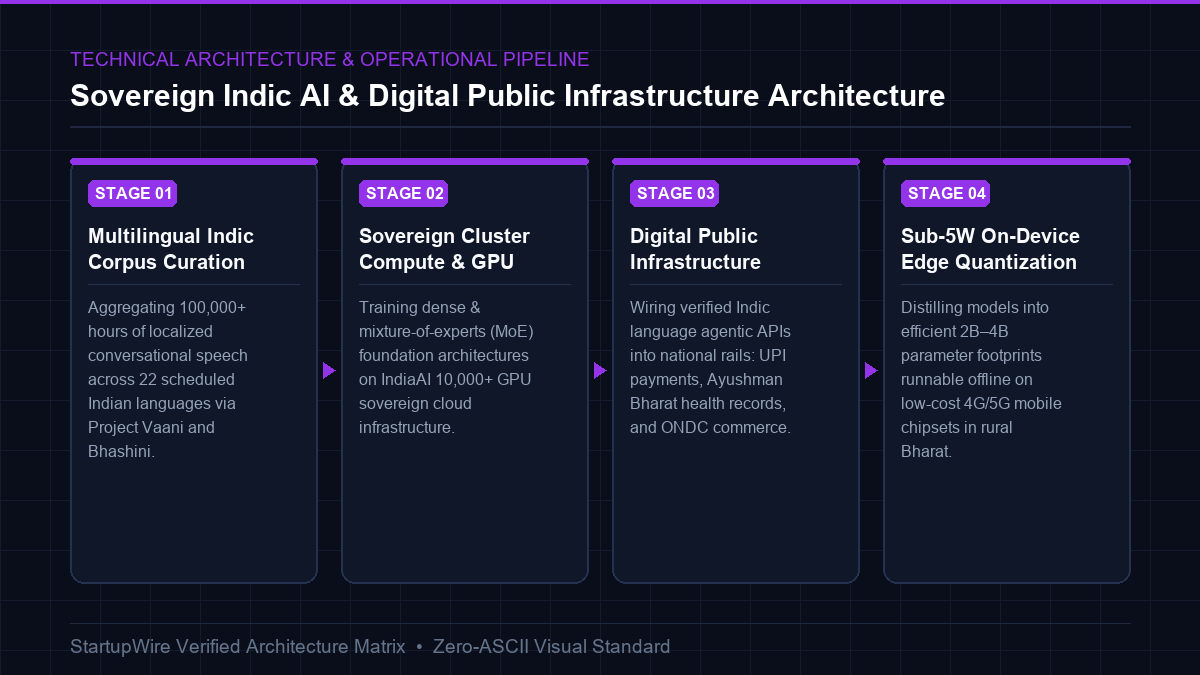
Shifting from Western LLM Wrappers to Sovereign Scale
During the keynote sessions, tech luminaries pointed out that Western foundational models (such as GPT-4 and Claude 3.5) exhibit severe architectural tokenization penalties when processing Indian languages. In standard Byte-Pair Encoding (BPE) tokenizers, a single Hindi sentence frequently requires three to five times more tokens than its English equivalent, tripling compute latency and inference costs for domestic users.
To solve this systemic friction, Google India highlighted collaborative open-data initiatives like Project Vaani—conducted in partnership with the Indian Institute of Science (IISc), Bengaluru—which has mapped conversational speech across all 773 districts of India, creating open datasets to ensure that voice-driven AI interfaces function seamlessly for farmers, rural artisans, and small traders.
"India cannot simply import AI models trained on Western internet data and expect them to magically resolve agricultural credit, public healthcare triage, or vernacular education,"stated a senior Google India executive during the forum panel. "AI in India must be built around India's scale, India's linguistic diversity, and India's economic realities. When you solve artificial intelligence for a street vendor in Varanasi or a primary healthcare worker in rural Odisha, you build solutions that can serve the next four billion people across the Global South."
Architectural Benchmark: Generic Global LLMs vs. Indic-Native Models
The structural performance gap between monolithic Western models and dedicated Indic sovereign architectures is outlined below:
| Technical Benchmark | Global Foundation Models (US/EU Trained) | Indic-Native Sovereign Models (IndiaAI / Bhashini) | Sovereign Advantage |
|---|---|---|---|
| Tokenization Efficiency (Hindi/Tamil) | 3.2 – 4.8 Tokens per Word (High Compute Penalty) | 1.1 – 1.3 Tokens per Word (Native Byte Encoding) | 70% Lower Inference Latency & Cost |
| Cultural & Legal Context Accuracy | Low (Hallucinates Indian legal codes & idioms) | High (Pre-trained on SEBI, RBI, IPC & Indian Law) | Enterprise Regulatory Compliance |
| Spoken Dialect Phoneme Robustness | Fails on regional accents & acoustic noise | Trained on 100k+ hours of real Indian street audio | Accurate Voice Command Navigation |
| Data Residency & Sovereign Auditability | Offshored to US/EU GPU hyperscaler clouds | 100% Domestic Sovereign Cloud Data Residency | Zero Cross-Border Data Leakage |
| API Integration with National DPI Rails | Requires complex custom middleware | Native Webhooks into UPI, ONDC, and DigiLocker | Direct Zero-Click Public Service Triage |
| Edge Compute Footprint | Cloud-tethered (Requires 100+ GB VRAM clusters) | Quantized 4-bit Mobile Models (< 4 GB RAM) | Runs smoothly on budget smartphones |
The Convergence of AI with Digital Public Infrastructure
The most transformative consensus emerging from the ET World Leaders Forum was the inevitable marriage between generative intelligence and India’s established DPI rails. Instead of requiring citizens to navigate complex bureaucratic portals, next-generation agentic AI systems will allow citizens to speak in their mother tongue—whether Bhojpuri, Kannada, or Marathi—and have the agent automatically fetch crop insurance claims from DigiLocker, execute payments via UPI, or schedule telemedicine consults.
As Indian universities rapidly pivot to job-ready artificial intelligence training, as analyzed in Campus Hiring Turns Skills-First: Indian Universities Overhaul Curricula, the ET World Leaders Forum made one reality indisputable: the future of AI will not merely be determined by who builds the largest cluster in Silicon Valley, but by who builds the most useful, scalable, and inclusive intelligence in New Delhi and Bengaluru.