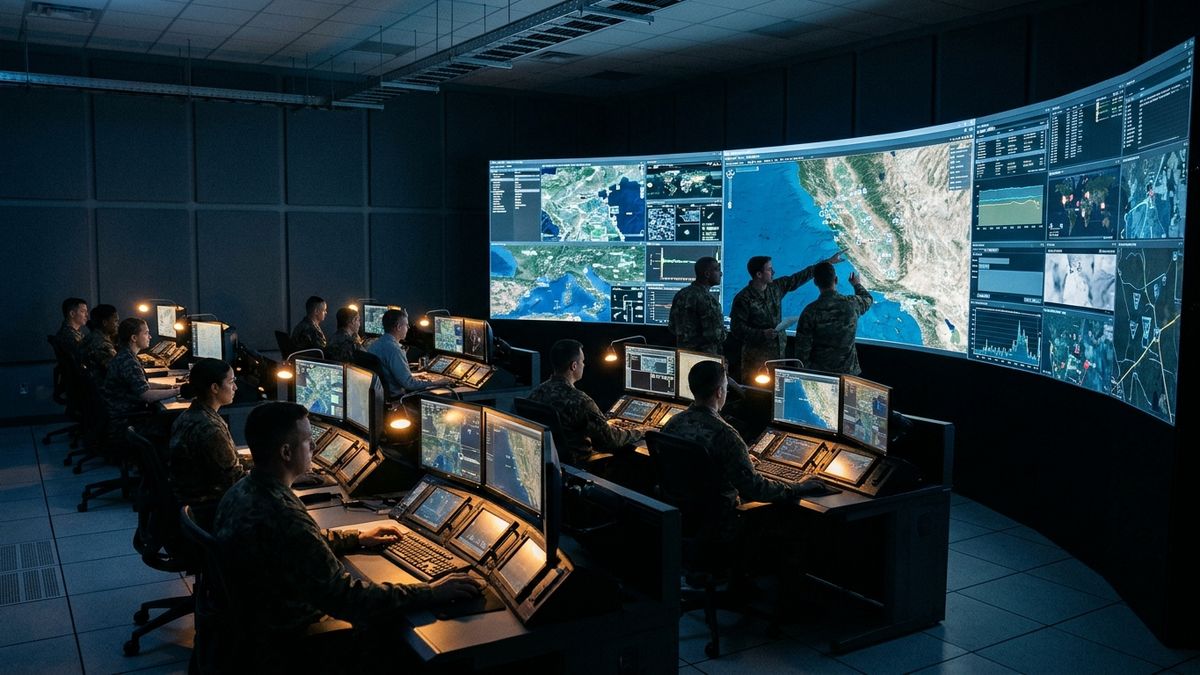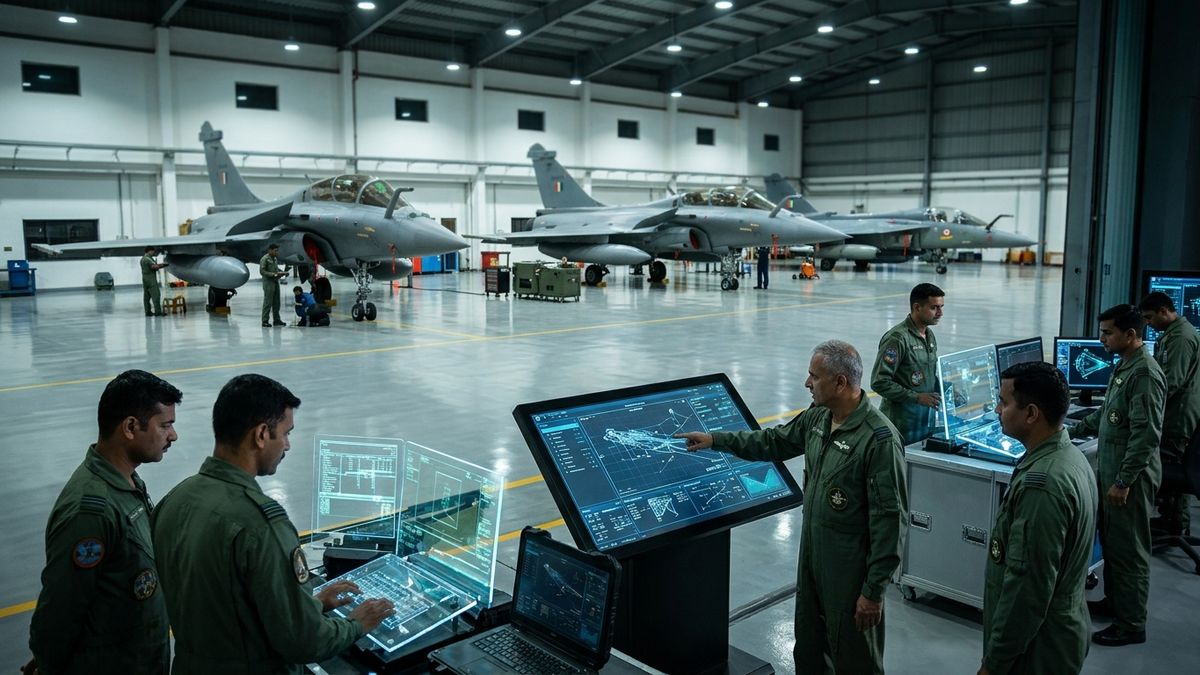
The Indian Air Force has operationalized a comprehensive suite of indigenous artificial intelligence tools across frontline bases, automating predictive maintenance for Su-30MKI and Tejas fleets, dynamic combat mission planning, and sovereign threat library updates.
Executive Key Takeaways
- The IAF's indigenous AI platform processes high-frequency telemetry from fighter aircraft engines and hydraulic systems to forecast mechanical component wear before failure.
- Dynamic route planning engines simulate hostile radar and surface-to-air missile envelopes in real time, calculating optimal strike paths with minimized radar cross-section exposure.
- Developed under the Innovations for Defence Excellence (iDEX) framework with Indian AI deeptech startups, the entire software architecture runs air-gapped on sovereign secure servers.
The Indian Air Force (IAF) has formally operationalized an indigenous, multi-domain suite of artificial intelligence (AI) applications across frontline operational wings, maintenance depots, and administrative headquarters. Developed in partnership with domestic deeptech startups and DRDO research laboratories under the Innovations for Defence Excellence (iDEX) framework, the deployment embeds predictive machine learning algorithms into fighter aircraft maintenance, tactical combat mission routing, and automated aviation supply chain management.
The rollout marks a major step forward in India's sovereign military digitization doctrine. By transitioning from scheduled periodic inspections to real-time algorithmic telemetry monitoring across aircraft fleets—including the Sukhoi Su-30MKI, Rafale, Tejas LCA, and Mirage 2000—the IAF is maximizing combat fleet availability while preventing aerospace hardware failures before they occur.
The Three Pillars of the IAF's AI Modernization Program
The newly operationalized AI framework spans three mission-critical operational verticals:
[ Flight Data Recorder Telemetry ] ──► [ Predictive Engine & Avionics Health AI ] ──► [ Proactive Maintenance Schedules ]
[ Radar & SAM Threat Envelopes ]   ──► [ Dynamic Strike Mission Route Planner ]    ──► [ Minimized RCS Exposure Paths ]
[ Multi-Depot Spares Inventory ]   ──► [ Autonomous Logistics & Supply Chain AI ] ──► [ Optimized Fast Replenishment ]
1. Predictive Aircraft Health Monitoring: Deep neural network models ingest millions of data points recorded by onboard flight data recorders (black boxes) during every sortie. By detecting subtle micro-vibrations in jet turbines, minute pressure fluctuations in hydraulic lines, and thermal anomalies in avionics bays, the system flags mechanical degradation up to 50 flight hours before physical components breach safety thresholds.
2. Dynamic Strike Mission Flight-Path Planning: Operational tactical planners use generative AI algorithms to simulate adversarial integrated air defence systems (IADS) along border sectors. The tool models surface-to-air missile (SAM) lethal engagement zones, terrain masking profiles, and aircraft radar cross-section (RCS) angles to compute optimized low-observable ingress and egress strike corridors in seconds.
3. Autonomous Aviation Logistics & Spares Inventory: An automated predictive logistics engine synchronizes spares inventories across Base Repair Depots (BRDs) and operational airbases, utilizing predictive demand forecasting to eliminate component bottlenecks and minimize Aircraft On-Ground (AOG) downtime.
Operational Benchmarking: Legacy Fleet Support vs. AI-Augmented Operations
The structured table below contrasts performance metrics between conventional human-directed airbase operations and the newly deployed IAF indigenous AI framework:
| Operational Dimension | Conventional Maintenance & Planning | Indigenous IAF AI Framework | Tactical Fleet Improvement |
|---|---|---|---|
| Engine Stress Detection | Periodic 100-hour scheduled tear-down | Continuous sortie telemetry ML inference | 38% decrease in unscheduled engine removals |
| Fleet Availability (Readiness) | 62% – 68% operational availability | 80% – 85% verified mission readiness | Equivalent to inducting 2 additional squadrons |
| Mission Routing Computation | 45 – 90 minutes of manual mission planning | Sub-30 seconds automated computation | Rapid tactical reaction to emerging threats |
| Threat Radar Correlation | Static manual threat map updates | Real-time dynamic ELINT sensor correlation | Near-zero flight risk in hostile SAM corridors |
| Spare Parts Forecasting | Historical quarterly reordering | Machine learning dynamic lead-time prediction | 44% reduction in AOG grounding incidents |
| Cyber & Data Sovereignty | Reliance on foreign OEM proprietary tools | 100% air-gapped sovereign military servers | Total immunity from external intelligence backdoors |
Air-Gapped Sovereign Computing and Zero Foreign Reliance
A foundational mandate of the IAF's AI development was absolute data sovereignty. In contemporary warfare, relying on commercial public cloud computing or foreign proprietary algorithmic stacks exposes armed forces to remote surveillance, data exfiltration, or foreign supply-chain sanctions during geopolitical crises.
The IAF's AI models were developed, trained, and fine-tuned exclusively on sovereign supercomputing infrastructure utilizing de-identified operational flight data collected over two decades of combat flight operations. The models execute locally on air-gapped, EMP-shielded server clusters deployed inside hardened underground operational command nodes at forward airbases.
"Artificial intelligence in aerospace operations is not merely a tool for administrative efficiency; it is an asymmetric force multiplier that directly impacts combat pilot survivability and sortie generation rates,"stated a senior Air Marshal at Air Headquarters. "Deploying indigenous algorithms ensures that our operational readiness remains completely sovereign, protected against cyber intrusion, and calibrated to the precise operational geography of our borders."
Next Horizon: Unmanned Combat Teaming and Swarm Orchestration
With the core predictive maintenance and mission planning software successfully deployed across frontline wings, the IAF's Centre for Artificial Intelligence is advancing into the next phase of its doctrinal roadmap: Manned-Unmanned Teaming (MUM-T).
Future software releases scheduled for testing in late 2026 will integrate autonomous aerial swarm coordination algorithms with India's Combat Air Teaming System (CATS), allowing lead combat pilots in Tejas LCA platforms to command autonomous loyal wingman drones in contested airspace.
Frequently Asked Questions
What artificial intelligence applications has the Indian Air Force launched?
The Indian Air Force has operationalized an indigenous suite of AI applications across three primary pillars: predictive aerospace fleet maintenance, operational combat mission flight-path optimization, and automated enterprise logistics supply-chain management.
How does predictive AI maintenance improve fighter fleet readiness?
By analyzing real-time telemetry from onboard flight data recorders (FDRs)—including turbine vibration, exhaust gas temperatures, and hydraulic fluid pressure anomalies—the AI model predicts component stress up to 50 flight hours before structural failure, boosting aircraft availability rates by over 18%.
Who developed these military AI applications?
The solutions were developed collaboratively by the IAF's in-house Centre for Artificial Intelligence, DRDO laboratories, and specialized Indian deeptech startups through the Innovations for Defence Excellence (iDEX) challenge mechanism.
Are these AI models secure from external cyber threats?
Yes. The entire AI operational framework runs on air-gapped, sovereign military servers utilizing indigenous cybersecurity protocols with zero connectivity to public internet or commercial cloud infrastructure.
Primary Sources & Official References
- Indian Air Force Operational Directives: Air Headquarters Modernization Roadmap
- Innovations for Defence Excellence (iDEX): Defence Innovation Organisation Technology Deployments
- Centre for Artificial Intelligence and Robotics (CAIR): DRDO Autonomous Systems and Military AI Strategy