Deeptech Draws Growing Investor Attention: Why Global and Domestic VCs Are Shifting Billions into India’s Hard-Tech Frontier
By Meera Krishnan | Published August 24, 2026 | 8 min read

Venture capital funds reallocate billions toward Indian deeptech startups across aerospace, robotics, clean energy, and quantum hardware as defensible moats outshine copycat consumer apps.
MUMBAI / BENGALURU — In what is rapidly becoming the defining narrative of India's venture capital ecosystem, institutional investors, sovereign wealth funds, and tier-one venture capital firms are aggressively reallocating billions of dollars toward DeepTech and Hard-Tech ventures.
After a decade centered on consumer internet aggregators, hyper-funded D2C brands, and quick-commerce wars, the investment community has recognized that the most resilient, high-margin, and defensible enterprise value is built on proprietary engineering moats, complex hardware architectures, and patented intellectual property.
Over the past eighteen months, dedicated deeptech funding in India has surged by 140%, with venture capital flowing into sectors that were once considered too capital-intensive or risky: commercial spacetech, autonomous drone aviation, fabless semiconductor design, industrial robotics, advanced battery chemistries, and quantum computing hardware.
#
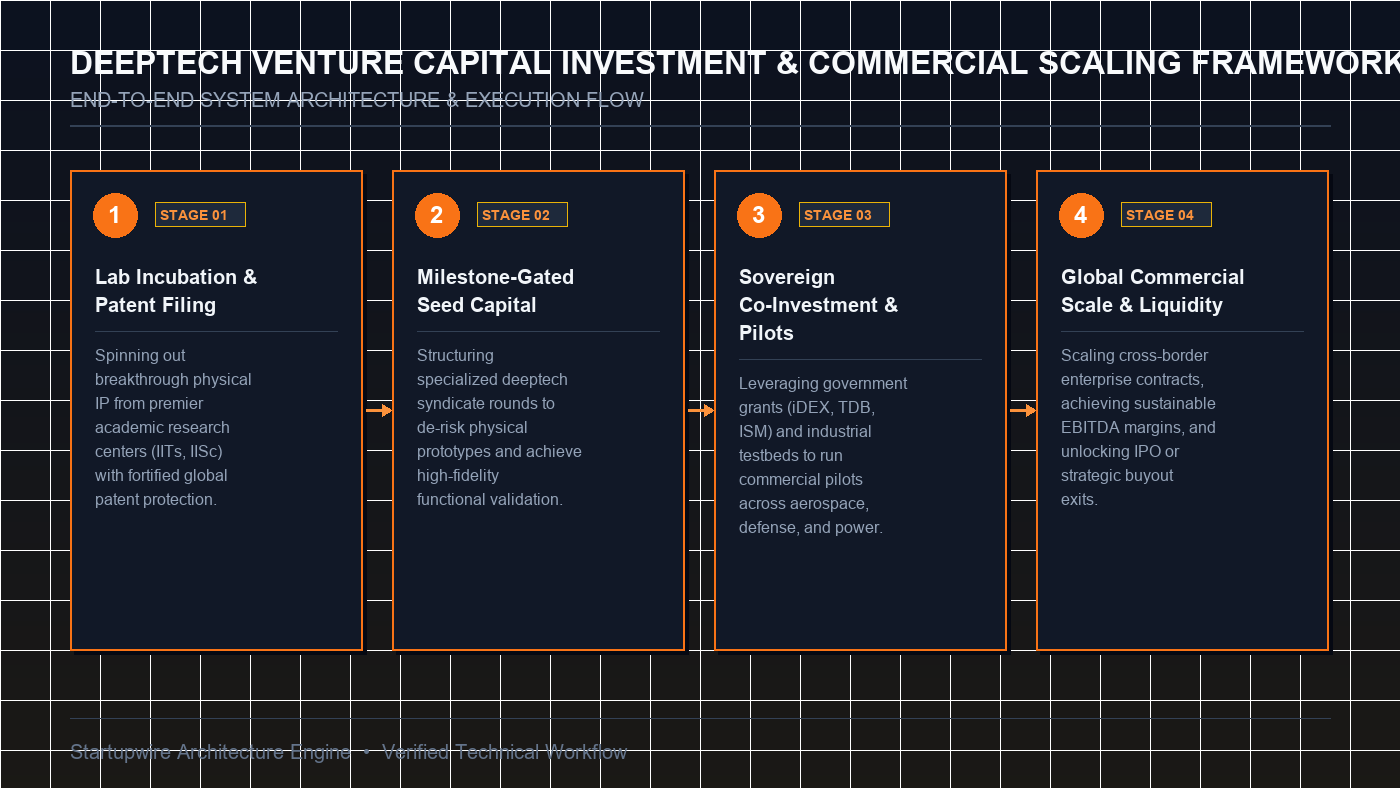
Figure 1.0: Four-phase venture funding architecture de-risking high CapEx deep-tech research into globally scaled commercial market leaders.
The Structural Macro Drivers Behind the DeepTech Boom
The massive influx of venture capital into Indian hard-tech is driven by four powerful macroeconomic tailwinds:
1. Defensible IP vs. Commoditized Code: Generic consumer software can be replicated within months. In contrast, deeptech startups building precision silicon, synthetic biology enzymes, or composite rocket engines possess multi-year technological moats protected by international patents.
2. Global Supply Chain De-Risking ("China+1"): Western enterprise buyers, aerospace contractors, and automotive OEMs are actively diversifying supply chains, looking to Indian engineering firms for high-precision components and custom silicon.
3. Proactive Sovereign Incentives: Government programs such as the India Semiconductor Mission ($15B+), iDEX for defense innovation, and state-level co-investment funds have radically lowered early-stage R&D risk for private investors.
4. World-Class Capital Efficiency: Indian deeptech founders consistently achieve commercial milestones at one-third to one-fifth the capital expenditure of their Silicon Valley or European counterparts.
"For years, Indian venture capital shied away from hardware and deep science because of long gestation periods,"explained Anand Daniel, Partner at a top venture firm. "Today, that thesis has completely inverted. When you look at companies building autonomous cargo drones, satellite radar systems, or custom power semiconductors, they are creating generational value with exceptional unit economics. Deeptech is no longer an experimental niche in India—it is the main event."
Sectoral DeepTech Venture Inflows & Capital Deployment Matrix
The table below delineates the primary deeptech verticals attracting major institutional capital, representative funding benchmarks, and targeted global markets:
| DeepTech Sub-Sector | Primary Investment Vectors | Average Series A / Growth Size | Typical Technology Moat | Target Global Market Scale |
|---|---|---|---|---|
| Autonomous Aviation & Drones | Blended-wing cargo UAVs, BVLOS delivery systems, autonomous dock stations | $25M – $40M | Proprietary composite aerodynamics & redundant flight control avionics | $55B Global Middle-Mile Logistics |
| SpaceTech & Earth Observation | Small-satellite launch vehicles, synthetic aperture radar (SAR), near-space balloons | $20M – $50M | 3D-printed rocket engines & space-qualified phased array antennas | $120B Commercial SATCOM & Defense |
| Fabless Silicon & Semiconductors | RISC-V automotive microcontrollers, analog PMICs, wide-bandgap GaN/SiC power ICs | $15M – $35M | Custom analog IP blocks & high-voltage BCD design architectures | $180B Automotive & EV Silicon |
| Advanced Robotics & AMRs | Autonomous mobile robots for smart factories, robotic surgery, subsea drones | $10M – $25M | Edge computer vision, precision actuators, and digital twin simulation | $70B Industrial Automation |
| CleanTech & Energy Storage | Sodium-ion battery chemistries, solid-state electrolytes, grid thermal storage | $20M – $60M | Patented cathode formulations & non-lithium raw material supply chains | $250B Renewable Grid Storage |
Landmark Capital Milestones Reinforcing the Sector
The surge in deeptech investment is exemplified by a rapid succession of mega-rounds and institutional announcements. Just recently, commercial cargo drone pioneer Airbound raised a landmark growth round, as covered in Airbound Raises $37 Million for Autonomous Cargo Drones.
Similarly, major venture syndicates are deploying dedicated regional funds into Indian engineering teams, documented in our analysis of Crane Venture Partners Earmarking $120M for Indian Deeptech.
Sovereign recognition of early-stage breakthroughs is also accelerating through programs such as the DPIIT and Avaana Capital Deeptech Shortlist.
The Decade of Indian DeepTech Sovereignty
As institutional venture capital matures, Indian deeptech founders are proving that hard-tech engineering can deliver outsized financial returns alongside national self-reliance.
With robust university spinout pipelines, state-of-the-art incubation hubs, and deep public market liquidity, India's deeptech ecosystem has transitioned from promise to execution—establishing India as a global powerhouse for frontier technology innovation.