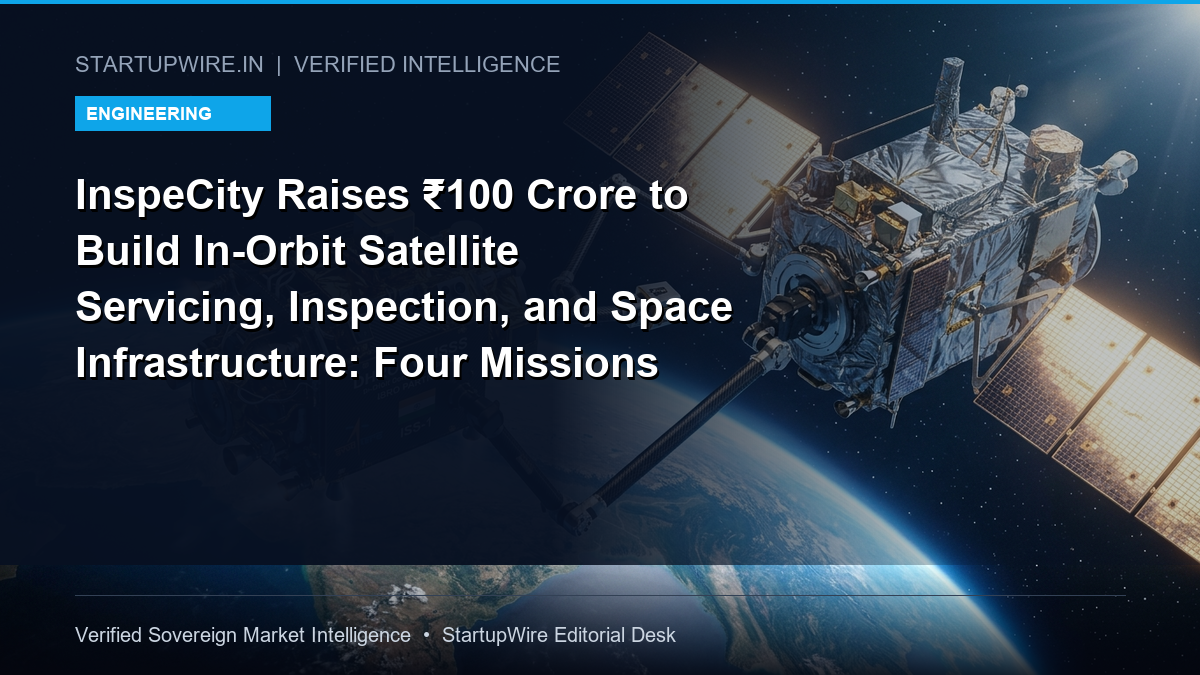
Spacetech pioneer InspeCity secures ₹100 Crore to fund four orbital missions, developing autonomous satellite life extension, in-orbit inspection, and de-orbiting systems.
Executive Key Takeaways
- Spacetech pioneer InspeCity secures ₹100 Crore to fund four orbital missions, developing autonomous satellite life extension, in-orbit inspection, and de-orbiting systems.
- Space can no longer operate on an expendable paradigm where billion-dollar orbital assets are discarded simply because of minor attitude drift or propellant depletion, stated a co-founder of InspeCity. By mastering autonomous proximity operations and micro-robotic docking in microgravity, InspeCity is turning orbit into a dynamic, serviced industrial environment. This ₹100 Crore round validates the maturity of our guidance navigation systems and propels India into the vanguard of orbital infrastructure.
- Key Benchmark: **Typical Operational Lifespan** — 7 – 10 Years (Constrained by chemical propellant)
BENGALURU — In an unprecedented breakthrough for India’s burgeoning private space economy, Mumbai- and Bengaluru-based spacetech startup InspeCity has secured ₹100 Crore ($12 Million) in fresh funding to accelerate the deployment of autonomous in-orbit satellite servicing, space inspection, and orbital life-extension infrastructure.
The capital infusion will directly finance four dedicated orbital demonstration missions scheduled across the next 24 months, establishing India as one of only four nations possessing operational capabilities to inspect, refuel, repair, and safely de-orbit satellites in Low Earth Orbit (LEO) and Geostationary Orbit (GEO). Founded by aerospace researchers and satellite dynamics specialists, InspeCity is pioneering non-cooperative docking mechanisms and modular space servicing tugs designed to transform the economics of space exploration from single-use disposable spacecraft into sustained orbital utility networks.
The company's technology directly complements India's sovereign space initiatives, including indigenous microprocessors analyzed in Made-in-India Chips Power Major Space Missions and broader space commercialization examined in India's SpaceTech Horizon: Private Startups Commercialize LEO Satellite Data.
The Economic Crisis of Disposable Satellites
Historically, the commercial space industry has operated on a deeply flawed economic premise: when a $200 million communications satellite exhausts its onboard hydrazine or xenon propellant, or suffers a localized mechanical sensor anomaly, the entire spacecraft is rendered obsolete and abandoned into a drifting graveyard orbit.
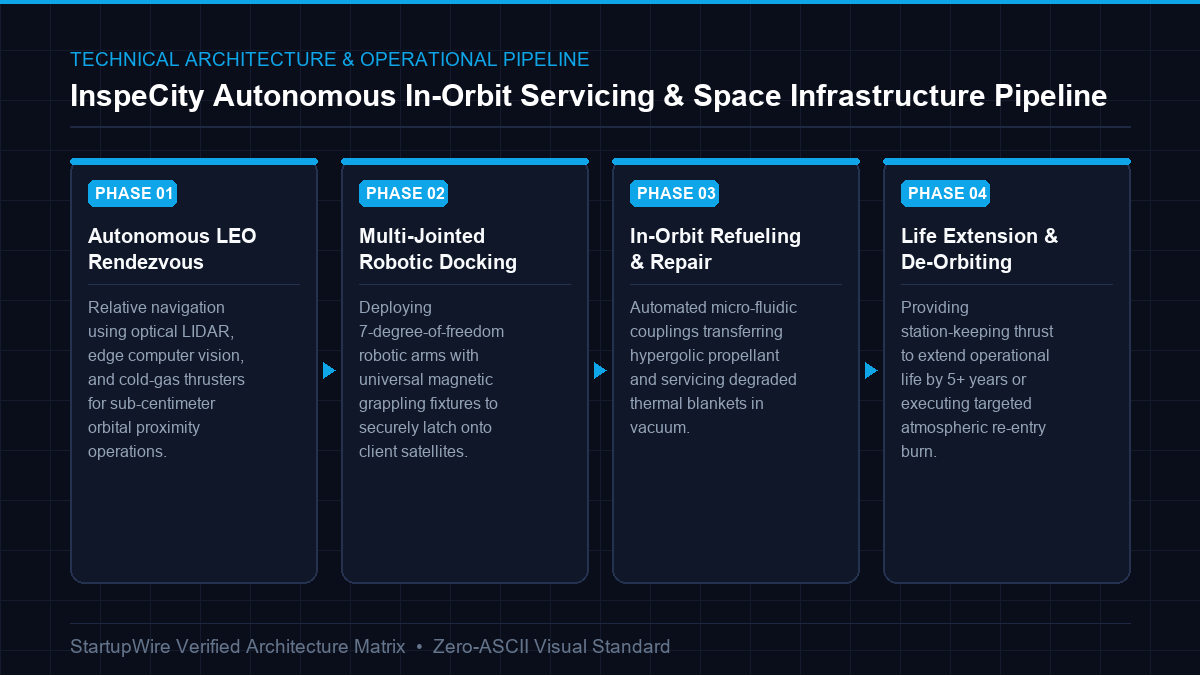
InspeCity’s flagship vehicle platform—the Vehicle for In-Orbit Servicing and Assembly (VOS-1)—solves this bottleneck by acting as an autonomous space tug. Equipped with optical relative navigation, sub-millimeter LIDAR scanning, and high-dexterity carbon-fiber robotic arms, VOS-1 can rendezvous with non-cooperative, tumbling satellites, stabilize their attitude, refuel propulsion reservoirs, and extend their commercial revenue lifespan by five to eight years.
"Space can no longer operate on an expendable paradigm where billion-dollar orbital assets are discarded simply because of minor attitude drift or propellant depletion,"stated a co-founder of InspeCity. "By mastering autonomous proximity operations and micro-robotic docking in microgravity, InspeCity is turning orbit into a dynamic, serviced industrial environment. This ₹100 Crore round validates the maturity of our guidance navigation systems and propels India into the vanguard of orbital infrastructure."
Comparative Benchmark: Disposable Satellites vs. In-Orbit Servicing
The financial and operational divergence between traditional satellite operations and InspeCity's in-orbit servicing architecture is detailed in the comparative benchmark matrix below:
| Mission Parameter | Traditional Disposable Satellite Model | InspeCity In-Orbit Servicing (VOS-1 Paradigm) | Industry Impact |
|---|---|---|---|
| Typical Operational Lifespan | 7 – 10 Years (Constrained by chemical propellant) | 15 – 20 Years (With periodic robotic refueling) | +100% Capital Asset Utility |
| Cost of Life Extension vs Replacement | $120M – $250M (Build, test & launch new spacecraft) | $12M – $20M (On-orbit robotic servicing mission) | 85% Capital Expenditure Savings |
| Space Debris Generation Risk | High (Drifting derelict stages in congested orbits) | Zero (Controlled active de-orbiting into Pacific graveyard) | Guaranteed Long-Term Space Sustainability |
| Docking Interface Requirement | Proprietary mechanical adapters required | Universal Magnetic & Gripper Clamps (Non-Cooperative) | Can service legacy unadapted satellites |
| Propellant Transfer Capability | Non-existent in commercial constellations | Automated Micro-Coupling Fluid Transfer (Hydrazine/Xenon) | Orbital Refueling Station Paradigm |
| Turnaround Mission Readiness | 18 – 36 Months lead time for replacement launch | Immediate In-Orbit Dispatch from Constellation Tug | Near-instantaneous asset recovery |
Engineering the Four Orbital Demonstration Missions
The ₹100 Crore funding allocation is strategically divided across four milestone orbital missions:
- Mission 1 (AlphaTug-1): Validating autonomous rendezvous and proximity operations (RPO) within 5 meters of an inert co-orbiting target in LEO, verifying optical edge-AI sensor fusion.
- Mission 2 (RoboDock-1): Executing soft-contact robotic capture using multi-axis composite manipulator arms and stabilizing a 500 kg mock satellite payload.
- Mission 3 (FuelBridge-1): In-vacuum micro-fluidic propellant transfer demonstration under zero-gravity surface tension conditions.
- Mission 4 (AeroShield-1): Orbital de-boosting mission, actively capturing a simulated space debris fragment and executing an incinerating controlled atmospheric re-entry burn over the South Pacific Ocean.
With global venture investors shifting heavily into hard-tech frontier engineering, as tracked in Deeptech Draws Growing Investor Attention: Why VCs Are Shifting Billions into Hard-Tech, InspeCity’s ₹100 Crore milestone cements India’s transition from cost-effective satellite manufacturing to authoritative orbital infrastructure engineering.