Quanfluence Raises $10 Million to Accelerate Full-Stack Photonic Quantum Computer Development
By Sanjay Patel | Published October 7, 2026 | 9 min read
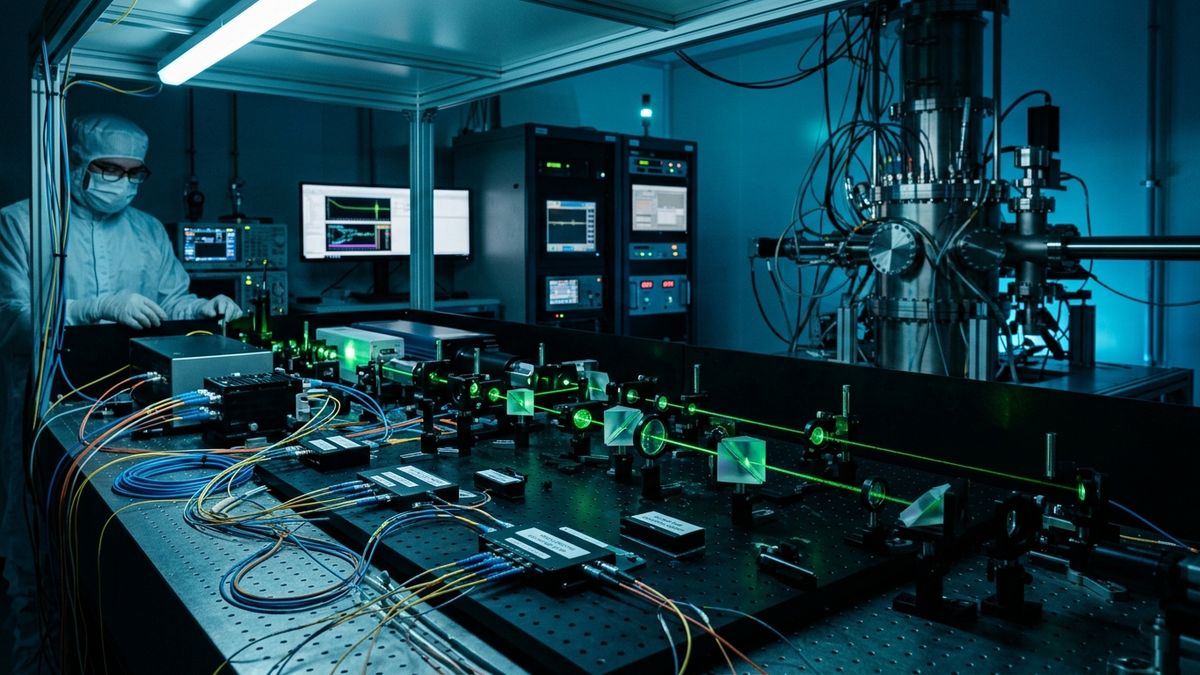
Indian deeptech startup Quanfluence raises $10 million in Series A funding to fabricate room-temperature photonic quantum computing processors and quantum cloud algorithms.
Indian deeptech venture Quanfluence has raised $10 million in a Series A funding round to advance the development of its full-stack photonic quantum computer. The capital commitment marks one of the most substantial private investments in India's frontier quantum hardware ecosystem, establishing the domestic startup as a formidable contender in the global race to commercialize scalable, fault-tolerant quantum computing systems.
The round was backed by premier international deeptech venture capital syndicates, domestic innovation funds, and institutional tech operators. Quanfluence will utilize the capital to tape out proprietary silicon photonic integrated circuits (PICs), expand its optical cleanroom laboratories, and build out its hybrid quantum-classical software development kit (SDK).
The Photonic Advantage in Quantum Information Processing
The global quantum computing landscape is divided across several competing physical architectures: superconducting transmon qubits, trapped-ion systems, neutral atoms, and photonics.
While superconducting systems (championed by IBM and Google) have demonstrated early quantum supremacy, they suffer from a major engineering limitation: superconducting circuits must be cooled to fractions of a Kelvin above absolute zero (-273.15°C) inside bulky, energy-intensive dilution refrigerators. This cryogenic requirement severely constrains system scaling, datacenter deployment, and inter-qubit networking.
Quanfluence sidesteps this cryogenic bottleneck by harnessing photons—particles of light—as information-carrying qubits. Photons do not readily interact with their thermal environment, meaning they experience negligible thermal decoherence even at room temperature.
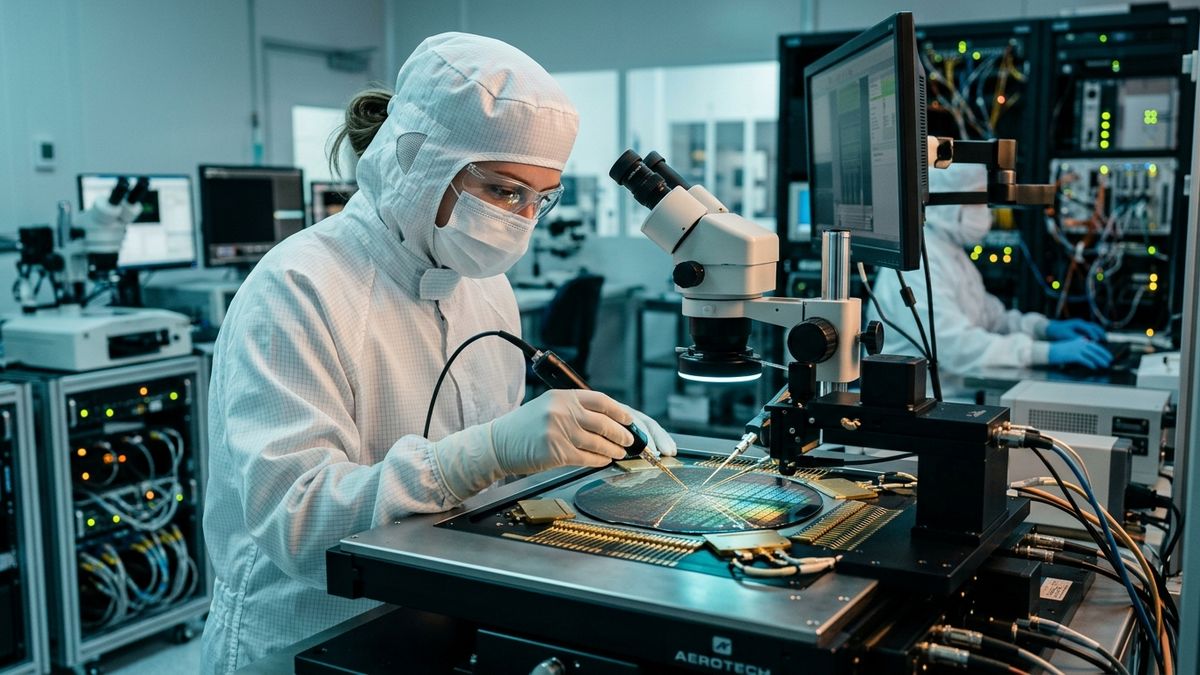
By etching nanoscale optical waveguides, directional couplers, phase shifters, and single-photon detectors directly onto silicon wafers, Quanfluence can leverage standard commercial semiconductor foundries to manufacture quantum processors at immense scale.
"Photonic quantum computing transforms quantum mechanics into a microelectronics and photonics manufacturing challenge,"stated Quanfluence leadership. "By building our architecture on silicon photonics, we eliminate cryogenic complexity and unlock seamless integration with global fiber-optic telecommunications infrastructure."
This deep silicon and hardware innovation complements broader sovereign hardware advances in India, including BigEndian's indigenous edge AI silicon supported under the DLI scheme and enterprise cloud infrastructure hosting local AI inference.
Architectural Comparison Across Quantum Modalities
The table below benchmarks Quanfluence's photonic approach against leading alternative quantum computing architectures:
| Architectural Metric | Photonic Quantum (Quanfluence) | Superconducting (IBM/Google) | Trapped-Ion (IonQ/Quantinuum) |
|---|---|---|---|
| Operating Temperature | Room Temperature / Mild Peltier | Extreme Cryogenic (< 15 mK) | Ultra-High Vacuum / Cryogenic |
| Decoherence Susceptibility | Extremely Low (Photons inert to EM) | High (Vulnerable to thermal noise) | Low (Isolated atomic states) |
| Manufacturing Foundry | Standard Silicon Photonic CMOS | Custom Superconducting Fabs | Custom Specialized Vacuum Traps |
| Networking & Interconnects | Native Telecom Optical Fiber | Complex Microwave-to-Optical Converters | Optical Cavity Interconnects |
| Gate Speed | Terahertz Optical Speeds | Megahertz Microwave Speeds | Kilohertz Laser-Pulse Speeds |
| Primary Engineering Challenge | Deterministic Photon Generation | Cryogenic Scaling & Wiring Bottleneck | Slow Gate Speeds & Scaling Limits |
Full-Stack Roadmap: From Silicon Photonic Chips to Cloud SDK
Quanfluence is building a complete full-stack quantum technology platform comprising three tightly coupled layers:
1. Photonic Quantum Processing Unit (QPU): Silicon photonic chips containing arrays of squeezed-light sources, reconfigurable interferometer meshes, and high-efficiency superconducting nanowire single-photon detectors (SNSPDs).
2. Control & Cryo-Peltier Packaging: High-speed FPGA-based electronic controllers that tune electro-optic phase shifters at gigahertz frequencies, dynamically compensating for optical loss and drift.
3. Quantum-Classical Hybrid Software Platform: A cloud-accessible compiler that translates complex mathematical optimization, quantum chemistry, and linear algebra problems into optical gate sequences executed across the QPU.
The company plans to deploy initial quantum cloud access to academic researchers and enterprise partners within the financial modeling, pharmaceutical drug discovery, and logistics routing industries.
Strategic Alignment with India's National Quantum Mission
Quanfluence's $10 million milestone arrives at a pivotal moment for domestic frontier technology. In 2023, the Union Cabinet approved the National Quantum Mission (NQM) with an outlay of ₹6,003 crore, establishing national targets to build intermediate-scale quantum computers with 50 to 1,000 physical qubits by 2031.
While public research institutes like TIFR, IISc, and IIT Madras have laid theoretical foundations, venture-backed startups like Quanfluence provide the commercial speed, engineering rigor, and intellectual property necessary to translate scientific breakthroughs into deployable enterprise hardware.
The platform's compute capacity will eventually interface with high-performance supercomputing data centers and AI cloud infrastructure deployed across the country.
Commercial Applications on the Horizon
Quantum advantage in photonic computing is expected to unlock breakthrough solutions across critical industrial domains:
- Materials Science & Battery Chemistry: Simulating complex molecular orbitals and electrolyte interactions to design next-generation solid-state electric vehicle batteries without years of empirical lab trial-and-error.
- Financial Portfolio Optimization: Solving combinatorial optimization problems—such as non-linear arbitrage, risk balancing, and fraud detection—in milliseconds rather than hours on classical mainframes.
- Supply Chain & Combinatorial Logistics: Determining optimal shipping routes and fleet schedules across complex multivariable global supply networks.
Future Outlook for Indian Quantum Deeptech
With $10 million in fresh capital, an experienced team of optical physicists and silicon designers, and the backing of global deeptech institutions, Quanfluence is positioned to spearhead India's quantum leap.
By turning silicon photonics into a practical quantum computational engine, the company demonstrates that Indian deeptech has evolved beyond software applications to compete at the cutting edge of global physics and hardware innovation.
Frequently Asked Questions
What is Quanfluence developing?
Quanfluence is an Indian deep-tech startup building a full-stack photonic quantum computer that utilizes photons (particles of light) manipulated through silicon photonic integrated circuits to perform high-speed quantum computations.
Why is photonic quantum computing advantageous over superconducting approaches?
Unlike superconducting qubits (used by IBM or Google) that require massive dilution refrigerators operating near absolute zero (-273°C), photonic qubits experience minimal thermal decoherence, allowing room-temperature or near-room-temperature operation and compatibility with standard telecommunications fiber-optics.
How will the $10 million Series A capital be deployed?
The funds will finance semiconductor foundry tape-outs for specialized photonic chips, expansion of laser optical laboratories, procurement of high-precision test instrumentation, and hiring top quantum physicists and quantum software engineers.
How does Quanfluence align with India's National Quantum Mission (NQM)?
The investment directly supports the targets of the Indian Government's ₹6,000-crore National Quantum Mission (NQM), which aims to build intermediate-scale quantum computers with 50 to 1,000 physical qubits within domestic research facilities.
Primary Sources & Official References
- Department of Science and Technology (DST): National Quantum Mission Guidelines
- Quanfluence Technologies Private Limited: Photonic Microarchitecture Technical Whitepaper
- Nature Photonics: Room-Temperature Optical Quantum Computing Scaling Benchmarks
- IEEE Quantum Week: Photonic Circuit Architectures for Hybrid Quantum-Classical Workloads