India's deeptech ecosystem accelerates toward sovereign AI infrastructure, post-quantum cryptography, and hybrid quantum computing as financial institutions and government agencies race to counter future decryption threats.
Executive Key Takeaways
- India's deeptech ecosystem accelerates toward sovereign AI infrastructure, post-quantum cryptography, and hybrid quantum computing as financial institutions and government agencies race to counter future decryption threats.
- Quantum supremacy will render classical public-key cryptography obsolete virtually overnight, cautioned a senior cybersecurity advisor to the Indian financial sector. The transition to post-quantum cryptography is not a distant theoretical exercise—it is an operational mandate that must be executed across banking mainframes and communication channels today to safeguard national financial sovereignty.
- Key Benchmark: **Public Key Exchange** — RSA-2048 / ECC-256
India's advanced technology ecosystem is undergoing an urgent structural transition toward sovereign artificial intelligence infrastructure, post-quantum cryptography (PQC), and high-performance quantum computing (HPC), galvanized by aggressive adoption across tier-1 financial institutions, defence establishments, and deeptech ventures. Catalyzed by the Union Government's ₹6,003-crore National Quantum Mission (NQM) and surging sovereign compute investments, domestic banks, clearing corporations, and telecom networks are deploying Quantum Key Distribution (QKD) and NIST-standardized quantum-resistant algorithms to neutralize the impending threat of quantum cryptographic compromise.
This convergence of sovereign compute clusters and quantum-resilient cyber defences reflects a broader national recognition that future economic security and computational sovereignty depend on mastering both silicon and quantum photonics.
The Post-Quantum Cryptographic Imperative in Indian BFSI
At the center of this acceleration is the banking, financial services, and insurance (BFSI) sector. Modern digital banking, payment clearinghouses, and inter-bank communication protocols rely on public-key cryptographic standards—principally RSA and Elliptic Curve Cryptography (ECC)—which are mathematically vulnerable to factorization by fault-tolerant quantum computers running Shor's algorithm.
Security agencies and financial regulators are particularly focused on the imminent danger of "Harvest Now, Decrypt Later" (HNDL) attacks. Hostile foreign actors and sophisticated cyber adversaries are actively intercepting and archiving encrypted financial transaction streams, confidential biometric databases, and sovereign diplomatic communications, awaiting the arrival of commercially viable quantum processors to decrypt them retrospectively.
In response, the Reserve Bank of India (RBI) and the National Payments Corporation of India (NPCI) have issued strict advisories urging financial institutions to achieve "cryptographic agility." As detailed in our analysis of RBI's warnings on technology concentration risks across Indian banking, systemic resilience requires diversifying foundational security stacks away from legacy single points of failure.
"Quantum supremacy will render classical public-key cryptography obsolete virtually overnight,"cautioned a senior cybersecurity advisor to the Indian financial sector. "The transition to post-quantum cryptography is not a distant theoretical exercise—it is an operational mandate that must be executed across banking mainframes and communication channels today to safeguard national financial sovereignty."
Convergence of AI Supercomputing Clusters and Quantum Simulation
The quantum transition is unfolding alongside an unprecedented buildout of sovereign high-performance computing infrastructure. The computational demands of training complex neural networks and simulating quantum algorithms share fundamental physical and architectural foundations: massive parallel processing, ultra-low-latency interconnects, and advanced liquid cooling.
India's computational landscape is expanding at record pace, with India's AI data centre capacity crossing 2.1 GW and institutional facilities like the Navi Mumbai AI data centre securing ₹75 crore in funding. High-density GPU clusters within these facilities are increasingly utilized for hybrid quantum-classical computing, executing tensor network contractions and Variational Quantum Eigensolvers (VQE) to accelerate drug discovery, semiconductor material design, and complex algorithmic portfolio hedging.
Deeptech Infrastructure Benchmark: Classical vs. Quantum-Resilient Security
The comparative table below highlights the architectural transition underway across India's digital security and computational infrastructure:
| Infrastructure Layer | Classical Architecture | Quantum-Resilient Architecture | Threat Neutralized | Key Adopters & Implementers |
|---|---|---|---|---|
| Public Key Exchange | RSA-2048 / ECC-256 | ML-KEM (Kyber) Lattice-based Cryptography | Shor's Algorithm Quantum Decryption | RBI Innovation Hub, NPCI, HDFC Bank |
| Digital Signatures | ECDSA / RSA Signatures | ML-DSA (Dilithium) & SLH-DSA (SPHINCS+) | Quantum Forgery & Signature Tampering | Stock Exchanges (NSE/BSE), UIDAI |
| Core Backbone Transmission | Standard Fibre Optic SSL/TLS | Quantum Key Distribution (QKD) Photonic Link | Physical Fibre Tapping & Interception | Indian Defence Forces, C-DOT, ISRO |
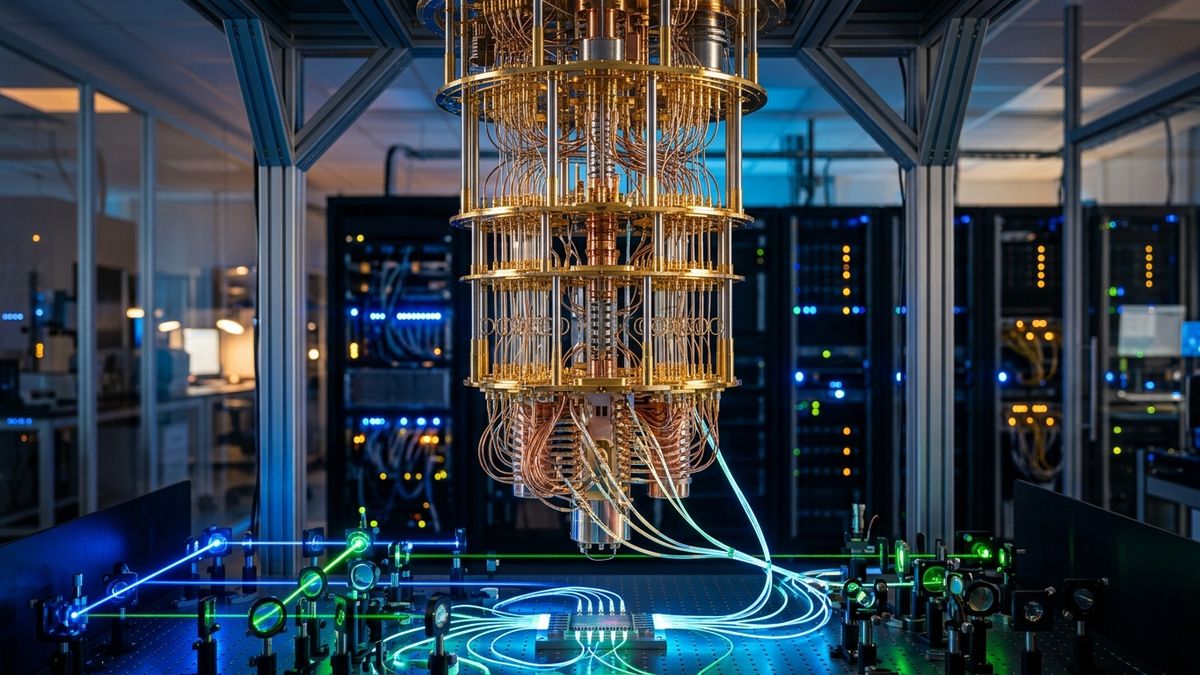
| Computational Hardware | Homogeneous x86/GPU Clusters | Hybrid GPU-Quantum Processing Units (QPUs) | Classical Simulation Scaling Limits | C-DAC PARAM Rudra, IIT Madras, IISc |
| Data Storage Protection | Standard AES-128 Encryption | AES-256 with Quantum Random Generators (QRNG) | Grover's Algorithm Brute-Force Attacks | Sovereign Data Centres, Cloud Providers |
Domestic Innovation Ecosystem: Startups Leading Hardware and Algorithmic Stacks
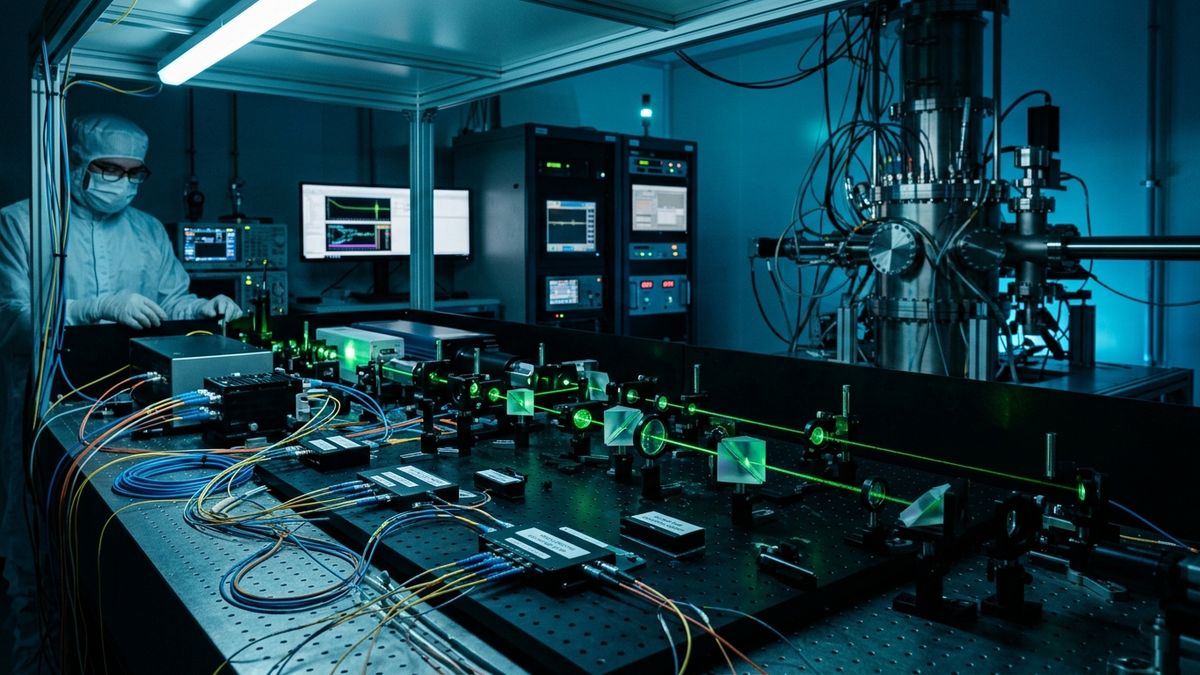
India's private deeptech ecosystem is rapidly closing the gap with global quantum leaders. Startups such as Bengaluru-based QNu Labs have successfully deployed commercial QKD systems over metropolitan optical fibre networks for defence communications and financial data centers, ensuring physically unhackable quantum-encrypted transmission.
Concurrently, deeptech ventures like BosonQ Psi are pioneering quantum software algorithms designed to run on near-term Noisy Intermediate-Scale Quantum (NISQ) systems, assisting automotive and aerospace manufacturers in simulating fluid dynamics and battery electrochemistry.
These domestic engineering breakthroughs are further reinforced by strategic international pacts, including India and Russia signing landmark technology cooperation deals in AI and high-performance computing.
Sovereign Strategic Roadmap: Towards Indigenous Quantum Processors
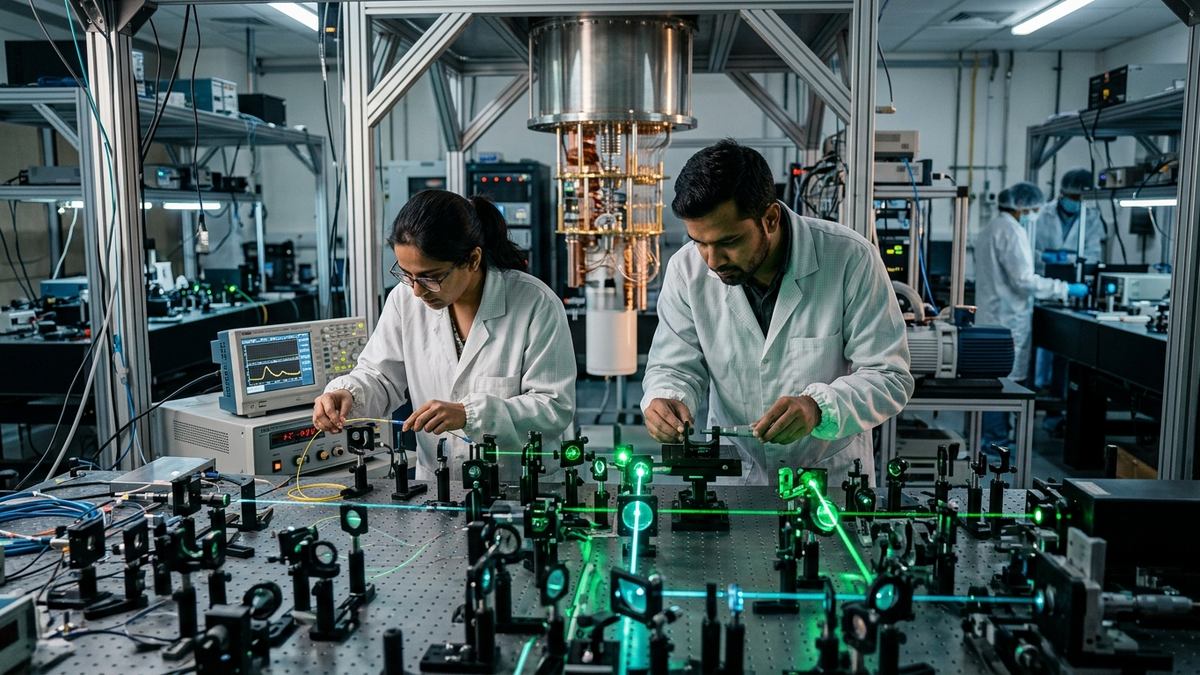
Under the National Quantum Mission, research consortiums across the Indian Institute of Science (IISc), Tata Institute of Fundamental Research (TIFR), and various Indian Institutes of Technology (IITs) are working to construct indigenous 50-to-100 physical qubit quantum processors within the next three to four years.
Efforts are concentrated across four primary technological architectures: superconducting circuits, photonic waveguides, trapped-ion traps, and silicon spin qubits. By simultaneously fostering domestic hardware fabrication, cryogenic control electronics, and post-quantum software algorithms, India is ensuring that its economic infrastructure remains secure, sovereign, and technologically dominant in the emerging quantum era.