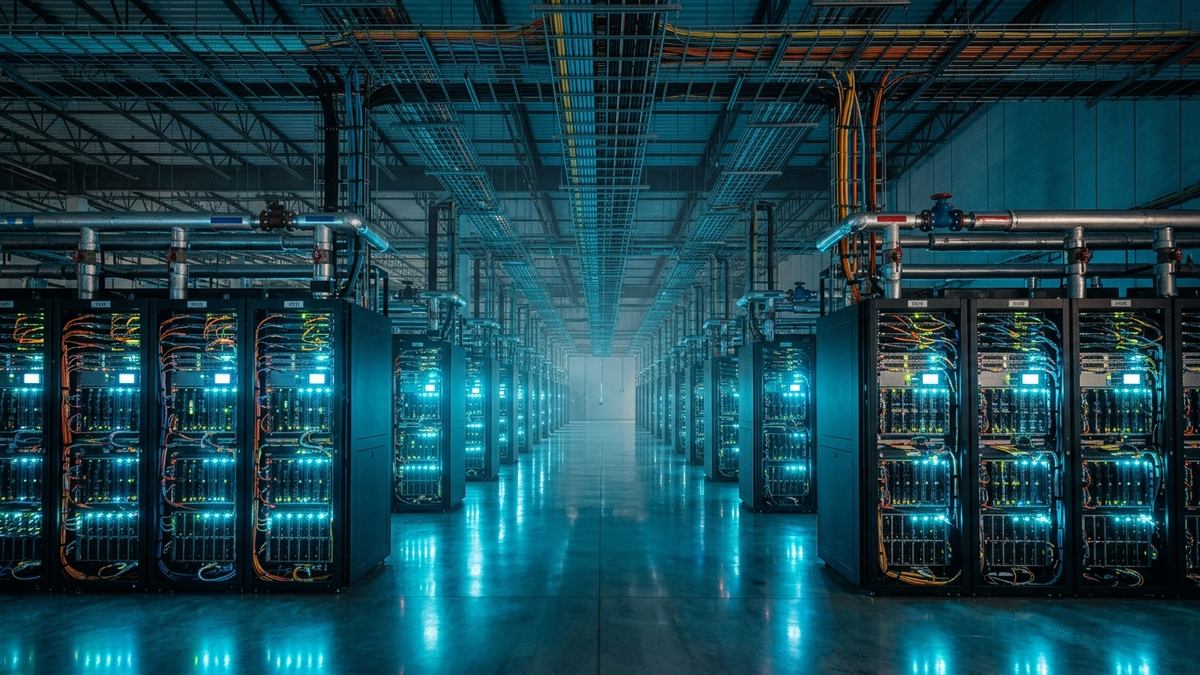
Samsung Opens Dedicated AI Cooling & Thermal Management Facility in Pune for Next-Gen Data Centres
By Karthik Ramaswamy | Published August 14, 2026 | 7 min read
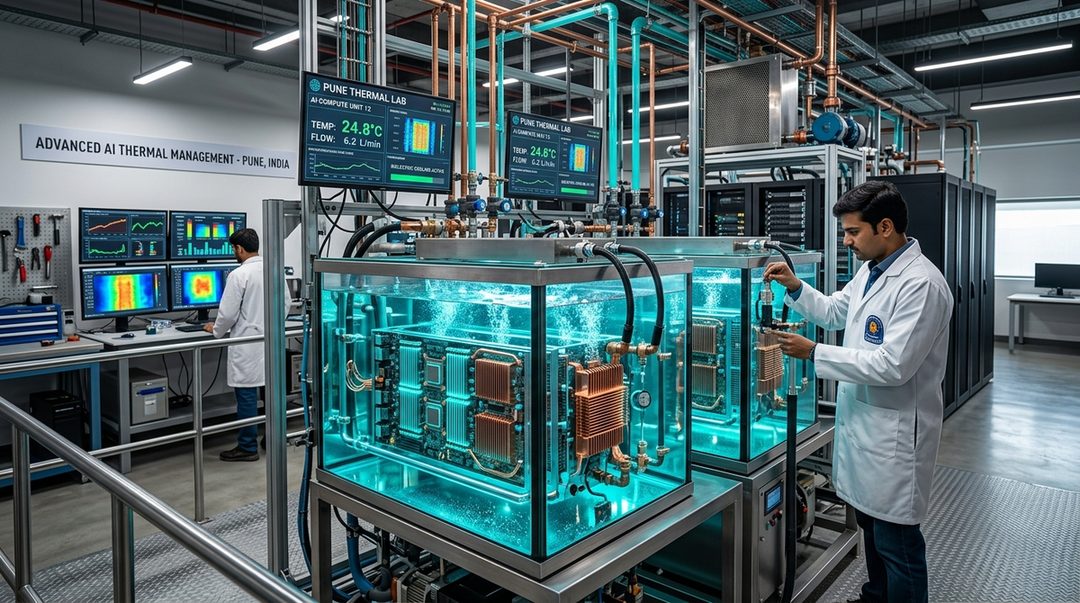
Samsung inaugurates a cutting-edge thermal engineering facility in Pune to pioneer AI-driven direct-to-chip and immersion liquid cooling for high-density AI data centres.
Global electronics and semiconductor leader Samsung has inaugurated a state-of-the-art AI Cooling & Thermal Management Research Facility in Pune, Maharashtra. The cutting-edge engineering centre is dedicated to researching, prototyping, and validating advanced two-phase immersion cooling, direct-to-chip microfluidic cooling plates, and AI-orchestrated dynamic thermal regulation systems engineered specifically for ultra-dense AI data centres and high-performance semiconductor clusters.
As next-generation AI accelerators exceed 1,000 watts per chip, conventional air-cooling systems are rapidly approaching physical thermodynamic limits. Samsung’s Pune facility will serve as the company’s global hub for engineering sustainable, energy-efficient thermal solutions that dramatically lower power consumption across hyperscale cloud infrastructures.
The Physics of Dense Compute: The Thermal Crisis in AI
Modern GPU architectures such as NVIDIA Blackwell and custom enterprise ASICs generate unprecedented localized heat flux, frequently exceeding 100 Watts per square centimeter at the silicon die surface. Air cooling is structurally incapable of dissipating this thermal load without requiring massive parasitic fan energy, which drastically inflates data centre operating expenditures and carbon footprints.
Samsung’s new Pune facility houses specialized fluid dynamics laboratories, environmental climate simulation chambers, and live 200 kW high-density test benches to benchmark thermal dissipation across various dielectric fluids and microchannel cold-plate geometries.
"Thermal management has become the single most critical engineering bottleneck in scaling artificial intelligence compute,"said Dr. Kyung-Tae Park, Executive Vice President and Head of Global R&D at Samsung Electronics. "Our Pune facility brings together world-class Indian mechanical, chemical, and software engineers to develop closed-loop liquid and immersion cooling technologies that will reduce data centre cooling energy by up to 45% while enabling record compute densities."
This R&D milestone highlights India’s expanding role in core hardware engineering, aligning with Samsung’s broader investments highlighted in Samsung Galaxy AI engineering in India and national precision aerospace and mechanical hubs detailed in India's precision engineering revolution.
Thermal Engineering Comparison: Cooling Architectures Benchmarked
Samsung's research engineers in Pune are benchmarking multiple cooling topologies to establish optimal PUE and operational efficiency:
| Thermal Cooling Architecture | Max Supported Chip TDP | System PUE Contribution | Water Consumption (L/MWh) | Cooling Energy Reduction |
|---|---|---|---|---|
| Conventional Air Cooling (CRAC/CRAH) | Up to 450 W | 1.45 – 1.65 | 1,800 – 2,400 L | Baseline (0%) |
| Single-Phase Direct-to-Chip (Liquid Cold Plates) | 800 W – 1,200 W | 1.15 – 1.25 | 400 – 600 L | 30% – 35% Savings |
| Two-Phase Direct-to-Chip (Evaporative Microchannels) | 1,200 W – 1,800 W | 1.08 – 1.14 | < 150 L | 40% – 45% Savings |
| Two-Phase Liquid Immersion Cooling (Submerged Tanks) | 2,000 W+ | 1.03 – 1.06 | Zero (Closed Loop) | 50%+ Savings |
AI-Driven Predictive Thermal Regulation
Beyond mechanical hardware, the Pune facility is pioneering proprietary AI-driven thermal orchestration software. By integrating thousands of micro-thermocouple sensors embedded directly into server motherboards and coolant manifolds, deep learning models predict heat spikes milliseconds before heavy tensor workloads execute.
The predictive system dynamically modulates coolant pump flow rates, valve apertures, and chiller compression cycles in real time. This dynamic tuning eliminates thermal shock on delicate silicon microstructures, extending server component lifespan by up to 25% while ensuring zero wasted pumping power.
Advancing Sustainable Green Data Centres
With hyperscale cloud providers committing to net-zero carbon targets by 2030, energy-efficient liquid cooling is transitioning from a niche specialty to an absolute enterprise necessity.
Samsung’s investment in Pune cements India’s position not just as a software application hub, but as an indispensable centre for foundational thermodynamic research and hardware engineering powering the global AI revolution.