India’s AI Data-Centre Buildout Accelerates: NaBFID Sanctions ₹3,000+ Crore Debt Loans for Next-Gen Compute Hubs
By Karthik Ramaswamy | Published September 18, 2026 | 9 min read
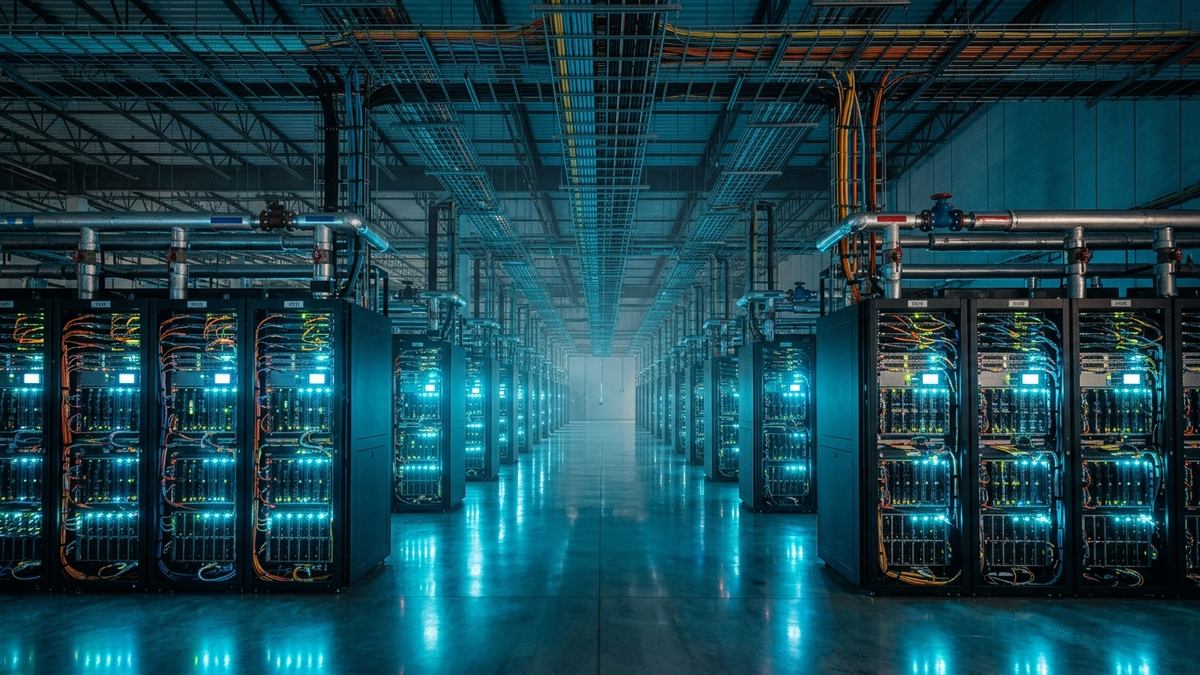
NaBFID sanctions over ₹3,000 crore in long-term debt financing across four major data centre projects to support surging hyperscale AI compute workloads.
India’s sovereign push to establish world-class artificial intelligence infrastructure has received a massive institutional capital infusion, with the National Bank for Financing Infrastructure and Development (NaBFID) sanctioning over ₹3,000 crore ($360+ million) in structured long-term loans across at least four major hyperscale data centre developments. The debt sanctions reflect skyrocketing enterprise demand for high-density compute, specialized GPU blade clusters, direct-to-chip liquid cooling architectures, and uninterrupted multi-megawatt power infrastructure as artificial intelligence workloads transition from experimental pilots to full production deployment.
Historically, Indian data centres were designed for standard enterprise cloud hosting, requiring modest power densities of 4 to 8 kilowatts (kW) per rack. In stark contrast, modern AI supercomputing clusters running Nvidia H100, Blackwell B200, or custom ASIC accelerators demand anywhere from 40 kW to upwards of 100 kW per rack. Meeting this computational intensity requires fundamentally re-engineering power distribution, substation redundancy, and thermal management.
Strategic Mandate: Long-Tenure Debt for Digital Capital Assets
NaBFID, India’s premier development finance institution established by an Act of Parliament, is playing an indispensable role in closing the capital gap for long-gestation digital infrastructure. Unlike commercial banks, which often enforce rigid 5-to-7-year repayment tenures and stringent asset-liability matching constraints, NaBFID provides patient 15-to-20-year structured project debt with competitive interest amortization.
The ₹3,000+ crore financing envelope targets four major developments situated across high-growth digital corridors:
* Navi Mumbai AI Compute Corridor: Expanding hyperscale coastal landing stations with submarine cable termination, delivering sub-10ms latency to financial institutions in Mumbai.
* Hyderabad Megawatt Hub: Co-locating next to dedicated solar-wind hybrid parks to secure 24/7 green power tariffs below ₹4.50 per kWh.
* Chennai Subsea Gateway: Providing direct international subsea optical fiber connectivity to Southeast Asia and Europe.
* Noida Digital Zone: Catering to sovereign government data localization mandates, defence compute, and North Indian enterprise workloads.
"Data centres are the physical backbone of the modern digital economy, and AI has fundamentally reshaped their technical and financial profile,"stated senior infrastructure lending officers at NaBFID. "By extending structured long-term debt financing to Tier-4 and hyperscale AI-ready facilities, we are ensuring India builds sovereign compute capacity capable of supporting national foundational models without relying on overseas hosting."
Engineering Innovations: Overcoming the Thermal and Power Barrier
Operating high-density AI clusters introduces extreme mechanical and electrical engineering challenges. Traditional computer room air handling (CRAH) units and raised-floor air cooling systems are completely incapable of dissipating 100 kW per rack.
The facilities receiving NaBFID debt financing are incorporating cutting-edge thermal designs:
1. Direct-to-Chip (D2C) Liquid Cooling: Circulating dielectric cooling fluids directly through copper micro-channel cold plates mounted on high-power GPUs and CPUs, removing 70–80% of heat directly at the silicon die level.
2. Rear-Door Heat Exchangers (RDHx): Using closed-loop chilled water coils integrated into rack doors to neutralize residual exhaust heat before it enters the server hall.
3. Power Usage Effectiveness (PUE) Optimization: Driving annualized PUE down from industry averages of 1.65 to below 1.25, significantly reducing carbon intensity and operational power overhead.
These engineering breakthroughs complement domestic innovations such as Samsung's dedicated AI cooling and thermal facility in Pune and Navi Mumbai’s Avisirah Technologies securing ₹75 Cr debt financing for high-performance AI compute.
Technical Specifications: Traditional Cloud vs. Next-Gen AI Data Centres
The matrix below illustrates the engineering parameters distinguishing conventional cloud server farms from the NaBFID-financed AI hyperscale facilities:
| Engineering Dimension | Traditional Cloud Facility | NaBFID-Financed AI Supercentre | Performance Multiple |
|---|---|---|---|
| Rack Power Density | 5 – 8 kW per rack | 40 – 100+ kW per rack | 8x – 12x Density Increase |
| Cooling Architecture | Perimeter CRAH / Chilled Air | Direct-to-Chip Liquid & Immersion | 4x Heat Dissipation Efficiency |
| PUE Benchmark | 1.55 – 1.70 | 1.20 – 1.28 | ~30% Energy Reduction |
| Optical Network Fabric | 25G / 100G Leaf-Spine Ethernet | 400G / 800G InfiniBand & RoCEv2 | 8x Bandwidth, Ultra-Low Latency |
| Substation Redundancy | N+1 Transformer Grid | 2N Dual-Grid Substation + BESS | 99.999% Fault-Tolerant Uptime |
| Floor Loading Capacity | 1,000 – 1,200 kg/sqm | 2,500 – 3,500 kg/sqm | Structural Support for Heavy Liquid Racks |
Capital Synergy and the National Compute Pipeline
NaBFID’s ₹3,000+ crore loan deployment arrives amid unprecedented momentum in Indian sovereign computing. Private equity consortiums, sovereign wealth funds, and domestic conglomerates—such as the Tata Group committing up to ₹70,000 crore across digital campuses, as seen in TCS's 1 GW AI data centre investment in Hyderabad—are actively co-investing.
Furthermore, dynamic power management innovations, such as Infineon’s acquisition of Bengaluru startup C2i Semiconductors for data centre power silicon, highlight how domestic silicon design directly enhances power supply efficiency across these massive facilities.
Strategic Outlook for Sovereign AI Capacity
As these four facilities break ground and energize over the next 18 to 30 months, they will add an estimated 350 to 450 megawatts of critical high-density IT load capacity to India's digital grid. By establishing indigenous capital pipelines and world-class thermal engineering standards, India is ensuring that its foundational AI algorithms and enterprise datasets remain securely hosted on domestic soil.