The newly unveiled ₹250 Crore TILT Fund will invest in early-stage Indian startups leveraging AI, IoT, and clean technologies to solve climate, MSME supply chain, and employment challenges.
Executive Key Takeaways
- The newly unveiled ₹250 Crore TILT Fund will invest in early-stage Indian startups leveraging AI, IoT, and clean technologies to solve climate, MSME supply chain, and employment challenges.
- For too long, venture capital in India chased paper valuations in hyper-funded consumer niches while the biggest economic friction points—MSME liquidity, industrial emissions, and decentralized healthcare—remained starved of top-tier engineering talent, remarked the Managing Partner of TILT Fund. The TILT Fund proves that high impact and market-leading financial returns are not mutually exclusive. When you build deep technology to solve genuine existential problems for 1.4 billion people, you create massive, defensible enterprise value.
- Key Benchmark: **Financial Return Expectations** — 0% (Capital is consumed as non-repayable grants)
MUMBAI — Marking a critical maturation in India’s venture capital landscape, the ₹250 Crore TILT Fund has been officially launched to provide institutional early-stage backing to Indian impact startups leveraging frontier technology, artificial intelligence, and hardware to solve national climate, employment, and MSME challenges.
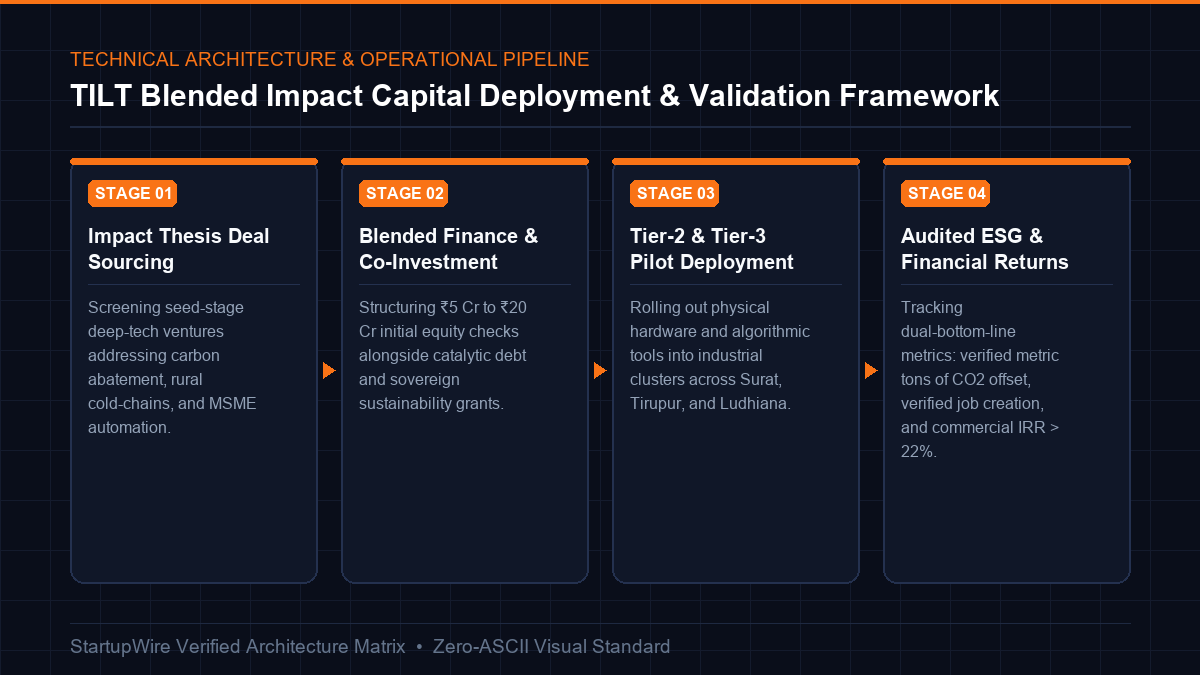
Structured as a specialized Alternative Investment Fund (AIF Cat-II), the TILT Fund seeks to bridge the critical "pioneer gap" where technical innovators building deep-tech solutions for decarbonization, agricultural resilience, and informal workforce enablement struggle to raise capital from conventional consumer-focused venture firms. The fund plans to deploy initial equity tickets ranging from ₹5 Crore to ₹20 Crore across 20 to 25 early-stage ventures, with substantial reserves earmarked for follow-on Series A and Series B rounds.
This launch reinforces the broader institutional reallocation of capital toward defensible moats, as analyzed in Deeptech Draws Growing Investor Attention: Why Global VCs Are Shifting Billions into Hard-Tech, and aligns with regional funding vehicles like the Tamil Nadu ₹50 Crore AI & Deep-Tech Fund.
The Four Strategic Investment Pillars of TILT
Rather than investing in speculative consumer apps or copycat ecommerce models, the TILT Fund has architected a disciplined four-pillar investment thesis focused on foundational economic challenges:
1. Climate Transition & Circular Economy: Decentralized solar microgrids, battery recycling, organic industrial chemistry, and thermal energy storage.
2. MSME Supply Chain Digitalization: Algorithmic invoice financing, predictive inventory routing, and automated compliance engines for India’s 63 million small enterprises.
3. Decentralized Healthcare & Cold-Chain Logistics: IoT-monitored vaccine and biological transport, portable automated diagnostic imaging for primary healthcare centers.
4. Inclusive Livelihoods & Technical Upskilling: AI-driven blue-collar skill assessment platforms that connect rural technicians with formal industrial employment.
"For too long, venture capital in India chased paper valuations in hyper-funded consumer niches while the biggest economic friction points—MSME liquidity, industrial emissions, and decentralized healthcare—remained starved of top-tier engineering talent,"remarked the Managing Partner of TILT Fund. "The TILT Fund proves that high impact and market-leading financial returns are not mutually exclusive. When you build deep technology to solve genuine existential problems for 1.4 billion people, you create massive, defensible enterprise value."
Investment Model Comparison: Traditional Philanthropy vs Pure VC vs TILT Fund
The systemic differences between impact capital vehicles operating in India are highlighted below:
| Investment Characteristic | Traditional Grant / Philanthropy | Conventional Tech VC (Silicon Valley Model) | TILT Blended Impact Venture Model |
|---|---|---|---|
| Financial Return Expectations | 0% (Capital is consumed as non-repayable grants) | 30%+ Target IRR (High tolerance for 90% failure) | 22% – 26% Target Commercial Market IRR |
| Technology Focus | Low-tech community interventions | Software wrappers, D2C brands, Quick-Commerce | Hard-Tech, IoT Hardware, and Vertical AI |
| Target Beneficiary Segment | Subsidized base-of-pyramid aid | Urban top 5% consumer demographic | Tier-2/3 MSMEs, Agricultural & Climate Hubs |
| Capital Recirculation | None (Requires constant philanthropic donor funding) | Liquidity via secondary sales and public IPOs | Commercial Exits via M&A and Strategic Buyouts |
| Impact Measurement Rigor | Qualitative narrative reporting | Neglected (Focus purely on GMV and revenue growth) | Audited Metric Tons of CO2 Offset & Real Job Multipliers |
| Follow-on Capital Support | Extremely limited | High for hyper-scalers | Dedicated 50% Reserve for Follow-on Series A/B |
Catalyzing the Next Era of Inclusive Venture Capital
By embedding rigorous engineering diligence alongside audited ESG impact benchmarks, the TILT Fund provides a blueprint for institutional limited partners (LPs)—including domestic banks, sovereign wealth entities, and family offices—to deploy capital into India’s real economy.
As analyzed in India Leads Forbes Asia 100 to Watch: 19 Startups Crowned, the startups generating the most sustainable long-term value are those combining cutting-edge technical architectures with measurable economic empowerment.