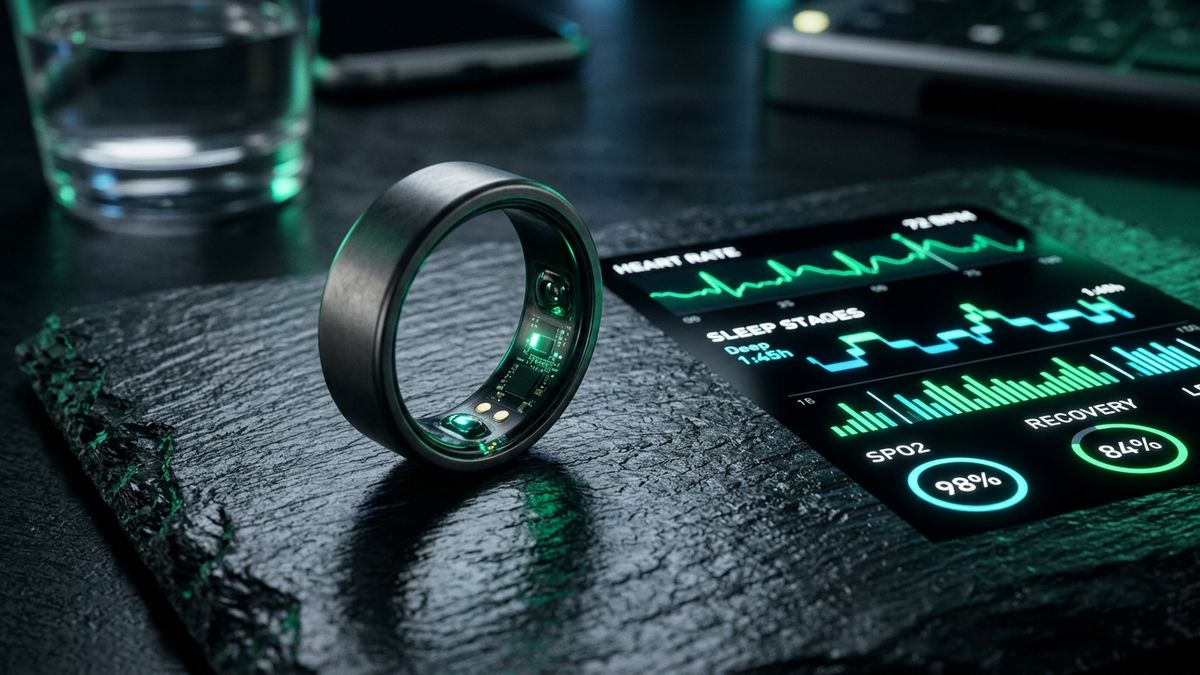
Smart-ring pioneer Ultrahuman raises $70 million backed by Qualcomm Ventures to scale domestic manufacturing, low-power edge silicon, and global wearable healthtech distribution.
Executive Key Takeaways
- Smart-ring pioneer Ultrahuman raises $70 million backed by Qualcomm Ventures to scale domestic manufacturing, low-power edge silicon, and global wearable healthtech distribution.
- Continuous metabolic tracking cannot rely on cloud round-trips for immediate physiological insights, noted Mohit Kumar, Founder and CEO of Ultrahuman. Our collaboration with Qualcomm accelerates on-device neural processing, enabling our wearable hardware to infer metabolic recovery states and circadian rhythm alignments directly on the user's hand with negligible battery drain.
- Key Benchmark: **Chassis Material & Weight** — Aerospace Titanium (2.4g – 3.6g)
BENGALURU — In a landmark validation of India's consumer deeptech and hardware engineering capabilities, smart-ring and continuous health-monitoring pioneer Ultrahuman has raised $70 million in a new funding round backed by Qualcomm Ventures, alongside continued participation from existing institutional investors Alpha Wave Global, Blume Ventures, and 3one4 Capital. The capital infusion comes as the Bengaluru-headquartered company experiences triple-digit international revenue growth, intensifying competition against Finland's Oura Health and Samsung's newly launched Galaxy Ring.
The investment underscores a structural shift in consumer wellness: the rapid convergence of ultra-low-power edge silicon, continuous physiological tracking, and predictive metabolic intelligence. Ultrahuman plans to allocate the capital towards expanding its automated manufacturing and cleanroom packaging facilities in Bengaluru, scaling its presence across premium retail networks in the United States and Europe, and co-developing specialized sensor algorithms with Qualcomm's mobile and wearable platform engineers.
This milestone follows broader hardware and deeptech acceleration across the Indian ecosystem, paralleling insights discussed in The Agentic Shift in Indian IT and fintech liquidity patterns highlighted in RBI Operationalises Pre-Sanctioned Credit on UPI.
Silicon Meets Biometrics: The Architecture of the Ultrahuman Ring AIR
While first-generation fitness trackers relied heavily on bulky wristbands and periodic optical heart rate sampling, the smart-ring form factor demands an unprecedented degree of micro-engineering. Ultrahuman's flagship device, the Ring AIR, weighs just 2.4 grams and encapsulates multi-wavelength photoplethysmography (PPG) sensors, a clinical-grade skin temperature sensor, a 6-axis motion accelerometer, and on-board memory within a medical-grade hypoallergenic resin encased in a fighter-jet-grade titanium outer shell.
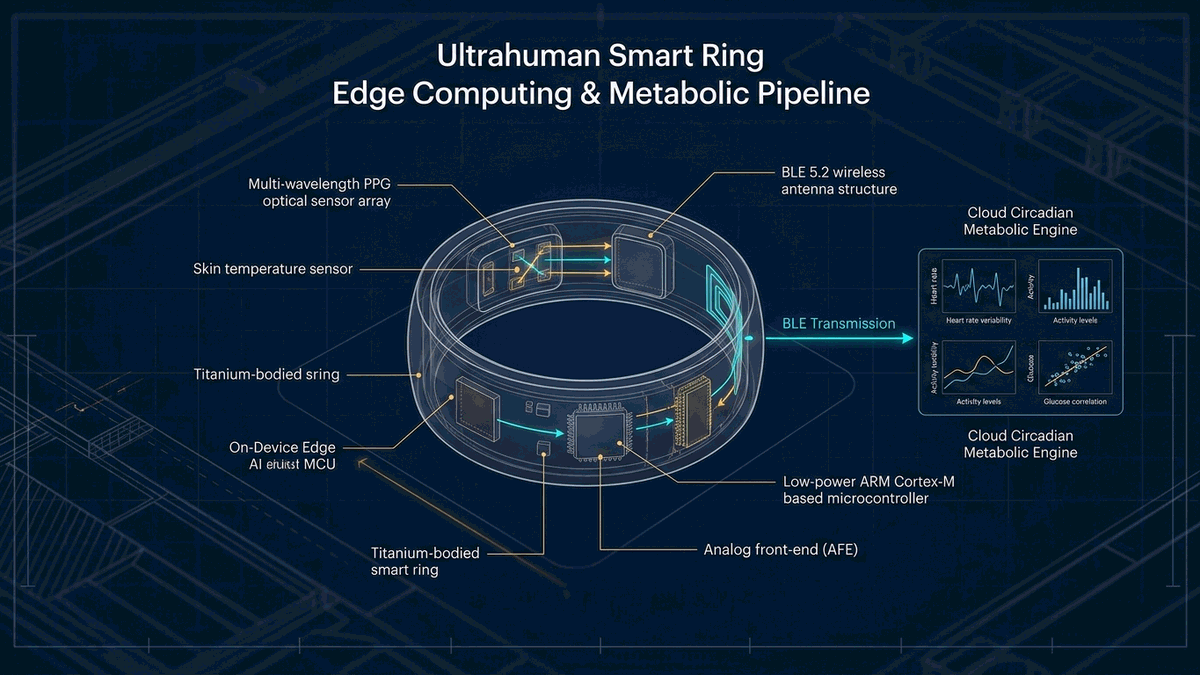
Sensor Integration and On-Device Processing
Unlike traditional wrist wearables that suffer from sensor displacement during nocturnal movement, the arterial network of the finger provides an exceptionally clean vascular signal for continuous biometric capture. The Ring AIR continuously monitors:
1. Heart Rate Variability (HRV): Measured in root mean square of successive differences (RMSSD) to quantify autonomic nervous system recovery and physiological stress in real-time.
2. Cardiovascular Drift & Skin Temperature: Micro-variations in peripheral temperature recorded with 0.1-degree Celsius resolution to predict circadian phase transitions and onset of illness.
3. Dynamic Sleep Architecture: High-frequency movement and pulse regularity parsing hypnograms into Light, Deep, and Rapid Eye Movement (REM) sleep cycles.
"Continuous metabolic tracking cannot rely on cloud round-trips for immediate physiological insights,"noted Mohit Kumar, Founder and CEO of Ultrahuman. "Our collaboration with Qualcomm accelerates on-device neural processing, enabling our wearable hardware to infer metabolic recovery states and circadian rhythm alignments directly on the user's hand with negligible battery drain."
Comparative Matrix: Ultrahuman Ring AIR vs. Global Competitors
The table below provides an exhaustive comparative breakdown between Ultrahuman, Oura, and Samsung across key hardware and commercial parameters:
| Engineering & Market Dimension | Ultrahuman Ring AIR | Oura Ring Gen 4 | Samsung Galaxy Ring |
|---|---|---|---|
| Chassis Material & Weight | Aerospace Titanium (2.4g – 3.6g) | Titanium Exterior (3.3g – 5.2g) | Grade 5 Titanium (2.3g – 3.0g) |
| Battery Life & Charging Cycle | 6 Days (100% in 90 minutes) | 7 Days (100% in 80 minutes) | 6 – 7 Days (Charging cradle) |
| Subscription / Paywall Model | Zero Subscription (Lifetime App Access) | $5.99 / Month Mandatory | Zero Subscription (Samsung Galaxy Only) |
| Silicon & Edge Processing | Custom Low-Power SoC + Qualcomm BLE | Nordic Semiconductor nRF53 | Samsung Custom Exynos Wearable IC |
| Metabolic Ecosystem Integration | Ultrahuman M1 (CGM) + Blood Vision + Home | Third-Party HealthKit / Strava Sync | Samsung Health Ecosystem Sync |
| Manufacturing Footprint | Indigenous Automated Line (Bengaluru, India) | Contract Manufacturing (Asia / Europe) | Samsung Production Lines (Vietnam / Korea) |
| Retail & Direct Channels | Direct Global D2C + Selfridges, Best Buy | Direct D2C + Amazon, Target | Carrier Stores, Best Buy, Samsung Direct |
The Qualcomm Strategic Alignment: Edge AI and Low-Power Compute
Qualcomm’s equity investment is not merely financial; it carries profound architectural implications for Ultrahuman's technology stack. Qualcomm Ventures has steadily expanded its footprint across smart sensing and edge intelligence. Integrating Qualcomm’s ultra-low-power microcontrollers and specialized neural processing units (NPUs) into next-generation Ultrahuman rings will enable:
- Sub-10-Milliamp Continuous PPG Sampling: Significantly prolonging battery cycles without compromising the temporal resolution of cardiac pulse wave velocity calculations.
- Local Biomarker Anomaly Detection: Identifying erratic cardiac arrhythmias or sudden febrile spikes directly on-chip, triggering immediate haptic or mobile alerts without awaiting background cloud synchronization.
- Unified Metabolic Fusion: Seamlessly blending continuous glucose monitor (CGM) interstitial data from the Ultrahuman M1 patch with pulse-wave metrics from the smart ring to compute real-time glycemic recovery scores.
Domestic Manufacturing and the Make-in-India Advantage
A standout competitive differentiator for Ultrahuman is its vertically integrated manufacturing facility in Bengaluru. While most Western wearable brands outsource assembly to contract manufacturers across East Asia, Ultrahuman established proprietary cleanrooms and precision micro-assembly lines in India. This structural advantage delivers:
- Rapid Prototyping Loops: Engineering teams can test and calibrate new casing geometries, antenna designs, and epoxy coatings within days rather than waiting for overseas shipping cycles.
- Resilient Supply Chains: Shielding the company from geopolitical tariff disputes and logistics bottlenecks that frequently disrupt consumer hardware fulfillment.
- Gross Margin Optimization: Maintaining gross margins above 65% by eliminating third-party contract manufacturing markups, allowing Ultrahuman to offer a zero-subscription commercial model while competitors impose recurring monthly fees.
Future Outlook: The Autonomous Preventive Health Frontier
As wearable health technology evolves from passive retrospective step-counting into proactive predictive diagnostics, Ultrahuman's capital injection positions the company to dominate the premium wellness tier. With deep pocketed tech conglomerates entering the ring form factor, Ultrahuman’s native ecosystem—encompassing the Ring AIR, continuous glucose monitoring patches, the Blood Vision biomarker laboratory, and the Ultrahuman Home indoor environmental monitor—creates a formidable data moat that turns raw physiological telemetry into actionable longevity intelligence.