Construction robotics startup Origin secures $20 million in Series A funding to scale heavy-payload building robots and target 150 deployments across commercial job sites.
Executive Key Takeaways
- Origin has closed a $20 million Series A financing round to scale commercial production of autonomous construction robots.
- The startup targets 150 active robot fleet deployments by late 2027 across high-rise commercial real estate and industrial building projects.
- Origin's physical AI stack integrates LiDAR SLAM, computer vision, and heavy-payload articulating arms to boost building speed by 40% while cutting structural waste.
Pioneering construction automation startup Origin has secured $20 million in a Series A financing round to scale commercial manufacturing of its autonomous building robots, establishing a clear milestone to deploy 150 robotic units across global construction sites by late 2027. The capital raise comes at a pivotal moment for the $12-trillion global construction industry, which continues to grapple with chronic skilled labor shortages, severe project delays, and climbing material costs.
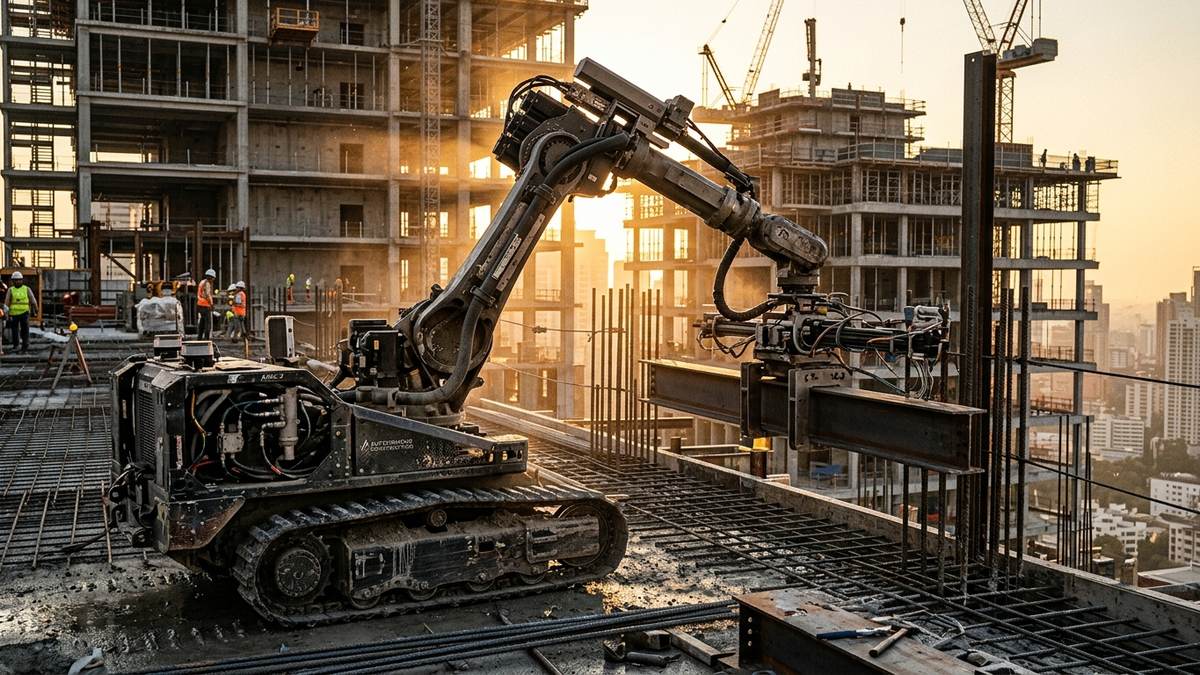
The financing was led by prominent industrial technology and deeptech venture capital syndicates, with participation from strategic real estate development partners. Origin's proprietary platform bridges the gap between digital architectural designs and raw physical execution, deploying tracked autonomous mobile robots capable of performing heavy-duty structural steel placement, precision masonry, and drywall finishing around the clock.
The Built Environment Crisis: Acute Labor Deficits and Inflexible Deadlines
Across North America, Europe, and rapidly expanding urban centers in Asia, general contractors face unprecedented operational constraints. According to industrial labor statistics, more than 40% of the active construction workforce is scheduled to retire within the next decade, with younger technical talent rarely entering manual building trades. This deficit has caused construction timelines to expand by 35% on average over the past five years.
Origin addresses this systemic bottleneck not by attempting to replace human project managers, but by automating the physically grueling, dangerous, and repetitive workflows that cause the highest injury rates and project bottlenecks.
"The construction jobsite remains one of the last major frontiers untouched by industrial automation,"stated the founders of Origin. "Automotive factories and microchip cleanrooms have operated with automated precision for decades. By equipping rugged mobile robots with high-payload arms and real-time spatial intelligence, we are turning chaotic building sites into high-efficiency, predictable manufacturing floors."
This rapid maturation of physical AI and advanced hardware engineering mirrors the breakthroughs in automated industrial fabrication examined in /post/tessolve-raises-75-million-for-semiconductor-expansion, highlighting the expanding frontier of hardware innovation.
Origin's Physical AI Architecture: Spatial Perception Meets Heavy Mechanical Actuation
Operating an autonomous robot on a dynamic, muddy, and crowded construction site is fundamentally more complex than operating in a warehouse with pre-marked barcodes. Origin's engineering team developed an end-to-end physical AI stack designed specifically for unstructured building environments:
1. Dynamic BIM Synchronization via Real-Time SLAM
Origin robots continuously ingest digital Building Information Modeling (BIM) architectural models. Utilizing multi-channel 3D LiDAR and stereoscopic computer vision, the robot performs real-time Simultaneous Localization and Mapping (SLAM), comparing the actual as-built physical concrete structure against the CAD blueprint down to a 2-millimeter tolerance.
2. High-Payload Articulated Actuation
Unlike lightweight consumer drones or delicate lab robots, Origin's tracked chassis houses heavy-duty industrial multi-axis arms capable of lifting, aligning, and fastening structural components weighing up to 120 kilograms. Hydraulic and high-torque electric servo drives provide the rigidity needed for continuous drilling, welding, and material handling.
3. Collaborative Safety Bubble (Physical AI Guardrails)
The robot's edge inference processors execute multi-modal human detection algorithms 60 times per second. If a human subcontractor enters the robot's active operational radius, the machine instantly throttles its speed or halts mechanical movement, adhering to stringent ISO and OSHA industrial safety standards.
Comparative Performance Matrix: Conventional Building Trades vs. Origin Autonomous Robotics
The structured table below highlights the operational and economic differences between traditional manual construction workflows and Origin's automated robotic systems:
| Operational Dimension | Traditional Manual Construction | First-Gen Semi-Automated Tools | Origin Autonomous Robotics Platform |
|---|---|---|---|
| Daily Operating Window | 8 Hours (Subject to daylight & fatigue) | 8–10 Hours (Requires continuous human operator) | 16–20 Hours (Continuous multi-shift autonomy) |
| Execution Schedule Speed | Baseline Project Timeline | 10%–15% Schedule Improvement | Up to 40% Acceleration in Core Trades |
| Dimensional Precision | ±10 mm to ±25 mm (Manual variance) | ±5 mm to ±10 mm | ±2.0 mm (Continuous BIM synchronization) |
| Material Wastage Rate | 12%–18% (Off-cuts, rework, breakage) | 8%–12% | < 3.5% (Optimized cutting & placement) |
| Jobsite Injury Exposure | High (Heavy lifting, falls from height) | Moderate | Near Zero (Robots handle elevated tasks) |
| Commercial Model | Direct Subcontractor Hourly Labor | Expensive Outright Machine Purchase | Robotics-as-a-Service (RaaS) + Outcome Billing |
Scaling via the Robotics-as-a-Service (RaaS) Business Model
To overcome capital expenditure hurdles for general contractors, Origin provides its fleet under a Robotics-as-a-Service (RaaS) model. Instead of paying hundreds of thousands of dollars to purchase robotic hardware upfront, developers pay a fixed deployment fee plus a performance fee tied to square footage completed.
This scalable commercialization framework parallels the serverless infrastructure models transforming digital cloud computing, such as the elastic deployment economics highlighted in /post/ai-infrastructure-startup-modal-raises-750-million.
2027 Deployment Roadmap: 150 Robots Across Global Hubs
With $20 million in Series A funding in hand, Origin is establishing a dedicated assembly and testing facility to ramp production. The company has already logged over 10,000 operational hours across pilot construction towers in urban commercial corridors.
The 150-unit deployment roadmap focuses initially on high-density commercial real estate developments, hyperscale data center construction, and civic transit infrastructure. As urban populations continue to swell and sustainable building mandates require tighter tolerances, Origin's autonomous construction robots represent a transformative step toward automated urban growth.
Frequently Asked Questions
What does construction robotics startup Origin do?
Origin develops autonomous mobile construction robots equipped with high-precision articulating arms and spatial computer vision. Its machines automate heavy, repetitive, and hazardous tasks on job sites—including structural steel positioning, masonry, concrete finishing, and drywall installation.
How much capital did Origin raise and what are the funds earmarked for?
Origin secured $20 million in Series A funding. The company plans to use the capital to scale manufacturing operations, expand engineering teams in robotics perception, and deploy a fleet of 150 autonomous robots across global commercial real estate projects by 2027.
How do Origin's robots navigate unstructured construction environments?
The robots utilize a physical AI perception stack combining multi-frequency LiDAR, stereo depth cameras, and real-time Building Information Modeling (BIM) synchronization. This enables them to map dynamically changing construction sites, avoid human workers, and execute tasks with millimeter accuracy.
What productivity benefits do general contractors see from deploying Origin robots?
Field deployments indicate that Origin's robotic systems accelerate core trade schedules by up to 40%, reduce material wastage by 25%, and significantly improve jobsite safety by removing human laborers from hazardous high-elevation operations.
Primary Sources & Official References
- Origin Robotics Corporate Announcement: Series A Capitalization and Global Deployment Targets.
- International Council for Research and Innovation in Building and Construction (CIB): Automation in Built Environment Productivity Reports.
- Robotics Industries Association (RIA): Autonomous Mobile Robot Standards in Industrial Construction.
- Ministry of Housing and Urban Affairs (MoHUA): Technology Innovation Guidelines for Sustainable Urban Infrastructure.