Volantis Raises $88M Series A to Break the AI Memory Wall with Photonic Hardware Interconnects
By Elena Rostova | Published October 3, 2026 | 8 min read
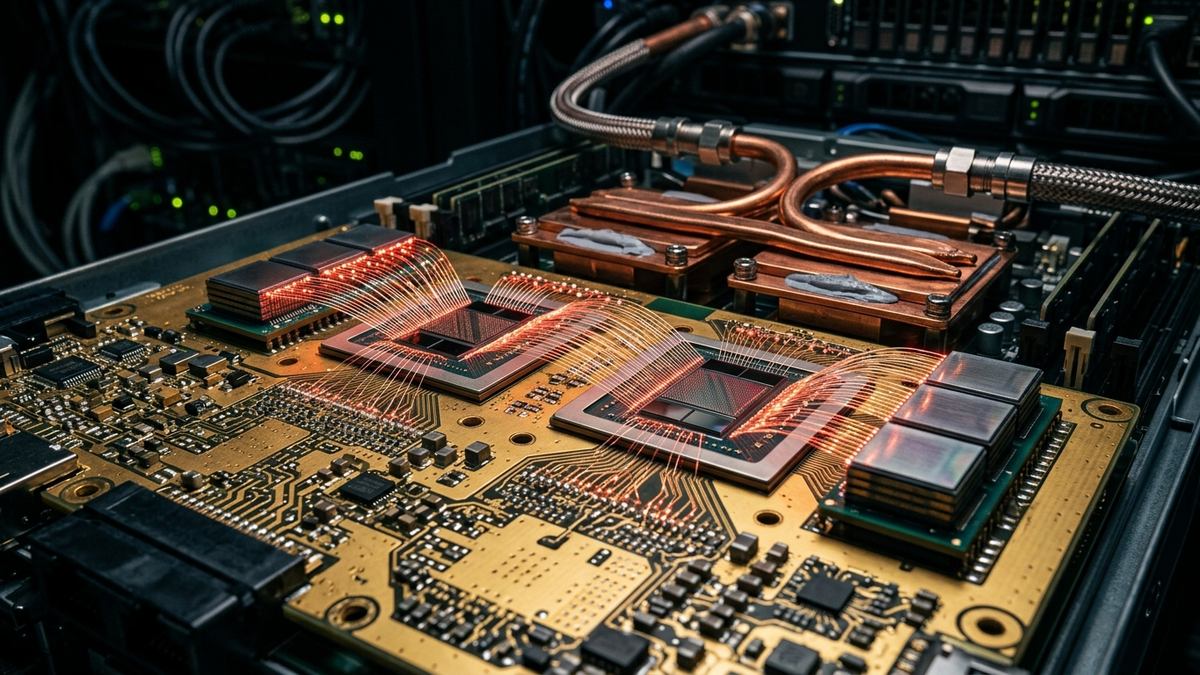
San Francisco startup Volantis secures $88M Series A to commercialize optical photonic interconnects linking single GPUs to 220 memory chips for 20-trillion-parameter AI models.
San Francisco-based semiconductor and optical fabric startup Volantis has raised $88 million in a heavily oversubscribed Series A funding round, bringing its total capital raised to approximately $97 million. The investment round was co-led by prominent technology investors Lachy Groom and Abstract Ventures, with participation from legendary venture capitalist John Doerr, VXI Capital, Triatomic, Susa Ventures, and notable AI pioneers including Naveen Rao, Dwarkesh Patel, and Sholto Douglas.
The massive capital infusion will be deployed to commercialize Volantis' proprietary A-1 optical inference architecture, an optical hardware platform engineered to shatter the "AI memory wall"—the defining hardware bottleneck that limits the scale, speed, and energy efficiency of frontier generative artificial intelligence systems worldwide.
Shattering the AI Memory Wall With Light
Over the past four years, artificial intelligence accelerators—most notably NVIDIA's H100, B200, and Google's TPUs—have achieved staggering leaps in raw floating-point computing capacity (FLOPs). However, memory bandwidth and physical interconnect density have failed to keep pace. In large language model (LLM) inference, processors spend the vast majority of their operational cycles idling, waiting for weights and attention cache parameters to travel across electrical copper traces between High Bandwidth Memory (HBM) and the compute die.
Traditional copper interconnects suffer from severe physical limitations:
- Resistive Signal Degradation: Electrical pulses over copper experience high attenuation at frequencies exceeding 100 GHz, requiring power-hungry retimers and repeaters.
- Severe Pin-Count Limits: Physical semiconductor packaging cannot accommodate enough copper pins to link more than eight HBM stacks to a single GPU.
- Thermal and Power Traps: Moving a single bit of data electrically across a circuit board consumes substantial energy, with interconnects consuming up to 30% of a modern AI data centre's total power budget.
Volantis completely circumvents these electrical constraints by substituting electricity with light. Utilizing vertical-cavity surface-emitting lasers (VCSELs) operating at specialized near-infrared wavelengths, Volantis converts digital signals directly into optical laser pulses transmitted through micro-optical waveguides.
Because photons do not interact electromagnetically or generate resistive heat, Volantis' optical interconnect operates at an astonishing energy efficiency of less than 1 picojoule per bit (pJ/bit).
"The computing industry has reached the thermodynamic end of electrical copper scaling,"remarked technical leadership at Volantis. "Scaling foundation models to 20 trillion parameters cannot be achieved by stacking more hot copper wires into server racks. By using light to link compute processors directly to massive, unified memory oceans, we are unlocking orders of magnitude faster inference at a fraction of the power consumption."
The A-1 Architecture: Connecting 220 Memory Chips to One GPU
The architectural implications of Volantis' optical fabric are staggering. In current state-of-the-art AI servers—such as NVIDIA's NVL72 or DGX systems—a single GPU is physically constrained to eight High Bandwidth Memory (HBM) stacks mounted on a silicon interposer.
In contrast, Volantis' A-1 architecture enables a single compute processor to communicate directly and coherently with up to 220 discrete memory chips:
- Massive Memory Footprint: Rather than distributing multi-trillion parameter models across dozens of separate server nodes interconnected by bulky InfiniBand cables, the entire model can reside within a unified optical memory fabric.
- Extreme Inference Speeds: The architecture is engineered to deliver inference throughput of up to 10,000 tokens per second per user, enabling real-time agentic reasoning loops and continuous test-time compute.
- Targeting 20-Trillion Parameter Frontiers: Providing the memory capacity required to serve next-generation multimodal architectures that exceed 20 trillion parameters without catastrophic memory fragmentation.
Comparative Architecture Matrix: Copper vs Photonic Optical Fabric
The table below contrasts conventional copper GPU interconnects against Volantis' VCSEL-based photonic architecture:
| Architectural Metric | Conventional Copper (HBM3e / NVLink) | Co-Packaged Optics (CPO) Gen 1 | Volantis A-1 Photonic Optical Fabric |
|---|---|---|---|
| Physical Interconnect Medium | Electrical Copper Micro-Traces | Silicon Photonic Optical Fibers | Vertical-Cavity Surface-Emitting Lasers (VCSEL) |
| Memory Chips per Processor | Strictly 8 HBM Stacks | 16 to 32 Memory Dies | Up to 220 Discrete Memory Chips |
| Interconnect Energy per Bit | 5.0 – 8.0 pJ/bit | 2.5 – 4.0 pJ/bit | < 1.0 pJ/bit (Sub-Picojoule) |
| Maximum Model Parameter Tier | 1 to 2 Trillion (Fragmented) | 3 to 5 Trillion (Clustered) | 20+ Trillion Parameters Unified |
| Target Single-User Throughput | 100 – 250 Tokens/sec | 500 – 1,000 Tokens/sec | Up to 10,000 Tokens/second |
| Thermal Dissipation Load | Massive (Requires Liquid Cooling) | High (Laser Module Heat) | Ultra-Low (Near-Zero Waveguide Dissipation) |
Commercial Roadmap: 2027 Hyperscaler Deployment
Volantis, which emerged from stealth mode in mid-2025 with an initial $9 million seed round, plans to deliver its first integrated A-1 inference hardware engines to commercial hyperscalers and frontier AI laboratories in 2027.
The company's breakthrough arrives amid intense global focus on AI hardware efficiency, mirrored by sovereign compute expansions such as the IndiaAI Mission procuring tens of thousands of high-performance accelerators and edge semiconductor innovators like Mythic AI advancing analog compute in Bengaluru.
As foundation models evolve from static text generators into complex, real-time agentic reasoning engines that run billions of test-time simulation steps, memory latency has become the primary bottleneck of artificial intelligence. By replacing copper wires with laser light, Volantis is positioning itself at the very vanguard of the post-silicon computational era.
Frequently Asked Questions
What is the 'AI memory wall' and why is it a bottleneck for LLMs?
The AI memory wall refers to the performance bottleneck where computational processor speeds (FLOPs) far exceed the bandwidth and physical capacity of memory buses to feed data into the processor. Modern generative AI models spend most of their execution time waiting for parameters to transfer across memory interfaces rather than computing.
What is Volantis' core technological innovation?
Volantis utilizes an optical interconnect architecture called A-1 powered by vertical-cavity surface-emitting lasers (VCSELs). Instead of electrical signals traveling through resistive copper traces, data is transmitted as light, allowing a processor to connect directly to up to 220 memory chips without signal degradation or severe thermal penalties.
Who participated in the $88 million Series A funding round?
The financing round was co-led by prominent investors Lachy Groom and Abstract Ventures, alongside legendary venture capitalist John Doerr, VXI Capital, Triatomic, Susa Ventures, and leading AI figures including Dwarkesh Patel, Naveen Rao, and Sholto Douglas.
When does Volantis plan to deliver its first commercial hardware?
Volantis plans to deliver its first integrated inference engines (A-1) to commercial customers and hyperscale cloud providers in 2027, targeting foundation models exceeding 20 trillion parameters.
Primary Sources & Official References
- Volantis Semiconductor: A-1 Photonic Optical Interconnect Architecture Whitepaper and Investor Presentation.
- IEEE Photonics Society: Technical Survey on Optical Interconnects and Co-Packaged Optics for AI Supercomputing.
- Hot Chips: A Symposium on High Performance Chips: Microprocessor Interconnect Proceedings.
- Abstract Ventures and Lachy Groom: Series A Investment Thesis and Strategic Briefing.