Bengaluru space-tech pioneer Astrogate Labs has completed high-throughput ground trials of its 10 Gbps optical communication terminal, revolutionizing satellite data downlinks.
Executive Key Takeaways
- Astrogate Labs has successfully verified a 10 Gbps coherent laser communication downlink between optical ground stations and space payload simulators.
- The laser communication terminal achieves a 100x increase in data transmission throughput compared to legacy X-band radio frequency (RF) links.
- The breakthrough bypasses crowded satellite spectrum allocations and positions India as a key exporter of deep-space optical transceivers.
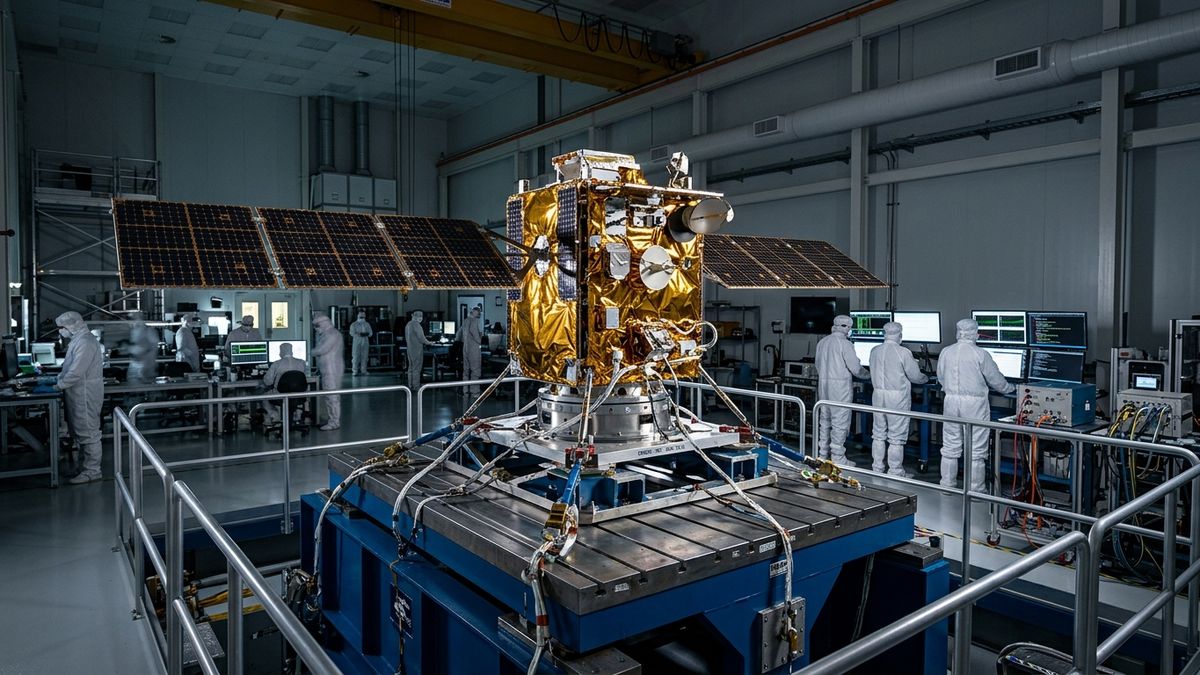
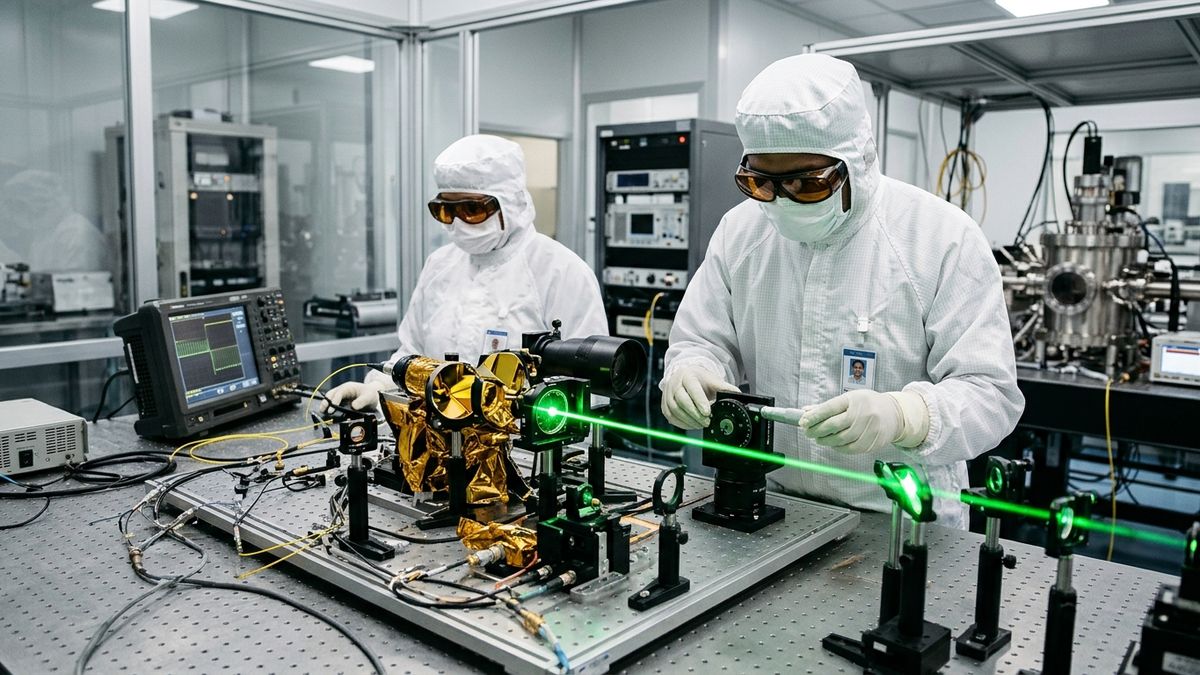
Bengaluru-based deeptech aerospace startup Astrogate Labs has achieved a historic milestone in sovereign space engineering, successfully concluding high-throughput terrestrial and simulated orbital verification of its 10 Gbps optical satellite communication terminal. The demonstration proves end-to-end free-space optical (FSO) laser links between spaceborne transceiver payloads and specialized optical ground stations (OGS), clearing the path for commercial orbital deployment on upcoming Earth observation and sovereign defense constellations.
As modern Earth observation satellites deploy high-resolution synthetic aperture radar (SAR), multispectral optical cameras, and hyperspectral sensors, satellites collect terabytes of raw planetary data every orbit. However, downlinking this data to Earth has historically created a severe bottleneck. Traditional radio frequency (RF) bands—such as X-band, Ku-band, and Ka-band—are constrained by strict international spectrum allocations, heavy antenna weight, high electrical power consumption, and maximum transfer limits that rarely exceed a few hundred megabits per second.
Astrogate's laser communication breakthrough removes this barrier entirely, unlocking a 100-fold increase in downlink capacity while slashing payload volume and power demands.
Breaking Free from Radio Frequency Spectrum Saturation
In the space sector, acquiring International Telecommunication Union (ITU) spectrum licenses for radio frequency downlinks often requires years of regulatory filings. Furthermore, adjacent satellites frequently suffer from radio signal interference, requiring complex beam steering and coordination.
In sharp contrast, optical laser communications operate in the unregulated infrared spectrum (around 1550 nanometers). Because laser beams diverge by mere fractions of a milliradian, the energy is concentrated into an exceptionally narrow pencil-thin beam. This ensures near-zero interception risk, total immunity from electronic warfare jamming, and freedom from international RF spectrum licensing disputes.
This achievement solidifies India's fast-maturing private space ecosystem, joining milestones like Dhruva Space's LEAP-2 satellite deployment and GalaxEye Space's OptoSAR sensor patents.
Comparative Engineering Specifications: Optical Laser vs. Radio Downlinks
The structured engineering matrix below compares Astrogate Labs' optical communication system against industry-standard satellite radio downlinks:
| System Engineering Metric | Standard Satellite X-Band RF Link | High-Capacity Ka-Band System | Astrogate Labs 10 Gbps Optical Laser Terminal |
|---|---|---|---|
| Downlink Throughput | 100 – 300 Mbps | 1.0 – 2.5 Gbps | 10.0 Gbps (Symmetric Burst) |
| Payload Mass | 8 – 15 kg (with dish/gimbal) | 12 – 22 kg (high-power amplifier) | < 3.5 kg (Integrated Optics) |
| Power Consumption (DC) | 80 – 160 Watts | 150 – 280 Watts | < 35 Watts |
| Frequency Regulation | Mandatory ITU spectrum filing | Strict ITU frequency coordination | Unregulated Optical Infrared (1550 nm) |
| Intercept & Jamming Vulnerability | Broad signal cone; prone to RF jamming | Vulnerable to directional jamming | Sub-milliradian pencil beam; Jam-proof |
| Data Delivered per 8-Min Pass | ~15 – 25 Gigabytes | ~80 – 120 Gigabytes | > 600 Gigabytes per pass |
"Earth observation without high-speed downlink is like capturing 8K cinematic footage on a high-end camera with no way to transfer the files off the memory card. By achieving 10 Gbps through precision laser optical communications, we are turning orbital imaging satellites from data-choked bottlenecks into real-time planetary intelligence nodes."
Adaptive Optics & Cloud-Mitigation Network Strategy
A historical criticism of free-space optical communications has been cloud susceptibility—thick cloud banks scatter optical laser beams, interrupting the signal.
Astrogate Labs has engineered a multi-layered solution combining spaceborne intelligence with ground-station distribution:
1. Precision Fine-Pointing Mechanism: The terminal features sub-microradian piezo-actuated steering mirrors that acquire and track optical ground stations across 1,000+ kilometer orbital trajectories while compensating for spacecraft jitter.
2. Adaptive Optics Wavefront Correction: Ground station receiver apertures employ deformable mirrors that continuously correct for atmospheric thermal turbulence in real time.
3. Cloud-Diversity Ground Station Grid: Rather than relying on a single reception hub, Astrogate is establishing distributed optical ground stations across high-altitude and arid geographical corridors in Ladakh, Rajasthan, and international partner observatories, dynamically routing downlinks to cloud-free sectors.
With space commercialization accelerating rapidly, Astrogate's successful validation positions India as an indispensable global supplier of optical telecommunications hardware for next-generation satellite mega-constellations.
Frequently Asked Questions
What is satellite laser optical communication?
Laser satellite communication, or Free-Space Optical (FSO) communication, uses tightly focused beams of infrared laser light instead of traditional radio frequencies to transmit gigabits of telemetry, radar, and hyperspectral imagery between orbiting spacecraft and optical ground stations.
How does 10 Gbps compare to existing satellite radio frequency downlinks?
Traditional satellite radio downlinks in the X-band or S-band typically top out at 50 to 300 Mbps due to spectrum licensing limits and power constraints. Astrogate's 10 Gbps optical link delivers over 30 to 100 times higher data throughput during short ground-station passes.
How does Astrogate overcome atmospheric turbulence and cloud cover?
Astrogate utilizes adaptive optics mirrors and multi-station cloud-diversity ground networks. If cloud cover obscures one optical ground station, the satellite dynamically routes the laser beam to an alternate ground station in an arid or high-altitude zone.
Can Astrogate's terminal fit on small CubeSats and SmallSats?
Yes. The miniaturized optical terminal weighs less than 3.5 kilograms and consumes under 35 watts of power, making it fully compatible with 6U, 12U, and 16U nanosatellite and microsatellite buses.