Dhruva Space Successfully Deploys LEAP-2 Mission Carrying Dual Payloads to Advance Commercial Satellite Hosted Services
By Sanjay Patel | Published October 4, 2026 | 8 min read
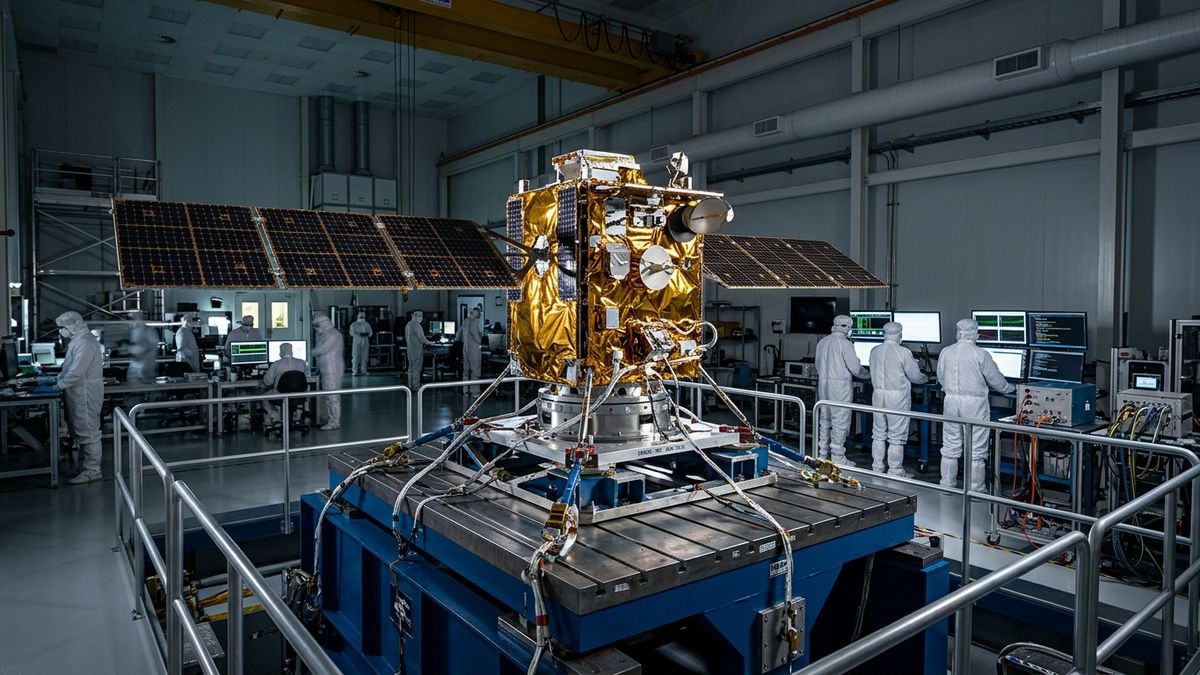
Hyderabad spacetech startup Dhruva Space achieves full mission deployment for LEAP-2, proving hosted payload capabilities and expanding India's private space industry.
Hyderabad-based space-technology pioneer Dhruva Space has confirmed the flawless orbital deployment and telemetry acquisition for its LEAP-2 (Launching Expeditions for Aspiring Payloads) mission. Carrying two dedicated customer payloads into low-Earth orbit (LEO), the mission validates Dhruva's proprietary modular satellite platform and hosted-payload architecture, establishing a scalable commercial pathway for global enterprises, research laboratories, and sovereign agencies to test and operate orbital technology without the prohibitive capital expenditures of building dedicated spacecraft.
The successful flight operation marks a major achievement for India's burgeoning private space economy, illustrating the rapid transition of domestic space startups from early experimental prototypes to mature, revenue-generating commercial orbital services under the regulatory framework of IN-SPACe.
Demystifying Satellite-as-a-Service: The Hosted Payload Advantage
Historically, conducting research or operating a commercial instrument in space required an organization to design a bespoke satellite bus, procure specialized space-grade components, navigate orbital launch vehicle contracts, and construct ground-station networks. This multi-year process frequently exceeded $10 million to $20 million per mission, effectively pricing out academic laboratories, agricultural sensing firms, and emerging defense contractors.
Dhruva Space's LEAP platform dismantles these barriers by implementing a "Satellite-as-a-Service" model:
- Standardized Multi-Payload Integration: The modular satellite chassis provides standardized electrical, thermal, mechanical, and data interfaces that accommodate diverse instrumentation without redesigning the core spacecraft bus.
- Comprehensive Onboard Subsystems: Dhruva handles primary orbital functions including three-axis attitude determination and control systems (ADCS), multi-junction gallium arsenide solar power harvesting, thermal radiator dissipation, and high-throughput RF transceivers.
- Turnkey Ground Telemetry and Downlink: Data collected by hosted sensors is automatically ingested, routed through Dhruva's distributed Earth station network, and delivered to customer cloud repositories via encrypted APIs.
- Accelerated Time-to-Orbit: Customers can transition from laboratory bench prototype to in-orbit operation in under nine months, cutting conventional launch gestation cycles by more than 60%.
"LEAP-2 is not simply an orbital milestone; it represents the operational validation of India's commercial satellite-as-a-service infrastructure,"stated space engineering specialists. "By proving that complex hosted payloads can be powered, stabilized, and monitored reliably, Dhruva Space is positioning Indian private engineering at the heart of the global small-satellite ecosystem."
Mission Architecture and Subsystems Overview
The LEAP-2 mission deployed a sophisticated CubeSat/SmallSat platform engineered entirely within Dhruva's high-tech manufacturing and cleanroom integration facilities in Hyderabad. The table below outlines the core technical specifications and mission parameters of the LEAP-2 spacecraft architecture:
| Spacecraft Dimension | Technical Specification | Operational Purpose |
|---|---|---|
| Mission Name & Platform | LEAP-2 (Hosted Payload Bus) | In-orbit payload hosting and multi-sensor validation |
| Target Orbital Regime | Low-Earth Orbit (LEO, ~500–550 km) | Sun-synchronous circular orbit for optimal solar capture |
| Payload Capacity | Dual Independent Commercial Payloads | Earth observation telemetry and optical sensing validation |
| Attitude & Pointing Control | 3-Axis Reaction Wheels & Magnetorquers | Sub-degree precision pointing for payload optical targeting |
| Power Generation Architecture | Deployable Gallium Arsenide (GaAs) Panels | High-efficiency solar array generating steady payload wattage |
| RF Communications Stack | Dual-Band UHF/VHF & High-Speed S-Band | Bi-directional commanding, health telemetry, and high-rate downlink |
| Separation & Ejection System | Dhruva Satellite Orbital Deployer (DSOD) | Indigenous, flight-proven mechanical separation mechanism |
| Ground Station Integration | Dhruva Space Earth Station Network (Hyderabad) | Real-time pass tracking, orbit determination, and data decryption |
Strengthening India's Sovereign Spacetech Value Chain
The success of LEAP-2 arrives amidst a generational wave of private aerospace engineering across India. From orbital launch pioneers like Skyroot and Agnikul to satellite-edge innovators recognized in recent initiatives like the Karnataka Innoverse deeptech cohort scaling frontier space propulsion and onboard computing, domestic ventures are capturing international commercial contracts.
Crucially, Dhruva Space has systematically built an integrated "full-stack" ecosystem encompassing:
1. Spacecraft Buses: Scalable satellite architectures ranging from 1U CubeSats to 300-kilogram microsatellites.
2. Deployer Systems: Indigenous separation deployers (DSOD) designed to house and gently eject fragile spacecraft from launch vehicle fairings with negligible shock forces.
3. Ground Segment Infrastructure: Turnkey ground stations, antenna tracking arrays, and cloud-native mission control software.
This integrated approach insulates the company from global supply chain choke points, an imperative mirrored in other high-precision hardware domains such as Agrani Labs building sovereign AI computing silicon and Spintronics AI commercializing domestic GaN semiconductor fabrication.
Commercial Trajectory and Future Constellations
With LEAP-2 successfully communicating with ground controllers, Dhruva Space is advancing plans for its upcoming LEAP-3 and constellation missions. The company is actively constructing a 280,000-square-foot aerospace manufacturing facility in Hyderabad designed to manufacture, integrate, and test up to 100 satellites per year.
As global demand for commercial satellite deployment surges across maritime tracking, disaster management, precision agriculture, and broadband telecommunications, Dhruva Space's proven hosted-payload architecture provides international customers with an agile, cost-effective launch partner. The flawless execution of the LEAP-2 mission cements India's reputation as a reliable and innovative hub for next-generation space engineering.
Frequently Asked Questions
What is the primary objective of Dhruva Space's LEAP-2 mission?
The LEAP-2 mission is designed to flight-qualify Dhruva Space's modular satellite platform (the LEAP bus) in low-Earth orbit, proving its capability to carry, power, and transmit telemetry for multiple third-party commercial customer payloads simultaneously as a hosted-payload service.
What is 'Hosted Payload' or 'Satellite-as-a-Service'?
Hosted payload services allow commercial, scientific, or defense entities to fly their specific sensors, cameras, or communication instruments on a pre-built, shared satellite bus without incurring the massive expense and multi-year timeline of designing, launching, and managing a dedicated spacecraft.
Where was the LEAP-2 spacecraft integrated and operated?
The spacecraft systems, separation deployers, and avionics were engineered and integrated at Dhruva Space's facilities in Hyderabad, Telangana, and are tracked and operated via Dhruva's indigenous Earth Station network.
How does this development align with India's space policy reforms?
The launch operates under the regulatory facilitation of IN-SPACe (Indian National Space Promotion and Authorization Centre), which empowers private domestic ventures to design, launch, and monetize commercial space assets independently of ISRO's operational pipeline.
Primary Sources & Official References
- Indian National Space Promotion and Authorization Centre (IN-SPACe): Commercial Space Authorization Registry.
- Dhruva Space: LEAP Hosted Payload Architecture and Mission Operations Brief.
- Indian Space Research Organisation (ISRO): Small Satellite Commercialization Protocols.
- Indian Space Association (ISpA): Annual Indian Space Economy and Startup Growth Survey.