Indian precision engineering and manufacturing firms are accelerating high-tech pivots into aerospace, sovereign defence, and semiconductor tooling to capture 25%+ margins.
Executive Key Takeaways
- Indian precision engineering and manufacturing firms are accelerating high-tech pivots into aerospace, sovereign defence, and semiconductor tooling to capture 25%+ margins.
- The transition from automotive precision machining to aerospace and semiconductor tooling is not merely a diversification strategy—it is an existential upgrade, observed Rajiv Merchant, Managing Director of Apex Precision Engineering. In automotive, you fight over fractions of a rupee per part with high volume volatility. In aerospace and semiconductor capital equipment, customers demand zero-defect tolerances at five-micron precision, and they are willing to pay handsomely for guaranteed metallurgical reliability.
- Key Benchmark: **Operating EBITDA Margins** — 8% – 12% (heavy annual price downs)
PUNE, BENGALURU & CHENNAI — India's precision engineering and industrial manufacturing heartlands are undergoing a structural transformation. Faced with commoditized margins and electric-vehicle disruption across the traditional automotive component supply chain, domestic tier-1 and tier-2 engineering companies are aggressively redeploying capital into high-margin, advanced-technology verticals: aerospace structural assemblies, sovereign defense systems, and semiconductor capital equipment manufacturing.
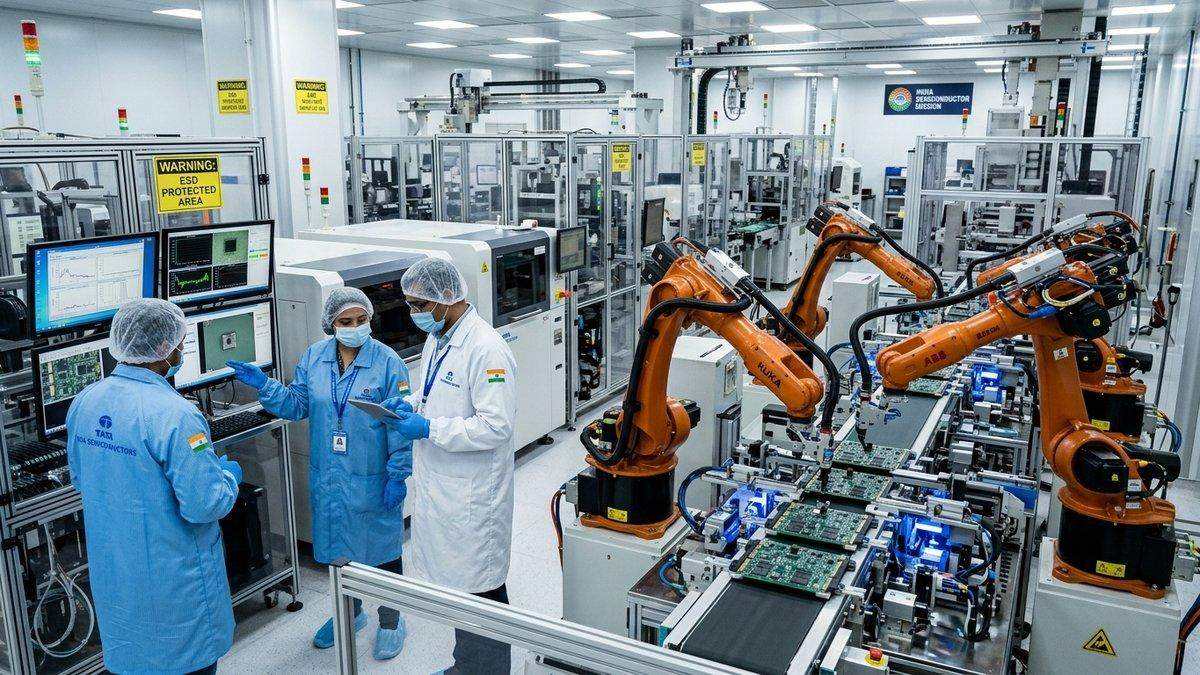
Spurred by robust government indigenization mandates, multi-billion-dollar global aerospace offsets, and the physical realization of domestic mega-fabs under the India Semiconductor Mission, precision manufacturers—ranging from industrial giants like Larsen & Toubro, Bharat Forge (Kalyani Group), Godrej & Boyce, and Dynamatic Technologies to specialized mid-caps like Centum Electronics and Azad Engineering—are establishing dedicated cleanrooms, acquiring multi-axis robotic CNC machining centers, and obtaining stringent AS9100 aerospace accreditations.
This industrial reallocation is closely intertwined with the rapid expansion of India's sovereign technology supply chains, detailed in our analyses of India's ₹13 Billion Semiconductor Mission and the burgeoning private launch economy outlined in ISRO Opens More Doors for India's Private Space Sector.
The Catalyst for Industrial Diversification: Margin Compression vs High-Tech Multiples
For nearly four decades, the backbone of India's precision manufacturing sector was built around internal combustion engine (ICE) automotive components: cylinder blocks, crankshafts, transmission gears, and sheet-metal stampings. However, the automotive ecosystem has entered a period of irreversible margin pressure:
1. Electric Vehicle (EV) Powertrain Simplification: Electric vehicles eliminate up to 70% of moving mechanical components found in ICE drivetrains, drastically shrinking addressable volumes for legacy engine casting and machining shops.
2. OEM Price Pressure: Global and domestic automakers continue to extract single-digit cost reductions annually, compressing operating EBITDA margins for tier-1 auto suppliers to the 8%–11% range.
3. Severe Valuation Multiples: Public and private markets afford legacy auto-component fabricators modest price-to-earnings (P/E) multiples of 12x–18x, while precision aerospace and defense suppliers command premium multiples exceeding 35x–55x.
In sharp contrast, high-tech sectors offer long-term revenue visibility, sticky decade-long customer qualification cycles, and robust EBITDA margins averaging 22% to 32%.
"The transition from automotive precision machining to aerospace and semiconductor tooling is not merely a diversification strategy—it is an existential upgrade,"observed Rajiv Merchant, Managing Director of Apex Precision Engineering. "In automotive, you fight over fractions of a rupee per part with high volume volatility. In aerospace and semiconductor capital equipment, customers demand zero-defect tolerances at five-micron precision, and they are willing to pay handsomely for guaranteed metallurgical reliability."
The Three Growth Engines: Aerospace, Defence, and Semiconductor Tooling
Indian precision engineering enterprises are systematically targeting three capital-intensive pillars:
1. Commercial Aerospace Aerostructures and Engine Components
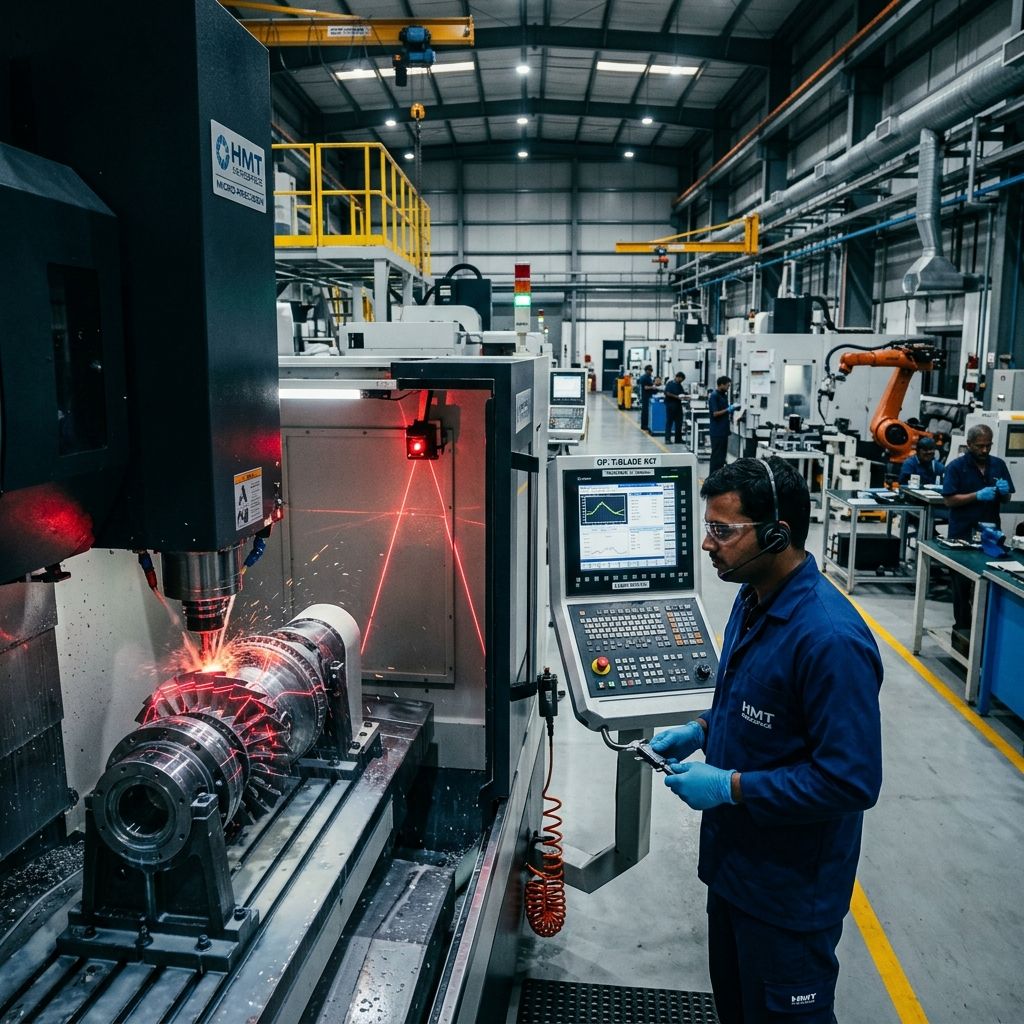
Global aerospace giants like Airbus, Boeing, and Safran are expanding their sourcing footprints in India to clear record order backlogs exceeding 14,000 commercial airliners. Indian firms are moving beyond simple sheet metal brackets to fabricate flight-critical aerostructures: titanium flap track beams, complex passenger door assemblies, landing gear actuation cylinders, and nickel-alloy turbine nozzle rings. Azad Engineering's long-term supply agreements with Rolls-Royce, GE Aerospace, and Pratt & Whitney illustrate how domestic precision machining is powering global civil aviation.
2. Sovereign Defence Indigenisation and Export Platforms
The Ministry of Defence's progressive Positive Indigenisation Lists—which ban the import of thousands of weapon systems, radar assemblies, and armored platforms—have created a guaranteed domestic market for private defense contractors. Engineering firms are building missile airframes, submarine pressure hull components, armored vehicle transmissions, and radar antenna pedestals. Concurrently, Indian defense exports have surged past ₹21,000 crore annually, driven by artillery systems, counter-drone hardware, and precision munitions shipped to Southeast Asia, the Middle East, and Europe.
3. Semiconductor Capital Equipment and Vacuum Precision
As commercial wafer fabrication plants break ground in Dholera and Sanand, global semiconductor capital equipment manufacturers (such as Applied Materials, Lam Research, and ASML) are localizing their tier-2 supplier networks. Semiconductor fabrication demands ultra-high vacuum (UHV) chambers, gas manifolds manufactured from 316L electropolished stainless steel, and electrostatic chuck assemblies manufactured under Class 1,000 cleanroom conditions. Indian precision shops with high-tolerance machining capabilities are capturing lucrative contracts to machine and assemble these critical modules.
Sector Comparison Matrix: Automotive vs High-Tech Precision Engineering
The structured overview below outlines the structural shift in operational parameters, quality tolerances, margin dynamics, and capital intensity as manufacturers transition into high-tech verticals:
| Operational Dimension | Conventional Automotive Tier-1 | Commercial Aerospace (Civil & Space) | Semiconductor Capital Equipment | Strategic Transformation |
|---|---|---|---|---|
| Operating EBITDA Margins | 8% – 12% (heavy annual price downs) | 22% – 28% (contractual inflation indexing) | 25% – 34% (high-value IP and cleanroom assembly) | Margin expansion of 1,200 – 2,000 basis points |
| Machining Tolerances | ±25 to ±50 microns (standard CNC) | ±5 to ±10 microns (5-axis simultaneous) | Sub-3 microns (ultra-precision EDM / micro-grinding) | Order-of-magnitude leap in machining precision |
| Metallurgical Materials | Cast iron, structural steel, aluminum | Titanium (Ti-6Al-4V), Inconel 718, composites | Ultra-pure aluminum alloys, quartz, 316L SS | Transition to high-temperature exotic superalloys |
| Customer Qualification Cycle | 6 – 12 months (fast prototype to line) | 24 – 36 months (AS9100, NADCAP audits) | 18 – 30 months (cleanliness & vacuum testing) | Deep customer moats; virtually impossible to displace |
| Contract Duration | 3 – 5 years (subject to model lifecycle) | 7 – 15 years (covers airline build program) | 5 – 10 years (evergreen equipment tool kits) | Exceptional revenue predictability and cash flow stability |
Overcoming Barriers to Entry: Capital Expenditure and Certification Moats
While the profit potential of aerospace, defense, and semiconductor precision is compelling, the technical and regulatory barriers to entry remain formidable:
- Stringent Quality Accreditations: Aerospace supply requires AS9100 Rev D certification, alongside specialized NADCAP (National Aerospace and Defense Contractors Accreditation Program) certifications for chemical processing, heat treating, welding, and non-destructive testing (NDT).
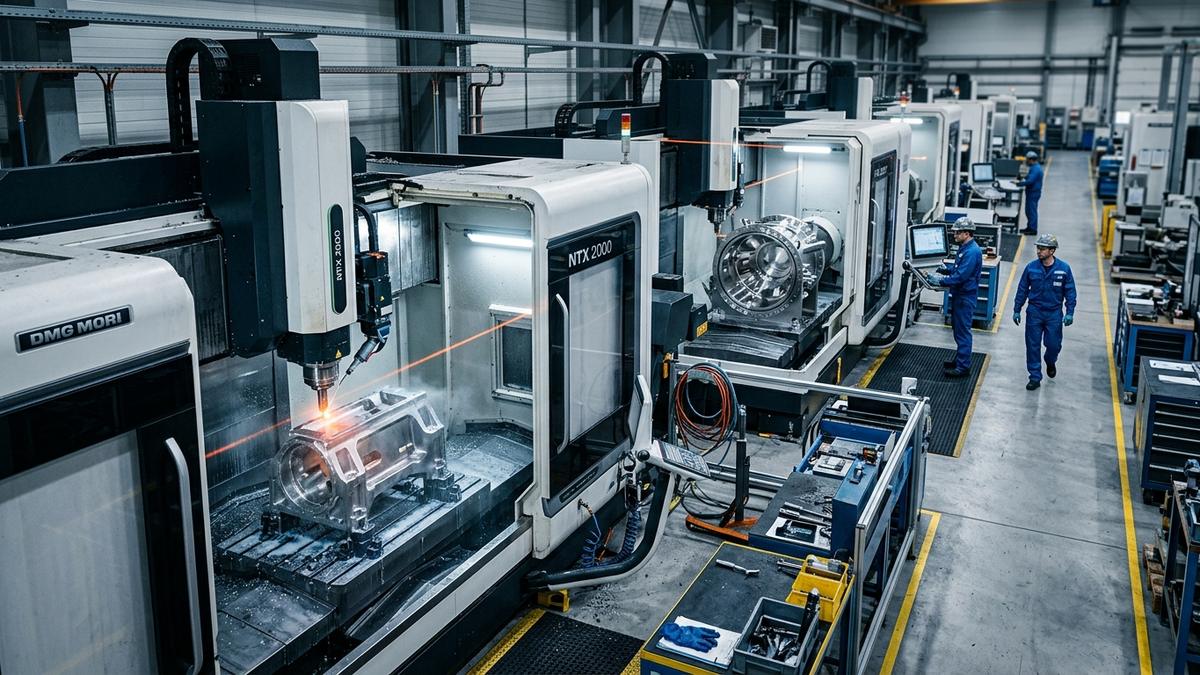
- Capital-Intensive Multi-Axis Tooling: Machining titanium and nickel superalloys requires heavy 5-axis robotic machining centers from manufacturers like DMG Mori, Makino, and Mazak, with individual machine tools costing ₹5 crore to ₹15 crore each.
- Specialized Cleanroom Facilities: Semiconductor capital equipment modules must be cleaned through multi-stage ultrasonic baths, passivated, and assembled within certified ISO Class 5 and Class 6 cleanrooms to prevent sub-micron particulate contamination.
To finance these heavy capital outlays, engineering firms are tapping public equity markets through specialized IPOs and partnering with industrial scaling platforms like LTTS's Commercial Engineering Scale Initiative.
The Strategic Outlook: India's High-Tech Industrial Renaissance
The pivot of Indian precision engineering companies toward aerospace, defense, and semiconductor tooling marks a maturation of the national industrial base. By escaping the low-margin trap of commoditized automotive components, Indian manufacturers are positioning themselves as irreplaceable links in the global high-tech supply chain.
As global original equipment manufacturers (OEMs) de-risk their supply networks away from concentrated geographic hubs and India's sovereign defense and semiconductor missions achieve full-scale manufacturing velocity, these precision engineering champions are building the foundational hardware backbone of a $5 trillion economy.