Ford Business Solutions (FBS) announces an aggressive expansion in Chennai and Bengaluru, onboarding 500 specialized engineers across AI, telematics, and software-defined vehicles.
Executive Key Takeaways
- Ford Business Solutions (FBS) announces an aggressive expansion in Chennai and Bengaluru, onboarding 500 specialized engineers across AI, telematics, and software-defined vehicles.
- Our Global Capability Centres in India have ceased to be support arms; they are co-architects of Ford's most critical software-defined vehicle platforms, noted automotive leadership tracking the expansion. By onboarding 500 world-class AI and software specialists in Chennai and Bengaluru, Ford is securing the architectural bandwidth required to build resilient, self-healing vehicle operating systems.
- Key Benchmark: **Connected Vehicle Telematics** — MQTT, CAN-bus parsing, Kafka, Rust
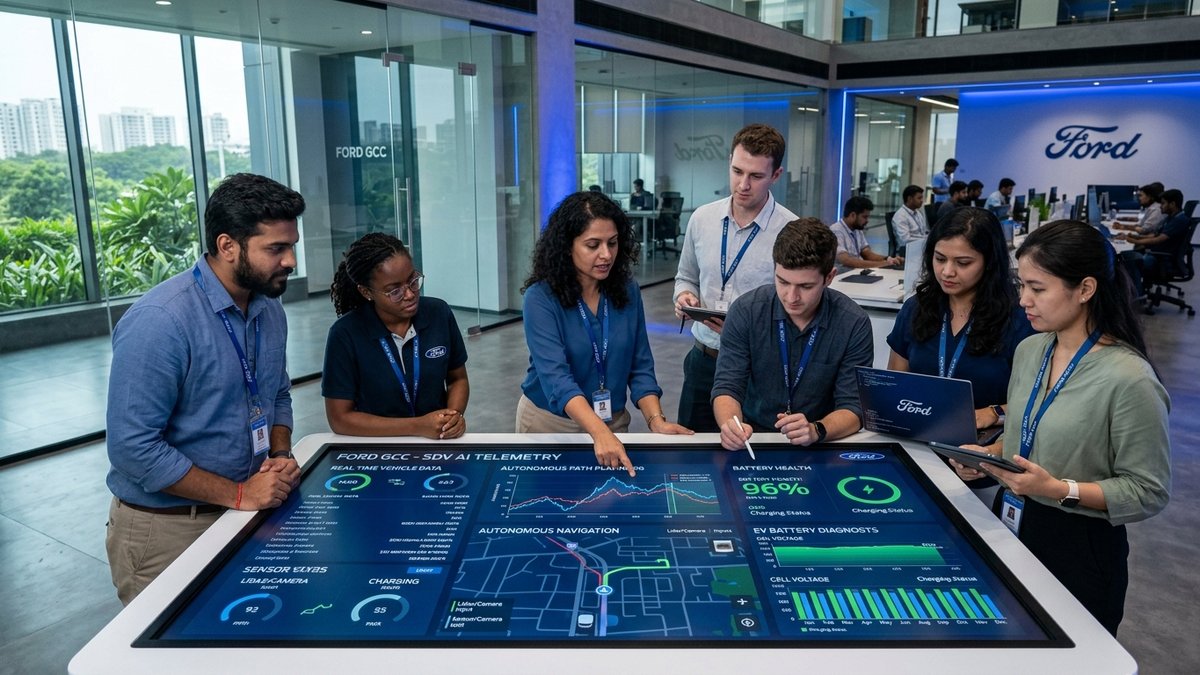
CHENNAI — Underscoring the pivotal role of Indian technical talent in the global automotive revolution, Ford Business Solutions (FBS)—the Global Capability Centre (GCC) of American automotive titan Ford Motor Company—has announced plans to hire approximately 500 specialized technology professionals in India.
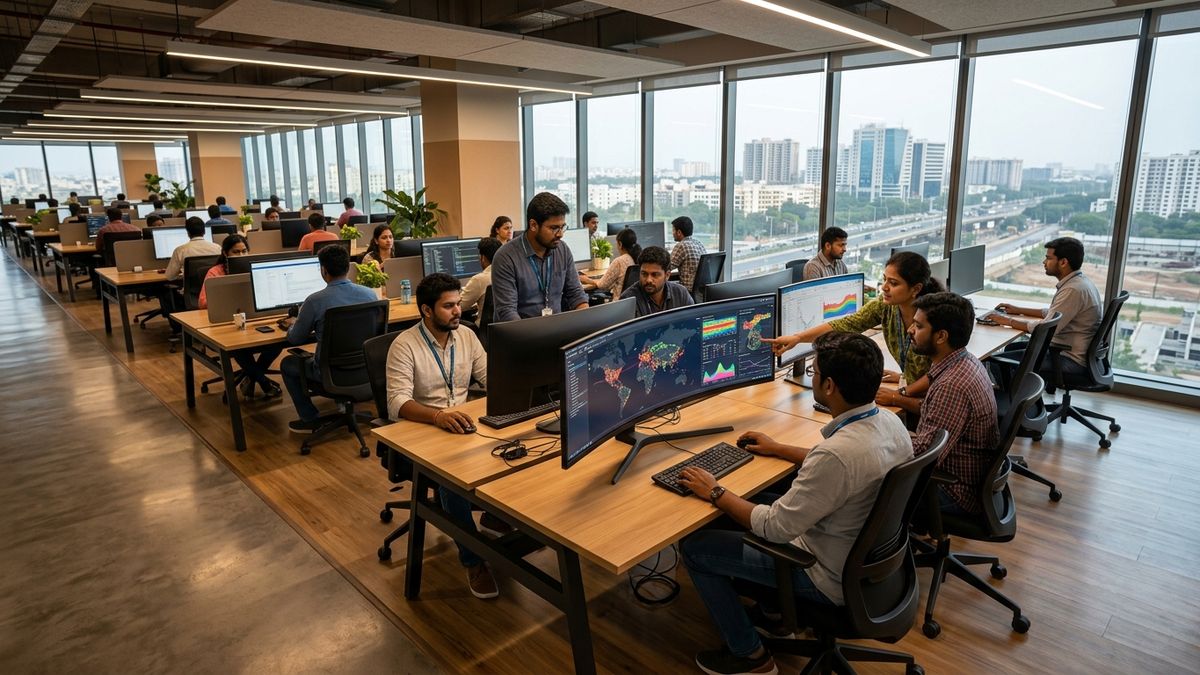
The aggressive recruitment drive will concentrate on high-complexity technical domains, specifically targeting Artificial Intelligence (AI), deep data engineering, connected-vehicle telematics, and software-defined vehicle (SDV) architectures. The positions will be distributed across Ford's world-class technology campuses in Chennai and Bengaluru, expanding an established Indian workforce that already exceeds 12,000 engineers, data scientists, and digital product specialists.
This strategic expansion demonstrates the continuing evolution of Indian capability centres from operational back-offices into primary software engineering nerve centers. The move reflects the systemic tech talent upskilling detailed in India’s AI Learning Boom Accelerates as Engineering Students and IT Professionals Race to Secure GenAI Skills and aligns directly with enterprise model efficiencies analyzed in IBM CEO Arvind Krishna Champions Smaller, Smarter AI Models: Why Specialized Architectures Outperform Trillion-Parameter LLMs.
The Software-Defined Transformation: Why Legacy Automakers Are Betting on India
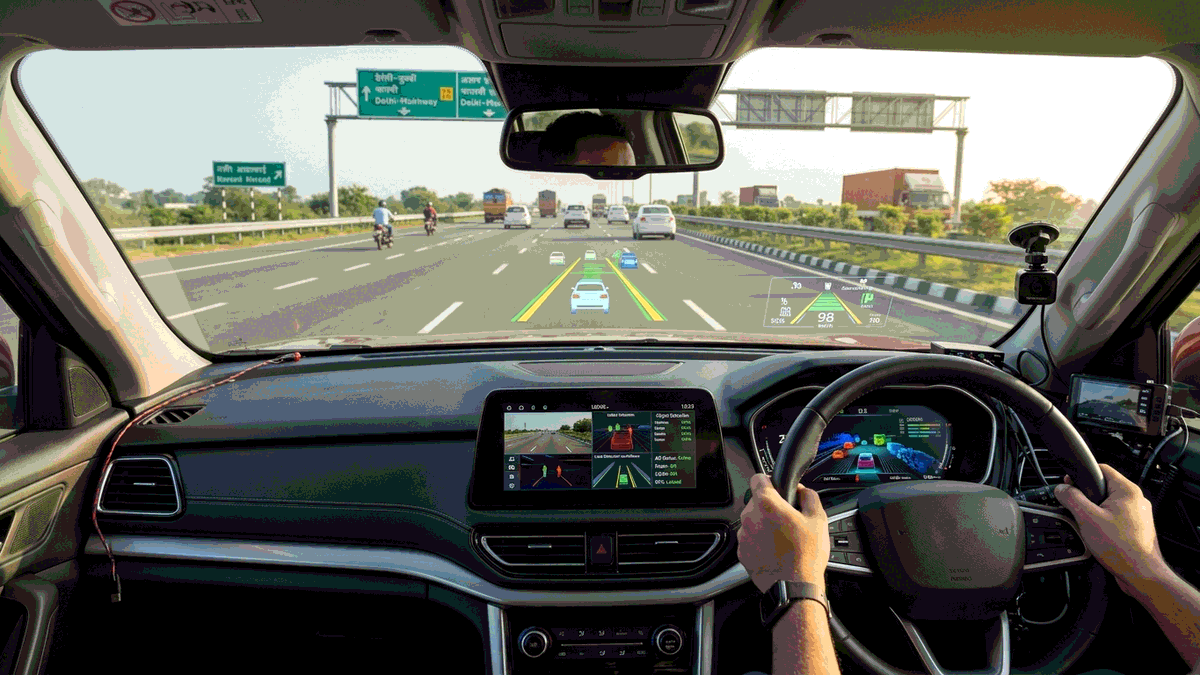
The automotive sector is undergoing its most radical transformation since the invention of the assembly line. Modern vehicles are no longer purely mechanical assemblies of engines, transmissions, and chassis; they are distributed supercomputers on wheels, executing upwards of 150 million lines of code across centralized zonal controllers.
Ford has committed tens of billions of dollars globally to transition its vehicle portfolio toward electric propulsion and intelligent connectivity under its Ford Blue, Ford Model e, and Ford Pro divisions. Crucial to this transformation is the development of in-house software stacks that govern everything from battery thermal management and autonomous driving assistance (ADAS) to predictive fleet analytics.
"Our Global Capability Centres in India have ceased to be support arms; they are co-architects of Ford's most critical software-defined vehicle platforms,"noted automotive leadership tracking the expansion. "By onboarding 500 world-class AI and software specialists in Chennai and Bengaluru, Ford is securing the architectural bandwidth required to build resilient, self-healing vehicle operating systems."
Rather than engaging in mass commodity IT recruitment, Ford is adopting a calibrated hiring strategy targeting senior specialists. The new hires will engineer solutions for:
- Predictive Battery Management Systems (BMS): Leveraging machine learning models to forecast individual lithium-ion cell degradation based on ambient driving temperatures, fast-charging frequency, and throttle habits.
- Over-The-Air (OTA) Firmware Orchestration: Building zero-downtime, cryptographically verified pipelines to update safety-critical automotive ECUs without requiring dealership visits.
- Enterprise Generative AI: Implementing internal agentic workflows across supply chain logistics, warranty claim automated diagnostics, and financial risk modeling.
Strategic Focus Areas of Ford India GCC Tech Expansion
The table below delineates the specialized technical roles being created and their direct deliverables to Ford's global product roadmap:
| Technology Domain | Target Skillset | Primary Engineering Deliverable | Global Business Impact |
|---|---|---|---|
| Connected Vehicle Telematics | MQTT, CAN-bus parsing, Kafka, Rust | High-throughput streaming data pipeline for 10M+ connected vehicles | Real-time vehicle health monitoring and remote diagnostic telemetry |
| Battery Intelligence & AI | Deep learning, Python, PyTorch, MATLAB/Simulink | Machine learning algorithms predicting battery state-of-charge & thermal health | 18% extension in electric vehicle battery pack lifespan |
| Software-Defined Vehicle (SDV) | Embedded Linux, QNX, AUTOSAR Adaptive | Zonal compute controller firmware and hardware abstraction layers | Decoupling vehicle software releases from multi-year hardware manufacturing cycles |
| Autonomous & ADAS Systems | Computer vision, sensor fusion, C++, ROS | Sensor fusion algorithms processing camera, radar, and lidar telemetry | Advanced lane centering, automated valet parking, and driver alertness monitoring |
| Cloud & Enterprise Data | AWS, Azure, Snowflake, Kubernetes | Enterprise data lakehouse consolidating telemetry, dealership CRM, & parts inventory | Sub-second enterprise queries optimizing global supply chain procurement |
The Talent Advantage: Chennai and Bengaluru as Global Automotive Tech Hubs
Ford's decision to deepen its Indian footprint highlights the exceptional maturity of the domestic automotive engineering ecosystem. Chennai, traditionally known as the "Detroit of Asia" for its mechanical assembly plants, has rapidly transformed into an advanced automotive software hub. Concurrently, Bengaluru offers an unmatched density of cloud software engineers, embedded firmware developers, and AI researchers.
By anchoring its digital engineering operations in India, Ford joins global peers like Mercedes-Benz R&D, Bosch, Continental, and Stellantis in recognizing that the future of automotive mobility—clean, connected, and autonomous—will be coded in India.