Kerala deeptech leader Genrobotics signs landmark MoU with the Territorial Army at KYTA 2.0 to deploy humanoid robots, remote rovers, and medical rehabilitation exoskeletons.
Executive Key Takeaways
- Kerala deeptech leader Genrobotics signs landmark MoU with the Territorial Army at KYTA 2.0 to deploy humanoid robots, remote rovers, and medical rehabilitation exoskeletons.
- Our mission has always been to leverage advanced robotics to preserve and protect human life in the most hazardous environments on earth, stated Vimal Govind M.K., CEO of Genrobotics. Partnering with the Territorial Army allows us to bring world-class, homegrown robotic engineering to our nation's armed forces, enhancing operational agility while safeguarding the lives of our soldiers in critical missions.
- Key Benchmark: **G-Bot** — Bipedal articulated humanoid robot
KOLKATA — In a major development for indigenous defense technology and military robotics, Kerala-based deeptech innovator Genrobotics has signed a landmark Memorandum of Understanding (MoU) with the Indian Territorial Army (TA).
The strategic agreement was officially formalized during the high-level KYTA & TA 2.0 Symposium held in Kolkata. The pact was signed by Vimal Govind M.K., Chief Executive Officer and co-founder of Genrobotics, and Major General SS Patil, Additional Director General of the Territorial Army. Under the partnership, the two organizations will collaborate closely on advanced robotics research, defense technology demonstrations, simulated user trials, and specialized training programs designed to modernize military engineer operations.
The collaboration marks a watershed moment in the commercial-to-defense technology transfer, demonstrating how civilian dual-use robotics can directly bolster national security. The partnership exemplifies the sovereign deeptech momentum explored in India’s Deeptech Ecosystem Gains Policy and Funding Momentum: Capital Pivots to Semiconductors, Quantum, and Hard Tech and reinforces the critical role of specialized computing platforms featured in India Approves ₹731 Crore Quantum & AI University in Amaravati: MeitY Backs 8.5-Acre Deeptech Research Hub.
From Eradicating Manual Scavenging to High-Altitude Military Engineering
Genrobotics initially rose to international acclaim for developing Bandicoot, the world’s first robotic scavenger, which has replaced dehumanizing manual sewer scavenging across more than 20 Indian states. Recognizing that the harsh, corrosive, and lethal confined environments of subterranean sewers share identical robotic challenges with military bunkers, tunnels, and collapsed disaster zones, Genrobotics systematically adapted its core mechatronic IP into defense and medical applications.
At the KYTA symposium, Genrobotics provided the Territorial Army with a comprehensive showcase of its advanced robotic platforms:
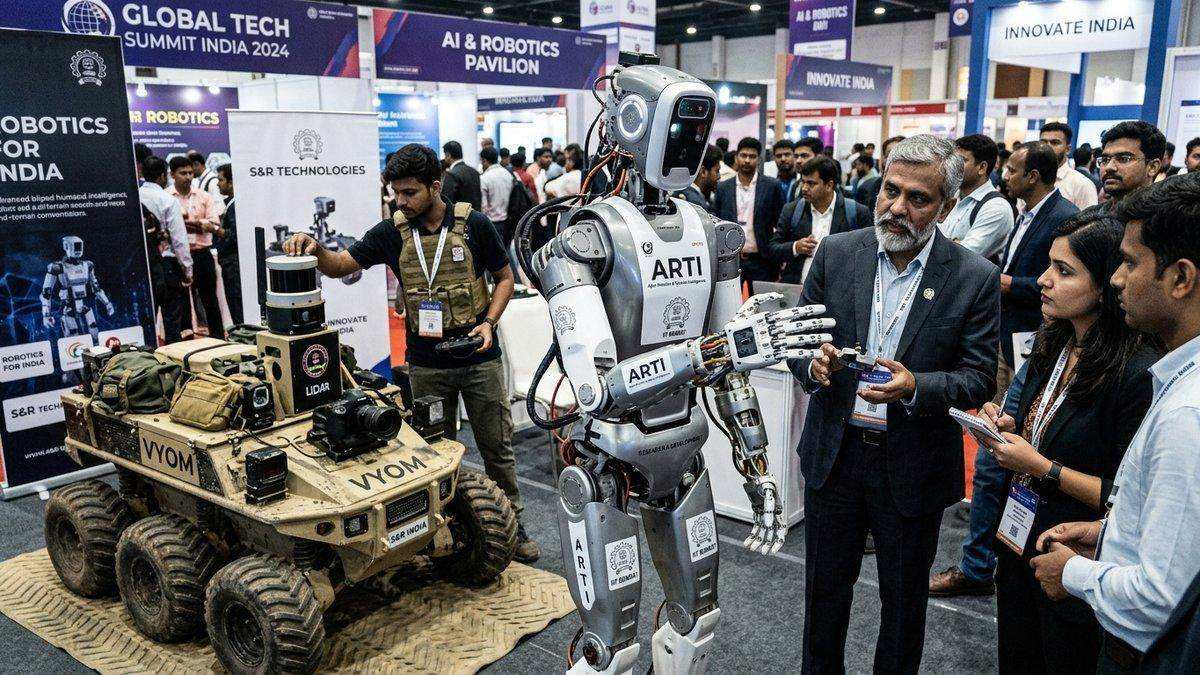
1. G-Bot (Humanoid Robot Prototype): Making its public debut, G-Bot is an indigenous bipedal humanoid robot designed to navigate human-built environments—including stairs, narrow trenches, and vertical access hatches—carrying reconnaissance and manipulation payloads where wheeled or tracked vehicles cannot venture.
2. Genbot: A ruggedized, tele-operated tactical robot engineered for hazardous inspection, chemical detection, and remote explosive ordnance evaluation.
3. Robotic Rovers: Multipurpose unmanned ground vehicles (UGVs) equipped with multi-spectral vision and lidar sensors for border terrain mapping and subterranean tunnel inspection.
4. G-KAI (Rehabilitation Exoskeleton): An advanced medical robotics platform developed for gait and upper-limb neuro-rehabilitation, designed to assist military veterans and soldiers recovering from spinal trauma and ballistic injuries.
"Our mission has always been to leverage advanced robotics to preserve and protect human life in the most hazardous environments on earth,"stated Vimal Govind M.K., CEO of Genrobotics. "Partnering with the Territorial Army allows us to bring world-class, homegrown robotic engineering to our nation's armed forces, enhancing operational agility while safeguarding the lives of our soldiers in critical missions."
Operational Matrix: Genrobotics Defence Platforms and Military Applications
The structured table below outlines the core specifications and operational deployment scenarios for Genrobotics platforms under the Territorial Army partnership:
| Platform Name | Form Factor & Mobility | Core Sensing & Payload | Targeted Military Scenario | Operational Benefit |
|---|---|---|---|---|
| G-Bot | Bipedal articulated humanoid robot | Multi-camera stereoscopic vision, tactile grippers | Urban combat reconnaissance, naval shipboard breach, bunker navigation | Traverses human staircases and confined vertical portals autonomously |
| Genbot | Heavy-duty compact tracked rover | Thermal imaging, chemical hazard sniffer, robotic arm | Confined space clearance, post-blast inspection, culvert verification | Eliminates soldier exposure to lethal airborne toxins and unexploded munitions |
| Tactical UGV Rover | All-terrain 4x4 / 6x6 high-clearance rover | 3D Solid-State LiDAR, high-gain mesh communication relay | Border patrol perimeter security, remote terrain mapping, supply mule | Operates in extreme weather (-30°C to +55°C) across rough rocky terrain |
| G-KAI Exoskeleton | Wearable powered robotic orthosis | EMG neural muscle sensors, automated weight-support motors | Military hospital neuro-trauma recovery, spinal cord injury rehabilitation | Accelerates veteran mobility recovery timelines by up to 50% |
Humanitarian Assistance, Disaster Relief (HADR), and Sovereign Defense Moats
A pivotal pillar of the Territorial Army's constitutional mandate is providing immediate disaster relief during civilian emergencies, including major earthquakes, cloudbursts, landslides, and industrial accidents. When catastrophic landslides strike the fragile Himalayan terrain or the Western Ghats, traditional heavy machinery frequently destabilizes loose soil, endangering trapped survivors.
Deploying compact, remotely operated robotic crawlers and humanoid manipulators enables the Territorial Army to probe subterranean voids, locate survivors through thermal and acoustic sensors, and clear debris without risking rescuer casualties.
Furthermore, this partnership reflects the accelerating success of India's Atmanirbhar Bharat (Self-Reliant India) initiative in defense technology. By bypassing costly foreign defense imports in favor of co-developing dual-use intellectual property with Indian deeptech startups, the Armed Forces ensure that mission-critical hardware can be manufactured, repaired, and upgraded rapidly within domestic supply chains.