India Wants to Build More Than Just Cars: Hyundai Leadership Urges Global Mobility Platform Push
By Karthik Ramaswamy | Published August 18, 2026 | 7 min read
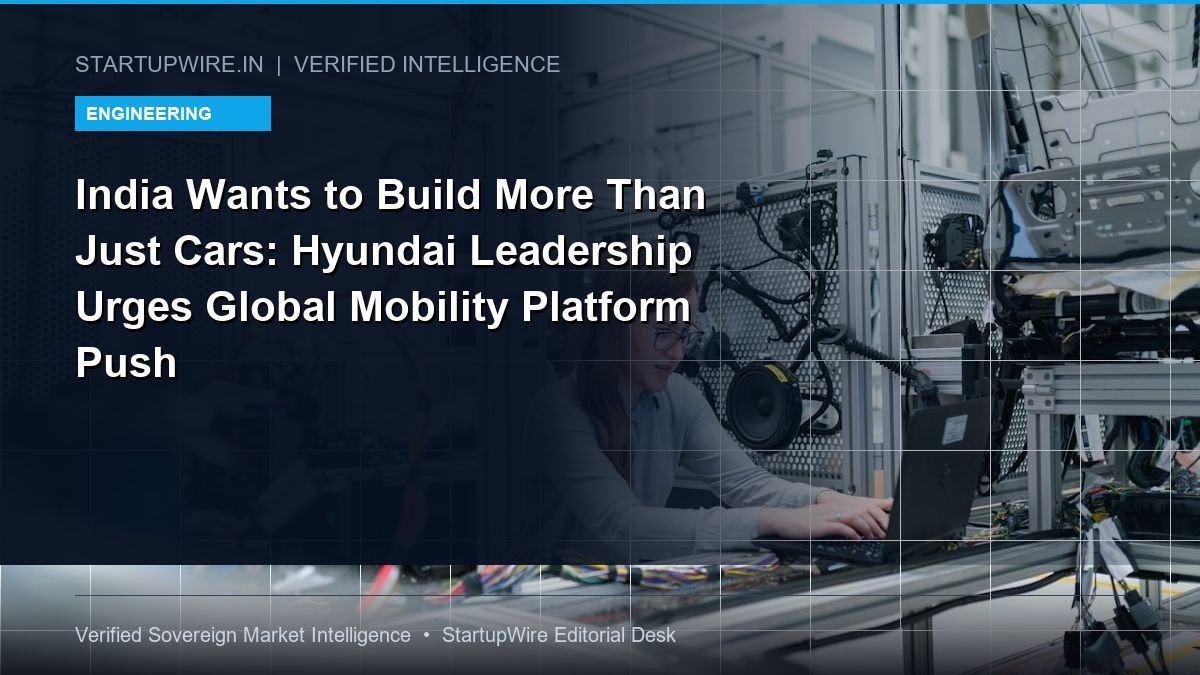
Hyundai Motor India leadership calls for India to move beyond vehicle assembly and exports to architect globally competitive, software-defined mobility platforms.
Senior leadership at Hyundai Motor India has articulated a bold strategic vision for the nation's automotive and transportation ecosystem: India must transcend its traditional identity as a cost-effective vehicle assembly and export base to become a global nerve center for software-defined mobility platforms, autonomous systems, and advanced powertrain engineering.
Speaking on the future of Indian manufacturing following Hyundai Motor India's historic market listing, leadership emphasized that the automotive sector's value pool is permanently shifting from steel stamping and mechanical assembly toward software architecture, telematics, battery management systems (BMS), and connected cockpit operating systems.
The Paradigm Shift: From Assembling Vehicles to Architecting Mobility
For the past three decades, India built a world-class automotive manufacturing hub in Chennai, Pune, and the NCR, producing millions of internal combustion engine (ICE) passenger cars for domestic consumption and export. However, the global mobility landscape is being fundamentally redefined by the electrification, autonomous driving, and software-defined vehicle (SDV) megatrends.
| Manufacturing Paradigm | Traditional Automotive Export Model | Software-Defined Mobility Platform Paradigm |
|---|---|---|
| Core Value Driver | Mechanical assembly, chassis stamping, engine tuning | Embedded software, OTA operating systems, neural compute chips |
| Revenue Stream | One-time vehicle sales transaction | Recurring software subscriptions, telematics services, energy management |
| Engineering Focus | Mechanical & metallurgical engineering | Full-stack software, embedded Linux, AI perception, cloud telematics |
| Export Profile | C-segment and sub-compact cars to emerging markets | Global skateboard architectures, autonomous stacks, and battery IP |
| Domestic Value Add | 45%–60% (heavily reliant on imported electronics) | 80%+ (domestically engineered software, silicon, and cells) |
Capitalizing on India's Dual Advantage: Software and Manufacturing Scale
Hyundai leadership underscored that India is uniquely positioned to lead the global mobility transition because it combines two critical competencies rarely found together in a single geography: world-class automotive manufacturing depth and a 5-million-strong software engineering talent pool.
"The car of today is a high-performance computer on wheels. India cannot be satisfied with merely assembling metal bodies. We have the software engineers, the electronics talent, and the market scale to design global electric skateboard platforms right here,"remarked a senior Hyundai Motor India engineering executive.
Strategic Imperatives for the Indian Mobility Ecosystem:
1. Localization of High-Voltage Electronics: Establishing domestic manufacturing for silicon-carbide (SiC) inverters, integrated motor controllers, and BMS microcontrollers.
2. Sovereign Telematics & Connected OS: Developing proprietary, localized connected-car software architectures that integrate seamlessly with Indian road conditions and languages.
3. Battery Chemistry Tailored for Tropical Climates: R&D in LFP (Lithium Iron Phosphate) and solid-state battery chemistries optimized for 45°C+ operating temperatures without thermal runaway risks.
Cross-Industry Industrial Synergies
The push toward next-gen mobility platforms aligns closely with broader domestic industrial collaborations, such as the Voltas and Atomberg 50:50 joint venture for motor and compressor manufacturing.
Furthermore, as India operationalizes 12 semiconductor projects worth ₹1.64 lakh crore, the domestic automotive supply chain will gain direct access to homegrown microcontrollers and power management ICs, unlocking complete technological sovereignty.