India’s SpaceTech Horizon: Private Startups Commercialize Low Earth Orbit and Satellite Earth Observation
By Karthik Subramanian | Published August 20, 2026 | 8 min read
Backed by IN-SPACe deregulation and defense procurement, private Indian space startups like Skyroot, Agnikul, and Pixxel are converting orbital launch capabilities into recurring commercial revenue.
India's private aerospace and space technology sector has crossed a pivotal threshold, evolving from speculative academic research into a high-growth commercial deep-tech industry. Fueled by strategic deregulation under the Indian National Space Promotion and Authorization Centre (IN-SPACe) and rising capital allocation from both domestic venture funds and sovereign defense agencies, Indian SpaceTech startups are securing long-term recurring contracts for orbital satellite deployments, high-resolution hyperspectral imagery, and precision launch vehicle services.
With global demand for Low Earth Orbit (LEO) satellite constellations surging across communications, precision agriculture, and geopolitical defense intelligence, Indian space enterprises are positioning themselves as high-reliability, low-cost alternatives to Western commercial aerospace primes.
Private Indian SpaceTech: Key Commercial Segments
The Indian private space ecosystem is anchored around three high-value technological domains:
| Commercial Domain | Pioneer Startups | Core Innovation & Technology | Target Market & Use Cases |
|---|---|---|---|
| Small Satellite Launch Vehicles (SSLVs) | Skyroot Aerospace, Agnikul Cosmos | 3D-printed cryogenic/semi-cryogenic rocket engines; modular carbon-composite airframes | Dedicated on-demand rideshare orbital delivery for 100kg–500kg payloads |
| Hyperspectral Earth Observation | Pixxel, GalaxEye Space | Multi-band optical & Synthetic Aperture Radar (SAR) sensor constellations | Soil health metrics, mineral exploration, maritime monitoring & military reconnaissance |
| In-Orbit Propulsion & Space Situational Awareness | Digantara, Bellatrix Aerospace | Space debris tracking sensors, green monopropellant thrusters & electric propulsion | Satellite life extension, collision avoidance, and orbital station-keeping |
The Economics of Responsive Orbital Launch
Historically, small satellite operators faced long lead times and restrictive payload schedules while booking secondary rideshare slots on heavy-lift government rockets. Indian launch pioneers have disrupted this dynamic through modular manufacturing architectures:
- Single-Piece 3D Printed Engines: Agnikul’s semi-cryogenic Agnilet and Skyroot’s Raman engines eliminate hundreds of individual sub-assembly welds, cutting engine manufacturing cycles from months to days while drastically minimizing component failure modes.
- Mobile Autonomous Launch Platforms: By decoupling launch operations from fixed, high-overhead launch pads, modern SSLV systems enable rapid military and commercial deployments within 72-hour notice windows.
- Cost-Per-Kilogram Parity: Through domestic supply chains and precision machining clusters in Hyderabad, Chennai, and Mumbai, Indian launch providers are targeting commercial orbital delivery rates below $18,000 per kilogram for dedicated sun-synchronous orbits.
Space-Based Data as a Service (DaaS)
While launch vehicles capture headlines, the highest-margin commercial opportunities lie in the downstream Earth Observation (EO) and analytics layer. Hyperspectral imaging constellations capture data across dozens of narrow spectral bands invisible to traditional RGB satellites, enabling real-time detection of crop disease pathogens, gas pipeline leaks, and covert defense camouflage.
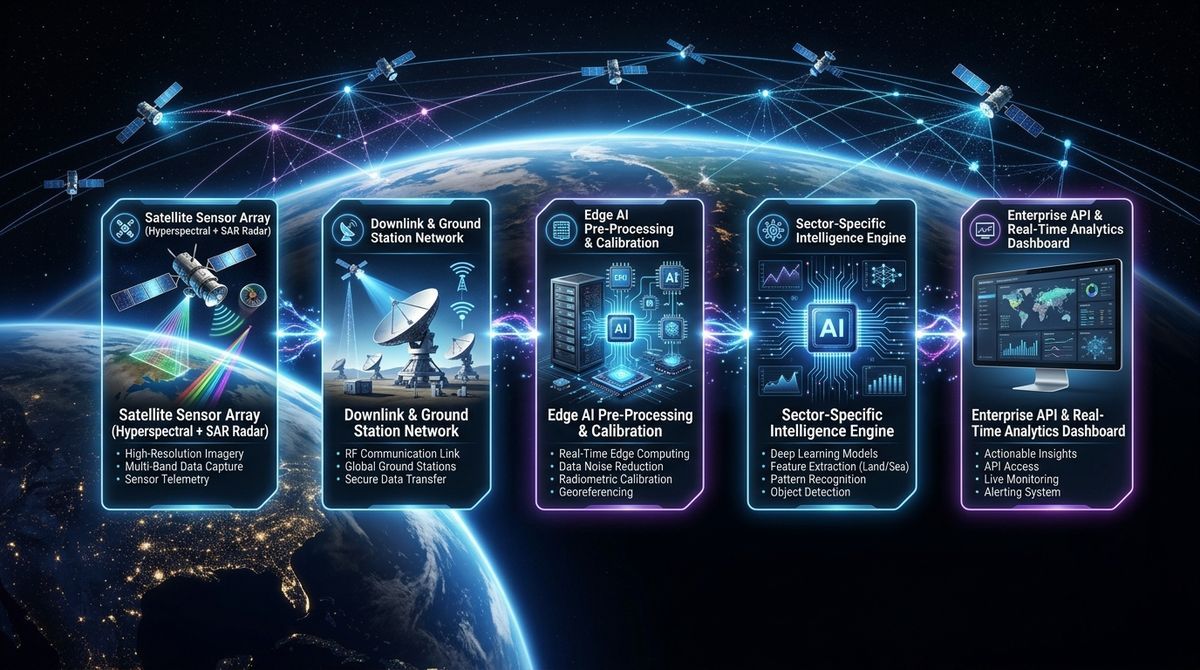
By packaging raw sensor streams into clean enterprise APIs, Indian SpaceTech companies are generating high-retention annual recurring revenue (ARR) from global agriculture conglomerates, commodity trading desks, and international climate monitoring agencies.
Sovereign Tailwinds and Capital Acceleration
The expansion of India's commercial space sector is heavily catalyzed by strategic government policies:
1. ₹1,000 Crore IN-SPACe Venture Capital Fund: Dedicated sovereign backing designed to support early-stage aerospace hardware prototypes through technical qualification and spaceflight validation.
2. iDEX (Innovations for Defence Excellence) Contracts: Direct grant procurement for indigenous defense payloads, including cryogenic cooling sensors (such as the Techno Defence miniature cryocooler milestone).
3. Commercial FDI Liberalization: 100% foreign direct investment allowance across satellite manufacturing and up to 74% for satellite launch services, driving global institutional capital into Indian aerospace tech hubs.
"The democratization of access to orbit is no longer just about national prestige; it is the critical infrastructure layer underpinning global logistics, telecommunications, and sovereign security."
As launch cadences increase throughout 2026, Indian space enterprises are demonstrating that low-cost, high-precision deep-tech engineering can compete and win on the global commercial stage.
Track deep-tech aerospace startups and funding trends on our VC Radar and discover verified companies in the Ecosystem Directory.