VELLOE Concludes AI Hackathon in Noida Connecting Engineering Graduates with Industry Deeptech Problem-Solving
By Karthik Ramaswamy | Published September 30, 2026 | 7 min read
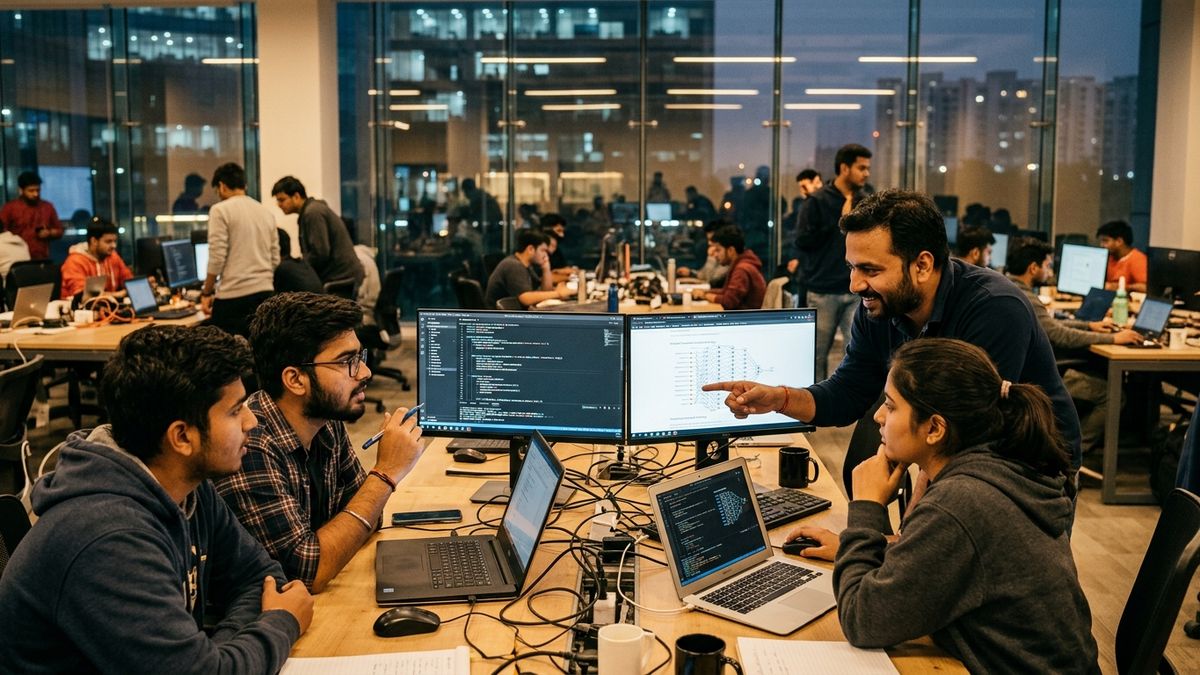
Noida-based VELLOE concludes an intensive industry-academia AI hackathon, granting final-year engineering students hands-on access to solve real-world industrial challenges.
Noida-based artificial intelligence solutions enterprise VELLOE has successfully concluded its high-impact industry-academia AI hackathon, providing hundreds of final-year engineering students with direct, hands-on immersion into enterprise deeptech problem-solving. The multi-day sprint brought together premier undergraduate engineers from across the National Capital Region (NCR) and North Indian technical universities, pairing them directly with seasoned software architects, data scientists, and hardware engineers to construct operational machine learning prototypes.
In an era where the software paradigm is undergoing rapid structural transformation toward AI-native engineering architectures, standard academic coursework often lags behind production-grade reality. The VELLOE AI hackathon directly tackled this systemic bottleneck, challenging student cohorts not with toy classroom datasets, but with raw, uncurated enterprise telemetry, real-time computer vision feeds, and complex edge hardware constraints.
The initiative also mirrors India's strategic push to cultivate world-class technical talent, reinforcing the capabilities highlighted across India's domestic chip design and deeptech engineering workforce.
Dismantling the Engineering Employability Paradox
India graduates more than 1.5 million engineering students each year, establishing the nation as one of the world's largest pools of technical manpower. However, industry assessments consistently reveal a glaring disconnect: fewer than 10% of graduating computer science and electronics engineers possess the practical competencies required to design, train, evaluate, and deploy scalable artificial intelligence systems in production.
Traditional academic curricula prioritize theoretical proofs, memorized algorithms, and basic textbook exercises. When students enter modern technology enterprises, they frequently encounter unfamiliar enterprise stacks:
- Distributed model training and parameter-efficient fine-tuning (PEFT/LoRA).
- High-throughput asynchronous API microservices and containerized Docker/Kubernetes clusters.
- Low-latency model quantization (INT8/FP4) on edge accelerators.
- Continuous model observability, drift tracking, and adversarial safety guardrails.
"Engineering education cannot remain confined to chalkboards and simulated multiple-choice exams,"remarked the organizing leadership at VELLOE. "By immersing engineering graduates in messy, real-world enterprise engineering sprints, we accelerate their technical maturity by years. The hackathon proved that when given access to production tooling and industrial mentors, Indian students can build world-class deeptech solutions."
Hackathon Challenge Tracks: From Industrial Vision to Edge Agents
The hackathon was structured around three intensive operational problem statements sourced directly from industrial enterprises:
1. Automated Industrial Defect Inspection via Edge Vision: Engineering teams ingested high-speed camera feeds simulating manufacturing assembly lines. The challenge required detecting microscopic surface cracks and soldering anomalies in real time under variable lighting conditions, running inference on low-power edge compute boards at under 15 milliseconds per frame.
2. Autonomous Multi-Agent Supply Chain Optimization: Participants developed agentic decision loops that ingested live weather telemetry, fuel pricing fluctuations, and fleet GPS coordinates to autonomously reroute freight deliveries, reducing logistics overhead and vehicle idle time.
3. Domain-Specific Small Language Models (SLMs) for Regulatory Search: Moving beyond generic conversational chatbots, students fine-tuned open-source 3B and 8B parameter models to perform precise semantic retrieval and clause validation across lengthy enterprise compliance filings without generating hallucinations.
Academic vs. Production Engineering: The VELLOE Evaluation Matrix
The table below contrasts standard university academic engineering assignments with the live industrial production benchmarks enforced during the VELLOE hackathon:
| Evaluation Dimension | Standard University Coursework | VELLOE Production Hackathon Standard |
|---|---|---|
| Data Nature | Clean, pre-packaged CSV datasets | Noisy, multi-modal, real-time sensor streams |
| Model Evaluation | Raw test accuracy percentage | Latency, throughput (FPS), memory footprint, P99 times |
| Deployment Target | Local Jupyter Notebook environment | Containerized microservice running on edge hardware |
| Failure Modes | Ignored if accuracy is high | Rigorous testing for edge cases and input drift |
| Code Modularity | Monolithic script files | Clean modular Git repos with CI/CD validation |
| Business Alignment | Theoretical grading criteria | Concrete unit economics and business ROI metric |
Direct Career Pathways: Pre-Placement Offers and Incubation
The culmination of the hackathon delivered immediate tangible career outcomes for student participants. Rather than awarding superficial certificates, VELLOE and collaborating corporate partners extended direct Pre-Placement Offers (PPOs) to the top 15 graduating engineers, circumventing traditional bureaucratic placement drives.
Furthermore, the winning team—which developed an indigenously optimized computer vision inference pipeline for automated textile flaw classification—secured a seed incubation grant and dedicated technical mentorship to convert their prototype into a commercial venture.
Building India's Frontier AI Engineering Pipeline
As global technology giants and domestic startups expand their research and engineering centers across Noida, Gurugram, and Bengaluru, initiatives like the VELLOE AI hackathon serve as critical workforce catalysts. By transforming student developers into battle-tested deeptech practitioners, North India's engineering corridor is establishing itself as a vital powerhouse for applied artificial intelligence innovation.
Frequently Asked Questions
What was the primary objective of the VELLOE AI Hackathon in Noida?
The hackathon aimed to bridge the persistent gap between textbook engineering academic curricula and live production-grade AI engineering, giving final-year students hands-on experience solving complex enterprise problems under the mentorship of senior industry architects.
What practical problem tracks were featured during the competition?
Key challenge domains included automated computer vision for factory defect detection, agentic supply chain logistics optimization, domain-specific small language model (SLM) document analysis, and edge sensor telemetry for industrial IoT.
What rewards and career opportunities were provided to winning student teams?
Beyond cash grants, top-performing finalists received direct pre-placement job offers (PPOs) at participating enterprise deeptech firms, paid research fellowships, and incubation support to commercialize their prototypes.
Why is industry-led hackathon training vital for India's engineering workforce?
While India graduates over 1.5 million engineers annually, industry reports indicate that fewer than 10% possess production-grade machine learning and cloud deployment skills. Initiatives like VELLOE's hackathon provide the high-velocity experiential training needed to produce job-ready AI engineers.
Primary Sources & Official References
- VELLOE Technology Solutions: Hackathon Official Results & Innovation Summary
- All India Council for Technical Education (AICTE): Industry-Academia Collaborative Framework
- NASSCOM FutureSkills Prime: Engineering Employability and Emerging Technologies Report
- National Institute of Electronics and Information Technology (NIELIT): Applied AI Curriculum Review