Agnikul Cosmos scales testing, factory throughput, and recovery architectures to make its 3D-printed Agnibaan rocket reusable, lowering launch costs for global small satellites.
Executive Key Takeaways
- Agnikul Cosmos scales testing, factory throughput, and recovery architectures to make its 3D-printed Agnibaan rocket reusable, lowering launch costs for global small satellites.
- Reusability in small launch vehicles was traditionally considered uneconomical due to payload-to-orbit penalties, explained Srinath Ravichandran, Co-founder and CEO of Agnikul Cosmos. However, our monolithic additive manufacturing fundamentally changes rocket economics. When your engine contains zero welds, assembly labor drops to near zero. By adding stage recovery, we can turnaround launch vehicles within weeks, providing satellite operators with true on-demand access to low Earth orbit.
- Key Benchmark: **LEO Payload Capacity (500 km)** — Up to 300 kg
CHENNAI & SRIHARIKOTA — Riding the momentum of its historic controlled flight test, Chennai-based aerospace pioneer Agnikul Cosmos has announced a massive multi-facility infrastructure expansion aimed squarely at industrializing reusable small-satellite launch systems. Spurred by surging global demand for dedicated orbital deployments and responsive launch cadence, the IIT Madras-incubated startup is expanding its advanced propulsion testing facilities, establishing a high-throughput additive manufacturing facility, and engineering structural recovery test stands to support the reusability roadmap for its flagship Agnibaan launch vehicle.
The strategic expansion builds on Agnikul's world-first achievement with Agnibaan SOrTeD (Sub-Orbital Technology Demonstrator), which validated the world's first single-piece, 3D-printed semi-cryogenic rocket engine—the Agnilet—in controlled flight from India's first private launch complex, Launchpad Alpha at Satish Dhawan Space Centre (SDSC) Sriharikota. By incorporating propulsive vertical landing algorithms, aerodynamic grid fins, and multi-restart semi-cryogenic engines, Agnikul is developing an accessible, recoverable small-launcher architecture capable of radically lowering launch costs across the Indo-Pacific.
This aggressive infrastructure push integrates seamlessly into the broader liberalization of national spaceflight resources, detailed in our report on how ISRO Opens More Doors for India's Private Space Sector, proving that commercial space infrastructure is rapidly scaling from experimental prototypes into sustained industrial operations.
Industrializing the World's First Single-Piece 3D-Printed Engine
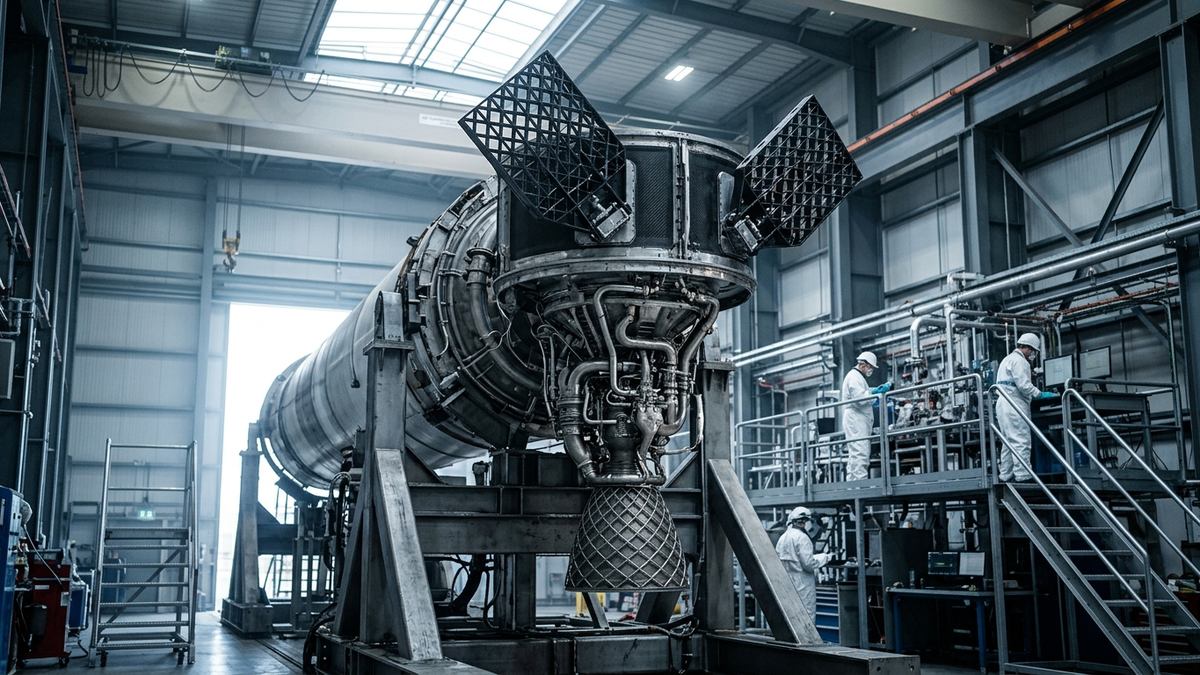
At the core of Agnikul's competitive moat is the Agnilet rocket engine: a sub-cooled semi-cryogenic propulsion unit utilizing aviation turbine fuel (kerosene) and liquid oxygen (LOX). Unlike conventional liquid rocket engines that assemble hundreds of precision-machined injectors, cooling jackets, manifolds, and combustion chamber shells with complex brazing and welding joints, Agnilet is printed as a single monolithic component via selective laser melting (SLM) in high-nickel aerospace superalloys.
Agnikul's new infrastructure expansion dramatically accelerates production capacity across key areas:
1. Monolithic Additive Manufacturing Throughput
Expanding additive manufacturing bays at IIT Madras Research Park to house large-format metal 3D printers, reducing the production cycle of an entire Agnilet engine from several months to under 72 hours.
2. Multi-Duration Propulsion Hot-Fire Test Stands
Constructing dedicated semi-cryogenic test benches capable of conducting multi-minute, full-duration burn tests, throttle sweep calibrations, and hot-gas reignition testing required for propulsive rocket landing.
3. Industrial Computed Tomography and Metrology
Deploying industrial computed tomography (CT) scanning and ultrasonic defect metrology to ensure micro-structural integrity of internal regenerative cooling channels without destroying flight-ready articles.
"Reusability in small launch vehicles was traditionally considered uneconomical due to payload-to-orbit penalties,"explained Srinath Ravichandran, Co-founder and CEO of Agnikul Cosmos. "However, our monolithic additive manufacturing fundamentally changes rocket economics. When your engine contains zero welds, assembly labor drops to near zero. By adding stage recovery, we can turnaround launch vehicles within weeks, providing satellite operators with true on-demand access to low Earth orbit."
Engineering Stage-1 Reusability: Grid Fins, Gimbaling, and Deep Throttling
Recovering an orbital booster stage during atmospheric re-entry requires solving severe aerothermal, structural, and guidance challenges. Agnikul's engineering team is actively constructing dedicated structural test fixtures and wind-tunnel validation pipelines focusing on four mission-critical subsystems:
Steerable Aerodynamic Titanium Grid Fins
Deployed near the top of the booster stage during atmospheric descent, steerable grid fins provide high aerodynamic control authority across supersonic and subsonic regimes, stabilizing the stage along its descent corridor.
Deep-Throttling Clustered Semi-Cryogenic Propulsion
Reusable landings require rocket engines to throttle down significantly to prevent the decelerating booster from ascending before touchdown. Agnikul is engineering a clustered configuration of Agnilet engines on Stage-1 capable of deep throttling down to 40% thrust margins.
Autonomous Cold-Gas Attitude Guidance and Carbon-Composite Landing Legs
High-pressure nitrogen thruster pods installed along the interstage maintain pitch and roll orientation outside the dense atmosphere. Simultaneously, lightweight deployable landing legs fabricated from carbon-fiber reinforced composites with internal crushable aluminum honeycomb cartridges dissipate residual touchdown kinetic energy.
Architectural Comparison: Agnibaan Expendable vs Reusable Configuration
The structural table below outlines the engineering specifications, mission profiles, and operational parameters of Agnikul's Agnibaan launcher across its expendable baseline and forthcoming reusable iteration:
| Performance Metric | Agnibaan Baseline (Expendable) | Agnibaan Reusable (Stage-1 Recovery) | Strategic Engineering Advantage |
|---|---|---|---|
| LEO Payload Capacity (500 km) | Up to 300 kg | 180 – 220 kg (with recovery propellant reserve) | Flexible configuration based on customer mass requirements |
| First-Stage Propulsion | Clustered Agnilet Engines (LOX + Kerosene) | Clustered Agnilet with Gimbal & Deep-Throttle Valves | In-flight reignition capability for boostback and landing burns |
| Aerodynamic Control | Fixed aerodynamic fins | Steerable high-temp titanium grid fins | High control authority across hypersonic-to-subsonic re-entry |
| Turnaround Cycle Time | 4 – 6 weeks (new build per flight) | 7 – 14 days (post-recovery inspection and re-flight) | Order-of-magnitude increase in annual launch frequency |
| Launch Infrastructure | Mobile Launchpad Alpha (SDSC Sriharikota) | Launchpad Alpha + Coastal Landing Recovery Barge | Portability enables launch from flexible geographic azimuths |
| Target Launch Cost Index | Industry-standard small-sat benchmark | Estimated 40% – 55% reduction per kg | World-class price-to-orbit competitiveness |
Expanding Launchpad Alpha and Downrange Recovery Infrastructure
A unique aspect of Agnikul's operational model is its Launchpad Alpha, located inside the secure perimeter of ISRO's Satish Dhawan Space Centre (SDSC) in Sriharikota. Unlike rigid massive gantries, Launchpad Alpha was engineered with mobile checkout systems, compact umbilical masts, and containerized mission control rooms that can be transported anywhere along India's 7,500-kilometer coastline.
As part of the current infrastructure push, Agnikul is expanding Launchpad Alpha's launch complex to handle automated LOX and fuel cryogenic offloading, high-speed automated propellant chilldown, and dual-pad operations. Additionally, downrange naval recovery assets—including autonomous ocean-going landing platforms modeled for the Bay of Bengal—are entering preliminary engineering design.
This rapid industrialization of specialized aerospace hardware mirrors the high-tech scaling strategies observed in commercial platforms like LTTS's Platform to Help Deeptech Startups Scale, bridging the critical divide between laboratory prototypes and enterprise-grade manufacturing.
The Economics of On-Demand Commercial Space Access
The global small-satellite sector—encompassing telecommunications constellations, hyperspectral earth observation arrays, and IoT telemetry nodes—faces a chronic bottleneck: rideshare launches on heavy rockets force small operators to accept secondary orbits and multi-month delays.
Agnikul's customizable, reusable rocket infrastructure addresses this market directly:
1. Custom Orbital Insertion: Deploying satellites into bespoke orbits, inclinations, and altitudes without compromising mission parameters for a rideshare primary payload.
2. Responsive Rapid-Call Launch: Ability to integrate payloads and launch within 48 to 72 hours of customer notification, a vital capability for sovereign defense reconstitution and disaster relief missions.
3. Resilient Domestic Supply Chains: Manufacturing 100% of engine components within India protects Agnikul from international export control embargoes and geopolitical supply shocks, synchronizing with the domestic precision manufacturing capabilities highlighted in India's Sovereign High-Tech Industrial Policies.
With structural testing stands expanding and factory throughput scaling to dozens of engines annually, Agnikul Cosmos is carving out a formidable path toward sustainable, sovereign, and commercially dominant reusable spaceflight.