Backed by ₹47 crore, Electropreneur 2.0 expands beyond Bengaluru to incubate 500 hardware startups across tier-2 and tier-3 Indian hubs, accelerating sovereign electronics.
Executive Key Takeaways
- Backed by ₹47 crore, Electropreneur 2.0 expands beyond Bengaluru to incubate 500 hardware startups across tier-2 and tier-3 Indian hubs, accelerating sovereign electronics.
- For too long, Indian venture capital treated hardware as an afterthought, forcing brilliant embedded engineers to either migrate to Bengaluru or build software wrappers around imported hardware modules, stated Dr. Arvind Sharma, Senior Advisor for Electronics System Design and Manufacturing (ESDM) at STPI. Electropreneur 2.0 acknowledges that engineering talent resides across regional technical universities in tier-2 cities. By providing ₹47 crore in shared laboratory access, seed prototyping grants, and industry mentorship, we are converting lab thesis projects into commercially viable electronics exports.
- Key Benchmark: **Pune Hub** — Automotive, Robotics & Precision Tooling
NEW DELHI, PUNE & BHUBANESWAR — In a strategic bid to decentralize India's deep-tech hardware revolution beyond the traditional tech corridor of Bengaluru, the Ministry of Electronics and Information Technology (MeitY) and the Software Technology Parks of India (STPI) have officially rolled out Electropreneur 2.0. Backed by a newly sanctioned ₹47 crore financial outlay, the flagship incubation initiative aims to identify, incubate, and commercially scale 500 electronics and embedded systems hardware startups across emerging tier-2 and tier-3 cities over the next five years.
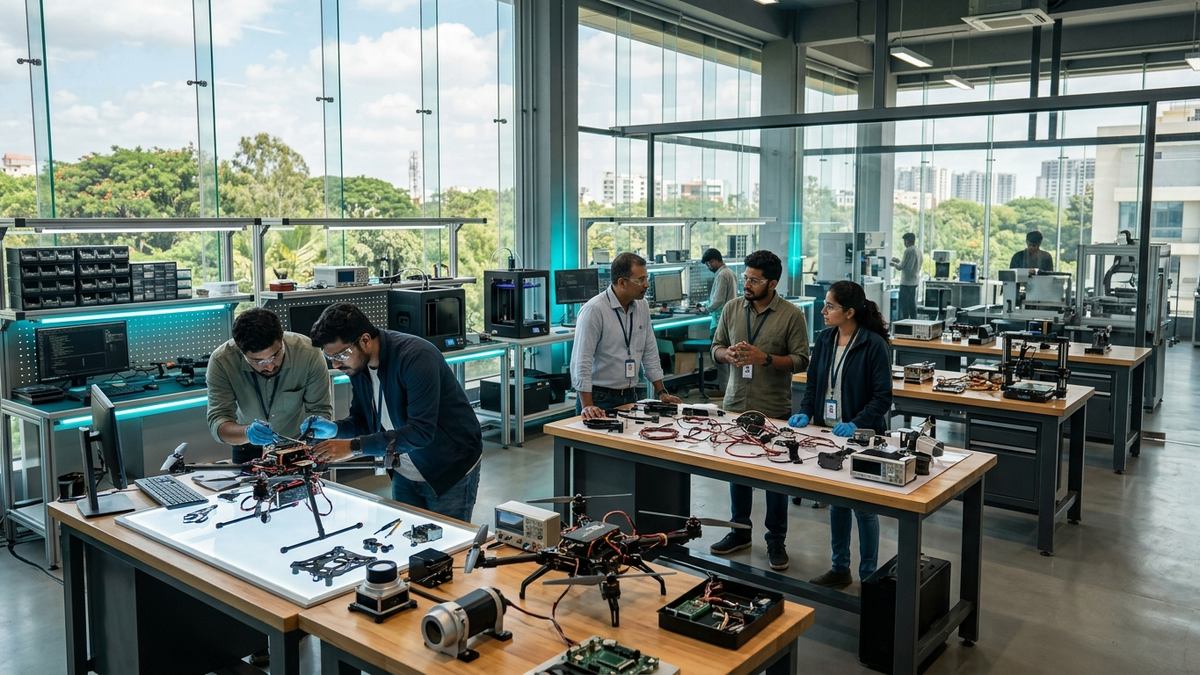
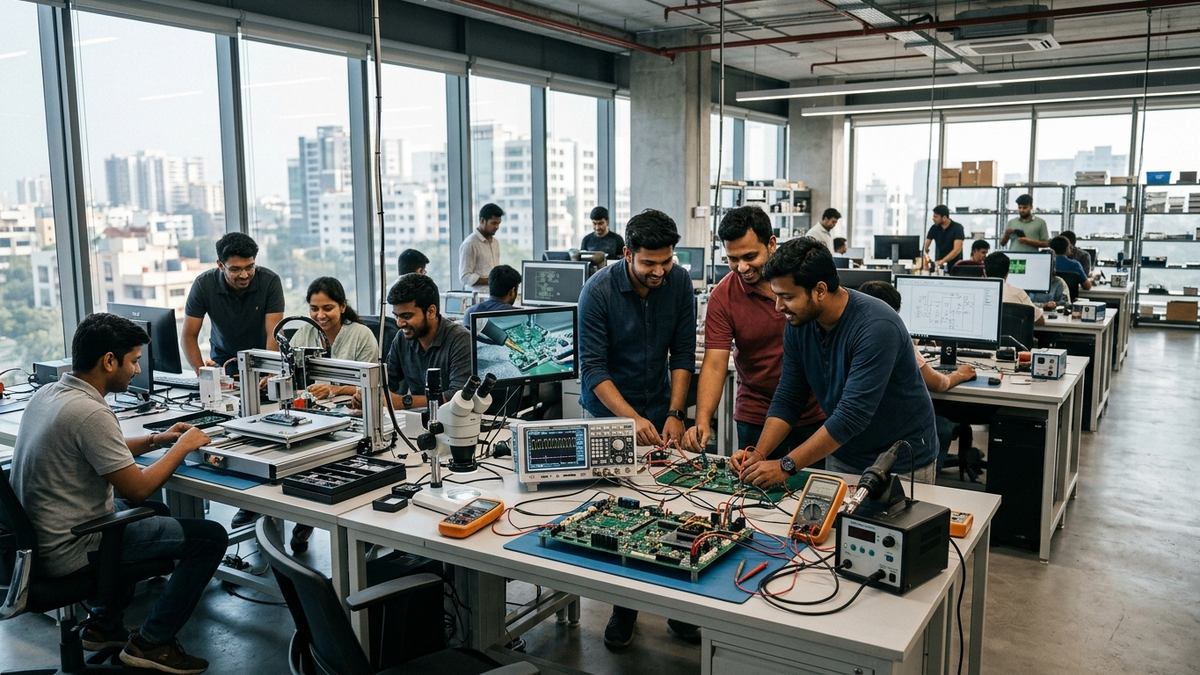
By targeting regional industrial hubs such as Pune, Bhubaneswar, Coimbatore, Jaipur, Kochi, and Visakhapatnam, Electropreneur 2.0 directly addresses the severe capital-expenditure bottleneck that has historically constrained domestic hardware engineering. Rather than forcing founders to navigate prohibitive real estate overheads or rely on expensive overseas prototyping facilities for printed circuit board (PCB) iterations, the program equips regional incubation centers with high-end radio frequency (RF) testing chambers, automated surface-mount technology (SMT) pick-and-place lines, and pre-compliance electromagnetic compatibility (EMC) testing rigs.
This regional hardware expansion complements national sovereign manufacturing priorities, working in tandem with the multi-billion-dollar semiconductor projects analyzed in India's ₹13 Billion Semiconductor Mission and industrial commercialization frameworks established in LTTS's Platform to Help Deeptech Startups Scale.
Escaping the Bengaluru Monoculture: Why Regional Hardware Hubs Matter
For more than two decades, Bengaluru has served as the undisputed capital of the Indian startup economy, capturing over 60% of total venture capital funding in digital technology. However, while software-as-a-service (SaaS) and consumer apps thrive within dense urban tech clusters, physical hardware engineering faces distinct operational realities:
1. Severe Operating Cost Pressures: Skyrocketing commercial leases and intense talent competition driven by global multinational GCCs (Global Capability Centers) make long-horizon hardware prototyping financially unsustainable for early-stage founders in Bengaluru.
2. Proximity to Industrial Manufacturing Ecosystems: Cities like Pune and Coimbatore already boast mature automotive, precision tooling, and heavy engineering supplier networks, providing hardware startups with immediate access to CNC machining shops, plastics molders, and specialized sheet-metal fabricators.
3. Untapped Academic Engineering Talent: Premier regional institutions, including regional NITs, IIT campuses outside metros, and government engineering colleges, graduate hundreds of thousands of electrical, mechanical, and instrumentation engineers annually who lack local deep-tech incubation support.
Electropreneur 2.0 systematically removes these structural friction points by embedding dedicated prototyping labs directly inside tier-2 and tier-3 engineering clusters.
"For too long, Indian venture capital treated hardware as an afterthought, forcing brilliant embedded engineers to either migrate to Bengaluru or build software wrappers around imported hardware modules,"stated Dr. Arvind Sharma, Senior Advisor for Electronics System Design and Manufacturing (ESDM) at STPI. "Electropreneur 2.0 acknowledges that engineering talent resides across regional technical universities in tier-2 cities. By providing ₹47 crore in shared laboratory access, seed prototyping grants, and industry mentorship, we are converting lab thesis projects into commercially viable electronics exports."
Solving the Prototyping Chasm: Shared Labs and Compliance Infrastructure
The primary barrier preventing Indian electronics startups from reaching market scale has always been the "hardware valley of death"—the capital-intensive phase between an initial Arduino or breadboard proof-of-concept and a fully certified, production-ready device.
Procuring the diagnostic instrumentation required for commercial electronics development can cost anywhere from ₹1.5 crore to ₹5 crore per startup. Electropreneur 2.0 addresses this through dedicated facilities:
1. High-Frequency RF Characterisation & Anechoic Chambers
Essential for validating 5G, Wi-Fi 6E, Bluetooth Low Energy (BLE), and cellular IoT transceivers, ensuring clean transmission without stray harmonics.
2. Environmental Stress Screening & Thermal Testing Rigs
Thermal shock chambers and vibration shakers required to guarantee that industrial and automotive sensors survive severe environmental operating ranges (-40°C to +125°C).
3. Pre-Compliance EMC/EMI Diagnostic Suites
Enabling startups to debug radiated and conducted electromagnetic emissions before submitting devices for mandatory Bureau of Indian Standards (BIS) and international CE/FCC certifications.
Under Electropreneur 2.0, these capital-intensive diagnostic tools are provided as a shared, subsidized service. Startups accepted into the cohort receive subsidized access to precision testing benches, free cloud EDA (Electronic Design Automation) licenses for high-speed PCB layouts, and up to ₹25 lakh in non-dilutive milestone-based prototyping grants.
Architectural Deployment Matrix: Electropreneur 2.0 Regional Hubs
The structured deployment overview below outlines the regional allocation of technical infrastructure, industry focus areas, and target deliverables under the Electropreneur 2.0 initiative:
| Regional Center | Anchor Industrial Ecosystem | Shared Laboratory Infrastructure | Target Electronics Domain | 5-Year Incubation Target |
|---|---|---|---|---|
| Pune Hub | Automotive, Robotics & Precision Tooling | Multi-Axis SMT Lines, High-Voltage Testing, EMI/EMC Chamber | Electric Vehicle Powertrains, Industrial Robotics, Automotive Telemetry | 125 Startups |
| Bhubaneswar Hub | Mining, Power Utilities & Heavy Metal Industry | RF Characterisation Suite, Environmental Stress Screening, IoT Testbeds | Industrial IoT, Smart Grid Infrastructure, Subterranean Sensing | 90 Startups |
| Coimbatore Hub | Textile Machinery, Precision Pumps & Motors | Micro-Machining Lab, Thermal Imaging, Power Semiconductor Rigs | BLDC Motor Controllers, Precision Agritech Hardware, Factory Automation | 110 Startups |
| Jaipur Hub | Renewable Energy, Solar Parks & Smart Meters | Solar Inverter Emulators, High-Temperature Burn-In Chambers | Green Energy Micro-Inverters, Smart Water Meters, IoT Gateways | 85 Startups |
| Kochi Hub | Marine Engineering, Shipbuilding & Aquaculture | Marine Ingress (IP68) Testing, Salt-Spray Chambers, Acoustic Rigs | Maritime Autonomous Systems, Aquaculture Telemetry, Drone Avionics | 90 Startups |
From Circuit Boards to Commercial Scale: Bridging the Manufacturing Divide
Creating a functional prototype is only half the battle; scaling physical production requires establishing trusted relationships with contract manufacturers (EMS) and component distributors. In the past, Indian founders often turned to Shenzhen or Taiwan due to the absence of domestic low-volume contract manufacturing for initial batches of 500 to 5,000 units.
Electropreneur 2.0 bridges this divide through pre-negotiated tier-2 manufacturing partnerships. Startups graduating from the incubation phase are matched with domestic contract manufacturers and precision engineering vendors—mirroring the supply chain transitions detailed in our analysis of Engineering Companies Eye Aerospace, Defence and Semiconductor Growth.
Additionally, the program integrates with specialized deeptech investment pipelines like BIO-NIVESH Deep-Tech Investment Bridge and institutional syndicates to ensure that founders who achieve commercial validation can secure follow-on institutional equity without relinquishing prohibitive founder ownership.
The Strategic Imperative for Sovereign Hardware
As geopolitical conflicts, export controls, and supply chain disruptions highlight the critical vulnerability of imported electronics, India cannot achieve technological sovereignty purely through software development. The domestic demand for electronic products in India is projected to surpass $400 billion by 2030, driven by the electrification of mobility, smart consumer appliances, defense indigenization, and industrial automation.
Electropreneur 2.0 ensures that the intellectual property, design architectures, and manufacturing value of this next-generation electronics revolution will be distributed across the length and breadth of India. By empowering 500 electronics startups across emerging cities, India is constructing a robust, decentralized hardware ecosystem capable of designing and building world-class hardware for the global market.